




A quiet residential street at dusk lined with illuminated two-story brick houses and mature trees.

Heat Pump Repair in Belvidere, IL

Tell us about the job

Takes about a minute. No obligation.

RepairHeat PumpBoone County, IL
Step 1 of 2

What ZIP code is the job in?

Half the homes in Boone County were built in 1986 or later. If yours is one of them, your heat pump probably isn't that old either, especially if it's the same system that came with the house. A unit installed in the last couple decades still has working life left in it. When something goes wrong, that history matters. Worn parts get replaced on a system like this, not written off.

8 months
October through May, your system heats
3 months
June through August, it cools
16°F
the average winter night it heats against
81°F
the average summer afternoon it cools against
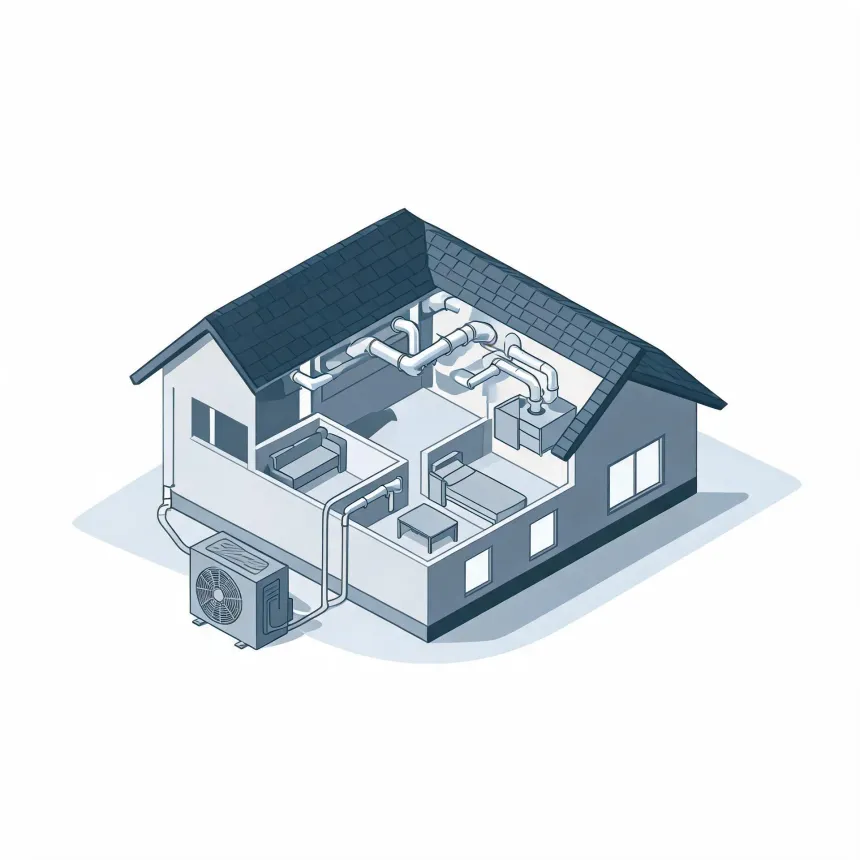
Isometric cutaway illustration of a house showing attic ductwork, an indoor air handler, furnished rooms, and an outdoor condenser unit connected by lines along the exterior wall.
Your system heats October through May and cools June through August.

NOAA nClimDiv, 1991–2020 normals

Boone County winters average 16°F at night, but that's a steady, predictable cold, not the kind of swing that beats up a heat pump.

A heat pump working against steady cold holds up better over the years, so a repair now is usually worth making.

Electricity here runs 15.87 cents a kWh, so a heat pump limping along is burning money every day you wait

Power costs 15.87 cents a kWh statewide
15 hail events from 2015 to 2024
14 winter storms from 2015 to 2024

Heat here runs from October through May, which means September is when a heat pump that's been limping along all summer finally gets asked to do more. That first real cold snap puts load on whatever part was already marginal, a contactor, a capacitor, a reversing valve that was sticking. If yours struggled to keep up in August, don't wait for the first cold morning in October to find out why. Getting it looked at in September, before heat season starts, is the difference between a scheduled repair and a no-heat call.

Get it fixed, not replaced

A heat pump that came with a newer home still has years ahead of it. That's reason enough to get the repair done instead of weighing a replacement.

Find a contractor
A gray heat pump outdoor unit mounted on a concrete pad next to the stone-accented exterior wall of a house.

Check these first

A few things are worth checking before anyone comes out. Start with the thermostat. Make sure it's set to heat, not auto-cool, and that the set temperature is actually above room temperature. Check the breaker panel next. A heat pump trips a breaker sometimes, especially the outdoor unit's, and that alone will make it look dead. If the breaker's fine, go look at the outdoor unit itself. Snow or leaves piled against it block airflow and can make the system struggle or shut down on its own. A light coating of frost is normal, heat pumps defrost themselves on a cycle, but a solid block of ice means something's not defrosting right. Last, check the air filter. A filter clogged with dust restricts airflow enough to cause exactly the warm-but-not-warm-enough air that looks like a bigger problem. None of this will fix a bad capacitor or a refrigerant leak. But it rules out the simple stuff first, and it means that when someone does come out, the time gets spent on the part that's actually failing.

A refrigerant leak doesn't stay small

A heat pump low on charge will still run, but the compressor works harder to move heat with less refrigerant doing the job. Run it like that for weeks and the compressor itself can overheat and fail. A leak caught early is a repair. A leak ignored is a compressor swap.
A failing part rarely fails alone

A weak capacitor makes the compressor or fan motor strain every time it starts. That strain is what eventually takes out the motor it's starting. Catching the capacitor first is a small fix. Waiting until the motor goes with it is a much bigger one.

A heat pump in trouble usually tells you before it quits outright. Air coming from the vents that's warm but not warm enough, especially on the coldest mornings, often means the system is losing the fight against outdoor temperature. Short cycling, where it kicks on and off every few minutes instead of running a steady stretch, points to a sensor or control problem. Ice building up on the outdoor unit and not clearing during the defrost cycle is worth a call on its own. So is a hissing or bubbling sound near the refrigerant lines. If the outdoor fan isn't spinning when the system is running, or it's grinding instead of turning smoothly, that's a motor or bearing issue that won't fix itself. None of these mean the system is done. They mean something specific inside it needs attention before it takes something else down with it.

A diagnostic visit starts outside at the unit, with pressure and electrical readings taken before anything gets opened up. From there it's a process of elimination. The capacitor gets checked. So does the contactor and the reversing valve, each one tested against the numbers it's supposed to hit. Inside, the tech checks airflow at the vents and looks at the coil for ice or buildup. A capacitor either holds its rated charge or it doesn't. A refrigerant charge either matches the system's spec or it's low, and if it's low, the next question is where it's leaking from. By the end, the part that's failing should be identified, not just suspected, and that's what gets fixed.