





An outdoor heat pump unit mounted on a concrete pad in front of a two-story suburban house with a landscaped lawn.

Heat Pump Repair in Centralia, IL

Tell us about the job

Takes about a minute. No obligation.

RepairHeat PumpMarion County, IL
Step 1 of 2

What ZIP code is the job in?

Marion County asks real work of a heat pump both ways, heating through the winter and cooling through the summer, but it doesn't push either side to an extreme. Winter nights average 25°F here, cold enough for the system to lean on its backup heat sometimes, not cold enough to run it ragged. That's a manageable load for a heat pump that's been kept up. So when one in Centralia starts short cycling or blowing air that isn't warm enough, the cause is usually something specific and fixable, not a system worn out from fighting the climate. A straightforward repair is often the right call.

7 months
October through April, your system heats
5 months
May through September, it cools
25°F
the average winter night it heats against
86°F
the average summer afternoon it cools against
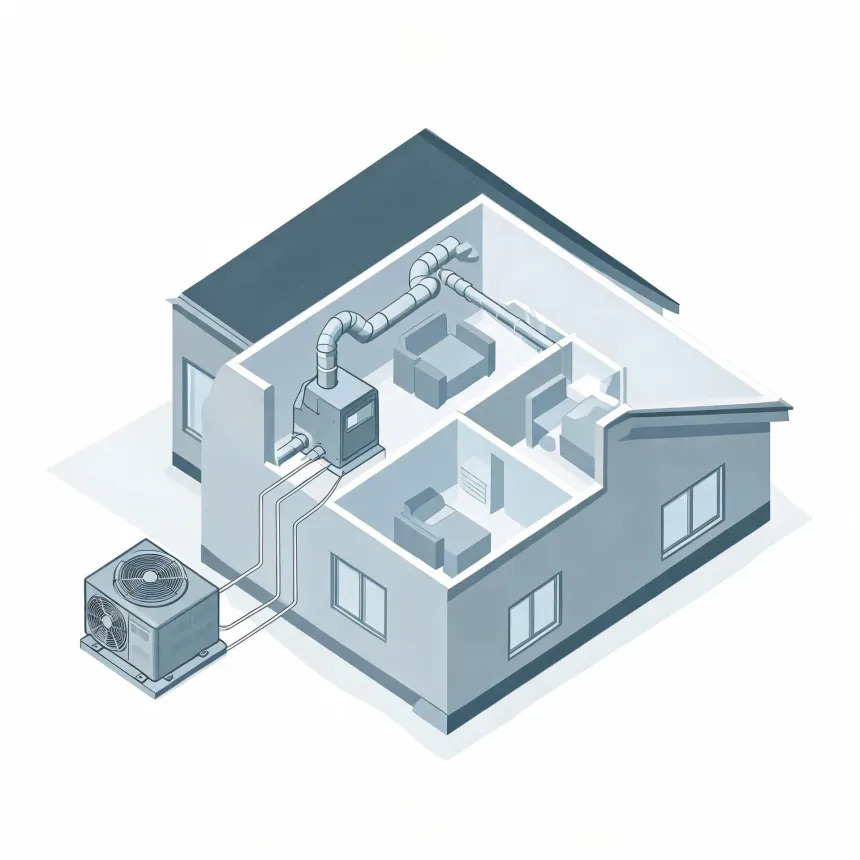
Isometric cutaway illustration of a two-room house showing an indoor air handler with ductwork connected by lines to an outdoor condenser unit on a pad.
Your system heats October through April and cools May through September.

NOAA nClimDiv, 1991–2020 normals

Heat in Centralia runs October through April, about seven months a year.

A heat pump that's been off since spring often shows its weak point in the first cold snap, not before.

At 15.87 cents a kWh, a heat pump running wrong costs you all winter

Power costs 15.87 cents a kWh statewide
Winter nights average 25°F
Climate zone 4A
Centralia's homes are older. Some still have the original system.Half the homes in Marion County were built in 1973 or earlier.

A heat pump that's been carrying a reasonable load for years usually fails in one place, not all at once. A contractor can check the reversing valve, the defrost control board, and the refrigerant charge without assuming the whole system is on its way out. If it's blowing air that isn't warm enough, that's often the valve stuck in the wrong position or the backup heat not kicking in, not a dying compressor. Get the actual cause named before anyone talks about replacement.

A heat pump running wrong is still running up your bill

At 15.87 cents a kWh, a heat pump stuck on backup heat or short cycling isn't costing you less because it's broken. It's costing you more. Get the actual cause named now, while it's one part, not a season of bad bills.

Find a contractor
A gray outdoor HVAC unit mounted on a concrete pad beside a house with gray lap siding and a stone foundation.

Ask its age before you approve the repair

If your heat pump came with the house, ask the contractor how old it actually is before any repair gets quoted. A unit from that era may have most of its life left or almost none, and that changes what's worth spending on a fix. Get the age confirmed and the cause named as two separate questions, not one.

What you can check yourself

Look at the outdoor unit first. If it's caked in ice beyond a thin frost layer, or if leaves and debris are packed against the coil, that alone can cause weak heat or short cycling. Check the thermostat is set to heat, not cool, and that the batteries aren't dead if it's not hardwired. Inside, pull the filter and hold it up to light. If you can't see through it, swap it or wash it if it's reusable. Walk the vents and make sure none are closed or blocked by furniture.
What to leave alone

Don't open the outdoor unit's panels or touch the refrigerant lines. Don't try to chip ice off the coil by hand, it can bend the fins and make things worse. If the breaker's tripped, you can reset it once, but if it trips again, stop and call someone rather than resetting it repeatedly. A heat pump that won't stay running after one reset is telling you something electrical or mechanical needs a real diagnosis, not another attempt.

Most heat pump failures trace back to a handful of parts, and they fail for ordinary reasons. The reversing valve can stick from years of switching back and forth between heating and cooling, leaving the system stuck in one mode. Refrigerant charge drops when there's a slow leak at a fitting or coil, and a low charge shows up as weak heat and a system that runs longer than it should. The defrost control board can fail outright or just stop timing the defrost cycle correctly, so the outdoor coil ices over and never clears. Capacitors wear out from heat and age and cause the compressor or fan motor to struggle on startup or not start at all. None of these mean the unit is finished. They mean one part did what parts eventually do, and a contractor can usually find which one with a gauge set and a multimeter rather than a guess.

A diagnostic visit starts outside at the unit itself, checking the coil for ice, the fan for free movement, and the lines for anything obviously wrong before a single gauge comes out. From there a contractor connects a gauge set to check refrigerant pressure against what the system should be running at, and uses a multimeter on the capacitors and the contactor to see if they're holding the values they should. The reversing valve gets tested by switching the system between heat and cool and listening for it to shift, since a valve that won't move is easy to miss just by looking at it. The defrost board gets checked too, since a board that's timing wrong can look identical to a refrigerant problem from the outside, weak heat and an iced-up coil, but calls for a different fix entirely. None of this takes guesswork once the gauges are on, because each part either reads correctly or it doesn't.