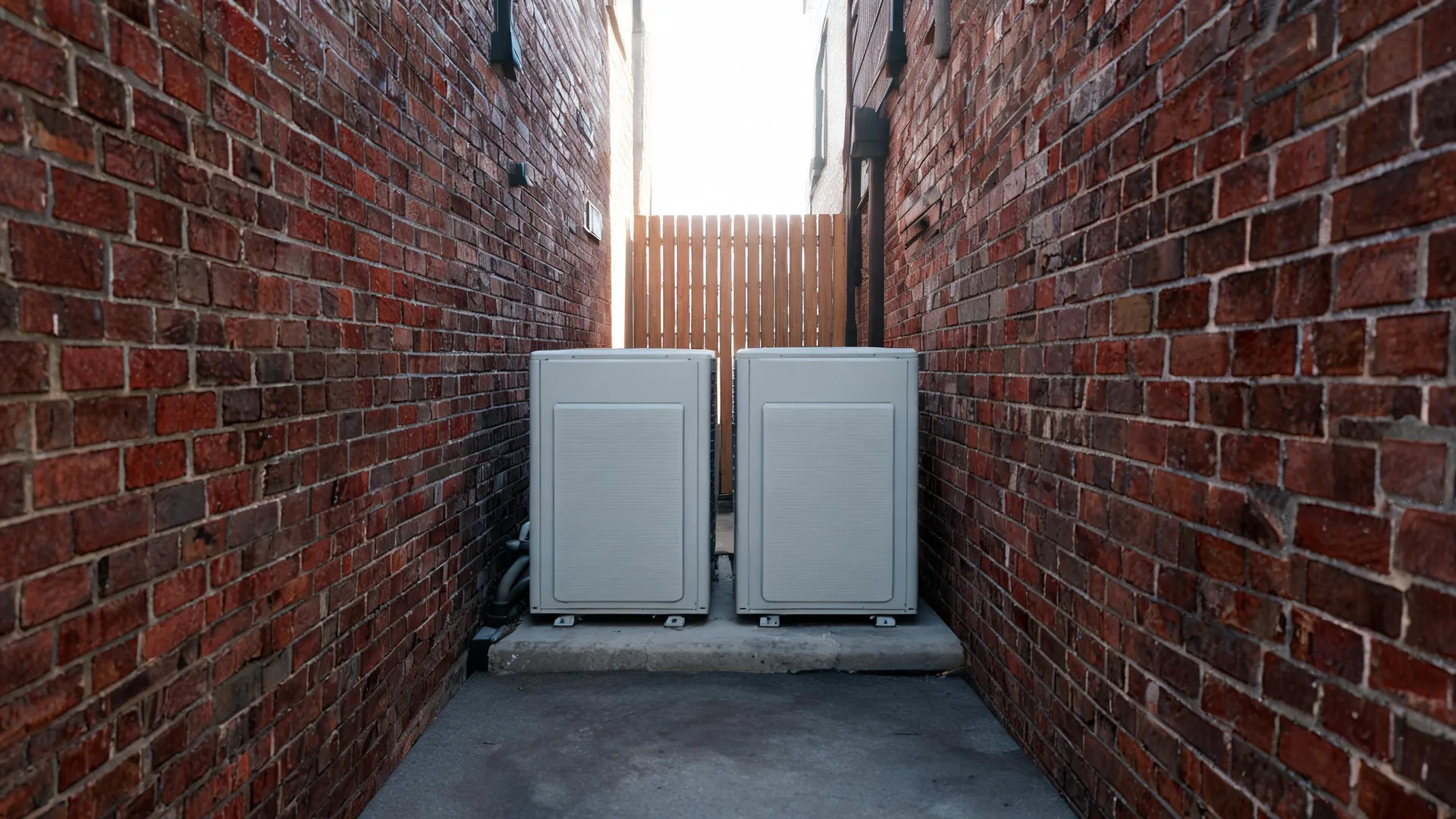
A small fault turns into a bigger one
A heat pump low on refrigerant will still run. The compressor keeps trying to pump a charge that isn't there, and that's what wears it out. What started as a slow leak ends as a failed compressor.
Takes about a minute. No obligation.
Before you call anyone, there are a few things worth checking yourself. Look at the outdoor unit first. If the coil is caked in ice or buried under leaves and debris, that alone can stop a heat pump from heating or cooling right. Check that the thermostat is set to the right mode and the temperature is actually calling for heat or cool, not just sitting there. Walk around and check your vents, and make sure none of them are closed or blocked by furniture or rugs. Look at your breaker panel too. Heat pumps trip breakers sometimes, and a flipped switch looks almost identical to one that's just on. Last thing, check your filter. A filter clogged with dust chokes off airflow, and a heat pump that can't move air will struggle no matter what else is right with it.

NOAA nClimDiv, 1991–2020 normals
Winter nights in Ottawa average 19°F, and your heat pump has to work for every degree of that.
A heat pump is built to handle cold like that, so a breakdown now points to a worn part, not weather it can't handle.




Electricity in Illinois runs 15.87 cents per kilowatthour, and a heat pump leans on electricity harder than a gas furnace does. When it's working right, that's the trade you accept for not burning gas. When it's not, a stuck defrost cycle or a low charge makes the unit run long and hard to reach the same temperature, and you pay that rate for all of it. A heat pump that's struggling doesn't fail quietly. It just costs more every month until someone finds out why.
A heat pump that's running wrong keeps pulling power at 15.87 cents a kilowatthour the whole time it struggles. The longer it takes to find the worn part, the more months it shows up on your bill.
Find a contractor
If your heat pump came with the house, ask the contractor how old it is before you approve a repair. A unit that's near the end of its run still needs a real diagnosis, but it's worth knowing whether you're fixing a part or buying time on the whole system.
A heat pump low on refrigerant will still run. The compressor keeps trying to pump a charge that isn't there, and that's what wears it out. What started as a slow leak ends as a failed compressor.
A frosted coil means the defrost cycle isn't clearing it like it should. Keep running the unit and that ice builds, blocks airflow further, and forces the system to work against itself. The fix is finding why defrost isn't working, not waiting for a thaw.
Most heat pump failures trace back to a handful of parts. The reversing valve is a common one. It's what switches the system between heating and cooling, and when it sticks, the unit blows the wrong temperature air or gets stuck running one mode. The capacitor is another. It gives the compressor and fan motors the jolt they need to start, and a weak one causes hard starts or a unit that hums but doesn't run. Low refrigerant almost always means a leak somewhere in the line, not normal use, since a sealed system doesn't lose charge on its own. Contactors wear out from the arcing that happens every time they open and close, and when one fails the outdoor unit just stops answering the thermostat. None of these announce themselves clearly. They show up as a system that runs but doesn't keep up, or cycles when it shouldn't.
A diagnostic starts outside at the unit, not at the thermostat. The contractor checks refrigerant pressure first, because that one reading points toward or away from other problems. From there it's the electrical side. The capacitor, the contactor, the wiring to the compressor, checked with a meter rather than a guess. If the system runs but blows the wrong temperature, the reversing valve gets tested directly, since that's the part that controls which way the system is working. A thorough visit also means watching the unit go through a full cycle, including defrost, because some faults only show up when the system switches modes. By the end, the goal is a part and a reason, not a guess dressed up as one.