A two-story black-clad house with a covered porch behind a trimmed hedge, photographed from ground level across a blurred lawn, with large green trees and a neighboring gray house nearby under an overcast sky.

Heat Pump Repair in Rochelle, IL

Tell us about the job

Takes about a minute. No obligation.

RepairHeat PumpOgle County, IL
Step 1 of 2

What ZIP code is the job in?

Rochelle winters keep a heat pump working

Overnight lows here average 16°F across December, January and February. Ogle County is rated zone 5A, a cool climate where heating is the bigger job for the system. A heat pump runs long hours on cold nights because that's the job. That's normal operation, not a sign of trouble.


The cause is still the usual one

A heat pump that short cycles, runs without stopping, or blows cold air is almost always one part failing. A defrost control board. A reversing valve stuck in one position. A low refrigerant charge. A weak capacitor. None of that has anything to do with Rochelle's weather. Finding which part failed is what settles it.

8 months
October through May, your system heats
3 months
June through August, it cools
16°F
the average winter night it heats against
82°F
the average summer afternoon it cools against
Isometric line illustration of a cutaway house showing interior rooms, an air handler with ductwork in the attic space, and an outdoor condenser unit beside the exterior wall.
Your system heats October through May and cools June through August.

NOAA nClimDiv, 1991–2020 normals

Heat pumps here run from October through May, about eight months a year.

September is worth a check. A weak part is more likely to fail once the first cold nights put a full heating load on it.

Ogle County gets its share of storms, but that's not why your heat pump is down

123 severe weather events from 2015 to 2024
16% of homes statewide lost power a day or more in 2024
76 damaging wind events from 2015 to 2024
Running a bad heat pump here costs moreIllinois electricity ran 15.87 cents per kilowatthour in 2024, and a failing part drives that number up fast.

Half the homes in Ogle County were built in 1972 or earlier. A heat pump doesn't last as long as the house around it, so if yours came with an older place, it's worth finding out when it actually went in. A system that old has had a lot of winters to wear down a capacitor or a control board. That history matters as much as what the heat pump is doing right now. Before paying for a repair, ask how much life is left in it.

Ask how old it is before you pay to repair it

If your heat pump came with the house, ask how old it actually is before you approve a repair. Half the homes in Ogle County were built in 1972 or earlier, and a unit that old has had a lot of winters to wear down a capacitor or a control board. Find out how much life is left in it before paying to fix one part.

Find a contractor
A man in a cap, navy T-shirt and tan work pants, seen from behind, carries a worn canvas tool bag up concrete steps toward a teal front door flanked by a potted shrub.
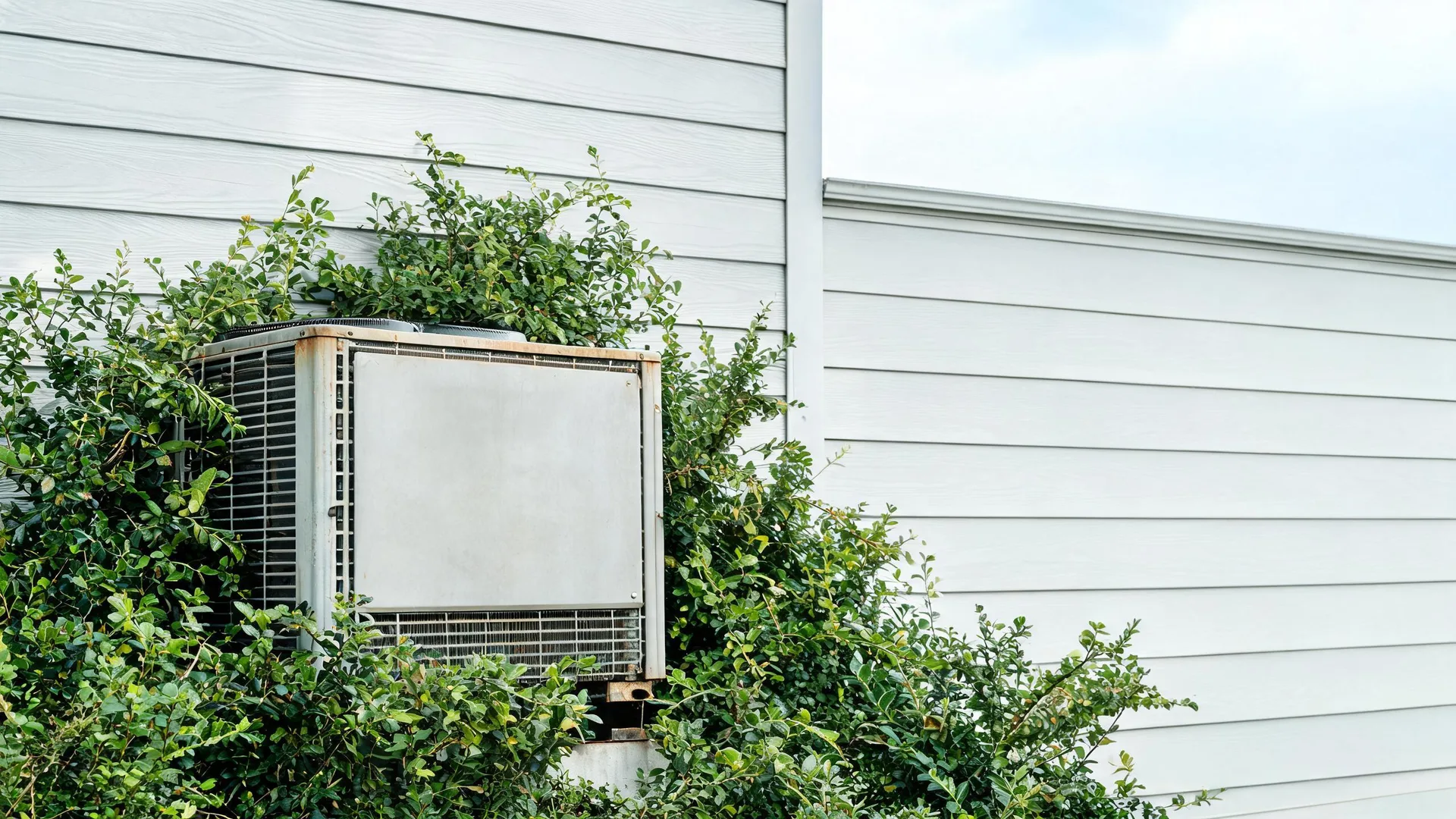
A residential heat pump outdoor unit mounted on a concrete pad next to a house with gray vinyl siding.

Running it while it's failing finishes the job

A heat pump that's already struggling doesn't fail cleanly. A reversing valve stuck halfway makes the compressor work against itself, and that heat builds up with nowhere to go. A low refrigerant charge makes the compressor run hotter than it's built for, every hour it's on. Keep running it and you're not just living with bad heat, you're pushing a strained part toward a full breakdown. What starts as a repair you could schedule turns into one you can't put off, and sometimes the compressor itself goes with it. If something's clearly off, short cycling, ice that won't clear, air that isn't warm, that's the signal to get it looked at before the next cold night finishes the job.

Check the thermostat first

Make sure it's set to heat, not auto, and the set point is actually above room temperature. Swap the batteries if it uses them. People call about a dead system and the fix was a thermostat stuck on the wrong setting.

Look at the outdoor unit

Walk outside and check the outdoor unit for ice coating the coil, or snow packed against the sides blocking airflow. A heat pump defrosts itself on a cycle, so a light frost is normal, but a solid sheet of ice means the defrost control isn't doing its job. Clear snow away from the cabinet if you can reach it safely, but don't chip at ice on the coil yourself.

Most heat pump failures come down to one of a handful of parts. The reversing valve is a common one. It's what switches the system between heating and cooling, and when the coil or solenoid that moves it wears out, the valve sticks and the system either stops heating or runs backward. The defrost control board is another. It tells the unit when to melt frost off the outdoor coil, and when the sensor or board itself fails, ice builds up until airflow is blocked. Capacitors wear down too, slowly losing their charge until the compressor or fan motor struggles to start. And a refrigerant leak, usually at a fitting or coil, starves the compressor of the charge it needs and makes it run hot for every hour it's on. None of these show up as a single obvious symptom. They show up as short cycling, weak heat, or a unit that runs constantly without catching up, and the only way to know which part is behind it is to have someone check the system directly.

A repair is worth doing when the failure is one part and the rest of the system checks out fine. A capacitor, a defrost sensor, a contactor, these are cheap to replace and swapping one doesn't strain anything else. Replacement starts to make sense when the compressor itself is the problem, since that's the part most likely to take other components down with it. Age matters too, separate from whatever just broke. A heat pump near the end of its working life tends to fail again in a different spot not long after the first repair, so fixing one part only buys a short stretch before the next one goes. If a technician finds a refrigerant leak on an older unit, that's usually the moment to ask about replacement rather than a recharge, since a leak found once often means the coil itself is wearing out.