Electricity here runs 17.72 cents a kilowatt-hour
That's higher than what most US counties pay. An air conditioner is one of the biggest draws on a home's power, so a higher rate per kilowatt-hour reaches straight into the bill.
Takes about a minute. No obligation.
That's higher than what most US counties pay. An air conditioner is one of the biggest draws on a home's power, so a higher rate per kilowatt-hour reaches straight into the bill.
The average dew point across June, July and August runs 66°F here. A system has to pull that moisture out of the air to make a house feel comfortable, not just cool it, and that's work on top of fighting the temperature.

NOAA nClimDiv, 1991–2020 normals
Cooling runs May through September here, five months straight.
Get a new system in before May and it's running at full stride from day one, not limping through the first heat wave.




Macoupin County sits in zone 4A under the 2021 energy code, a mixed climate that asks real work of both heating and cooling and leans humid. Any split-system air conditioner under 45,000 Btu an hour manufactured on or after January 1, 2023 has to meet the federal minimum for that climate: 13.4 Btu of cooling for every watt-hour it uses. That floor narrows what can legally go into a home here. It also means a system built to the old, lower minimum isn't something you'll find sold new anymore.
Power here costs more than most places pay, and the rate applies to every kilowatt-hour the new system pulls. A unit that meets the federal minimum is legal to install. One rated higher than that minimum keeps more of each bill in your pocket, summer after summer. Ask what rating the system going in actually carries.
Find a contractorA load calculation looks at the house itself, not just its square footage: the windows, the insulation, the duct runs already in place. That matters more in a house built in 1966 or earlier, where the ductwork was likely sized for a furnace and nothing else. A system sized off a chart instead of that calculation can end up too big for the house it's going into. An oversized unit cools the air fast and shuts off before it's run long enough to pull the moisture out, so the house still feels damp even though the thermostat reads satisfied. That happens over and over through a long cooling season. Ask whoever quotes the job whether they're running a load calculation on your house or sizing off a rule of thumb.
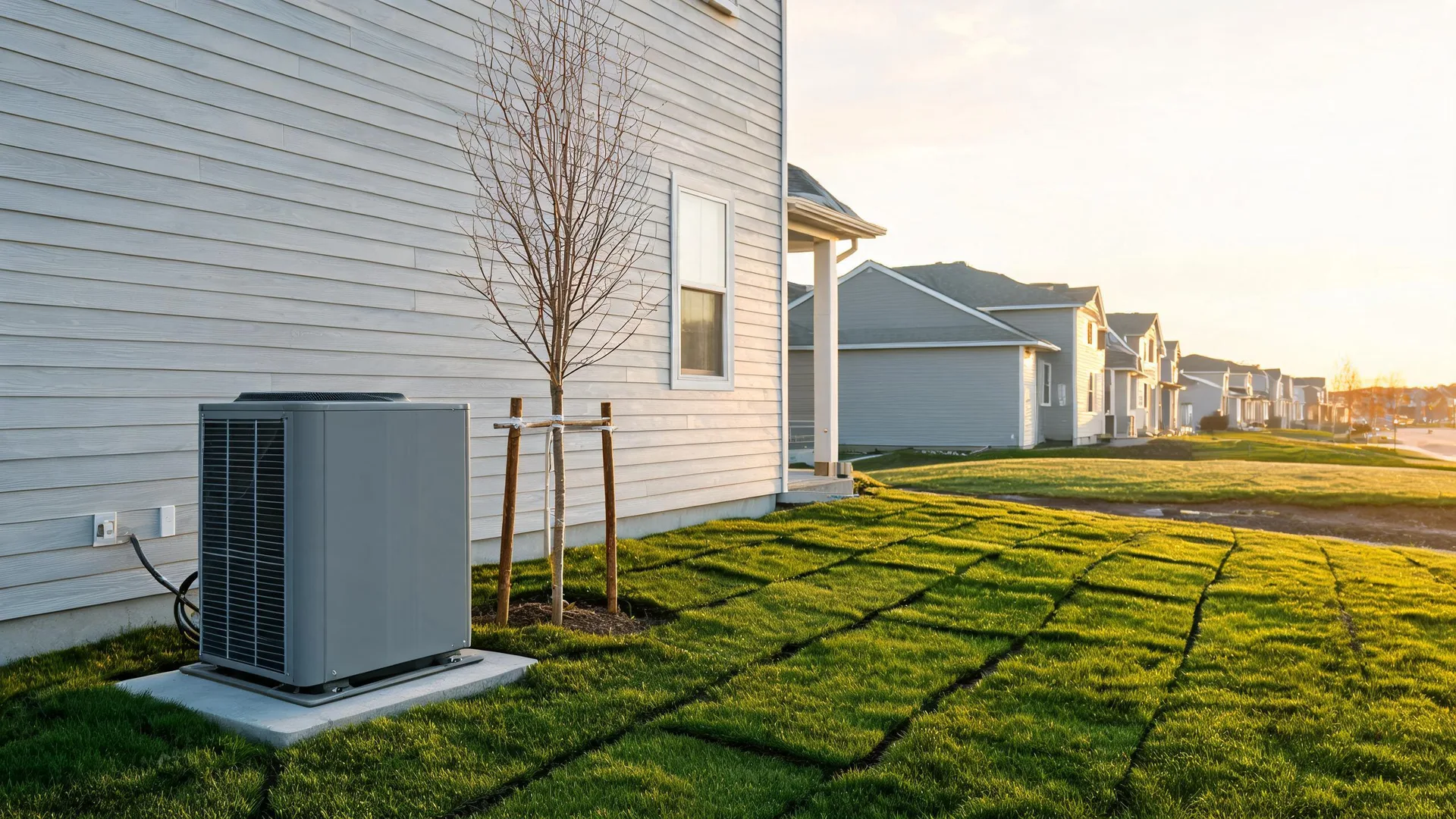
A straight swap keeps the same line sets and the same pad in most cases, so the outdoor unit gets disconnected, unbolted and lifted off, and the new one goes down in its place. If the refrigerant lines are old or the wrong size for the new system, those get replaced too, not just reused because they're already there.
The refrigerant in that system can't legally be vented into the air. It has to be recovered into a tank before the unit is disconnected for good. Older systems may be holding a refrigerant that isn't made anymore, which is its own reason not to patch a dying unit instead of replacing it.
Estimates for a typical Macoupin County home, from EIA household energy data, Illinois fuel prices and NOAA climate normals. Your home will differ.
Installation day starts with the old system still running or already dead, and it ends with the new one holding its target temperature. Between those two points, the indoor and outdoor units get set, the line set gets connected or replaced, and the whole system gets pressure tested before any refrigerant goes in. A vacuum pump pulls moisture and air out of the lines, because either one left behind will damage the compressor over time. Once the system holds that vacuum, refrigerant goes in to the exact charge the manufacturer specifies, not by feel. Then comes the part that gets skipped when a job is rushed: running the system, checking the temperature split between the air going in and the air coming out, and checking that the airflow matches what the duct work can actually deliver. A system that's never tested under real conditions can look finished and still be set up wrong.