






Three illuminated two-story brick houses on a tree-lined residential street photographed at twilight, with warm window light and landscape uplighting visible against a deep blue evening sky.

AC Installation in Galesburg, IL

Tell us about the job

Takes about a minute. No obligation.

New system or replacementCentral ACKnox County, IL
Step 1 of 2

What ZIP code is the job in?

Electricity in Knox County averaged 17.71 cents per kilowatt-hour in 2025, higher than in most US counties. That rate applies to every kilowatt the new system draws, all summer. A dew point averaging 63°F across June, July and August means the air holds a lot of moisture, and a system has to work through that moisture on top of the temperature. The two together mean a unit that runs a little less efficiently costs more here than the same unit would somewhere with cheaper power or drier air. How the system is sized and installed decides how much of that electricity goes toward actually cooling the house.

3 months
June through August, your air conditioner is on duty
83°F
the average summer afternoon it cools against
40 hail events
in ten years, and hail bends the fins on outdoor coils
13.4 SEER2
the federal minimum any new unit must meet
Isometric line illustration of a cutaway single-story house showing interior rooms, ducted air handler, ceiling ductwork, and an outdoor condenser unit connected by refrigerant lines.
Your air conditioner works hardest from June through August.

NOAA nClimDiv, 1991–2020 normals

Cooling here runs June through August.

Put the new system in during May and the job happens on your schedule, not after the old one quits in the heat.

Most homes here heat with gas, so central air almost always means adding AC to a furnace system already in the house

67.4% of homes heat with gas
Climate zone 5A
Power here costs 17.71 cents per kilowatt-hour

Knox County falls under zone 5A in the 2021 energy code, a cool zone where heating carries the bigger load but summer humidity still counts against the building. Any split-system air conditioner installed here, under 45,000 Btu an hour and manufactured on or after January 1, 2023, has to meet the federal minimum of 13.4 SEER2. That rating measures how much cooling the unit gets out of each watt-hour it draws over a summer, not how big it is or how fast it cools. A unit at the minimum still works. One rated higher pulls less power to do the same job, and with electricity priced the way it is here, that difference shows up on the bill before it shows up anywhere else. A federal tax credit is available for qualifying high-efficiency equipment, worth checking before deciding which unit to install.

The right unit pays you back on every summer bill

A higher SEER2 rating costs more up front and less every month after. Since the rate per kilowatt-hour doesn't change, the unit that uses fewer of them is the one that saves money here. Ask what SEER2 rating fits the budget before settling on the minimum.

Find a contractor
A man in a dark cap, dark t-shirt and tan work pants, seen from behind, carries a worn canvas duffel bag up wooden porch steps toward a teal front door.
An outdoor air conditioning condenser unit mounted on a concrete pad surrounded by gravel, photographed against a partly cloudy blue sky.

Half These Homes Predate Central Air

Half the homes in Knox County were built in 1957 or earlier. A house that old was not built with ductwork sized for a modern air conditioner, since central air wasn't standard then. Whoever installs the new system has to work with the ducts and return air already in the house, not just set a unit outside and connect it. If the ductwork can't move enough air for the unit chosen, the system runs longer to cool the same rooms. In a place where every kilowatt costs more than most, that mismatch shows up on the bill all summer.

The rating is measured over a whole summer

SEER2 isn't a snapshot of one hot afternoon. It comes from testing the unit across a range of conditions, from mild days to peak heat, then averaging what it draws against what it delivers. A unit can look strong on paper and still spend much of the summer running at partial capacity, cycling on and off as the load changes. The number on the label describes that full range, not just the worst day.

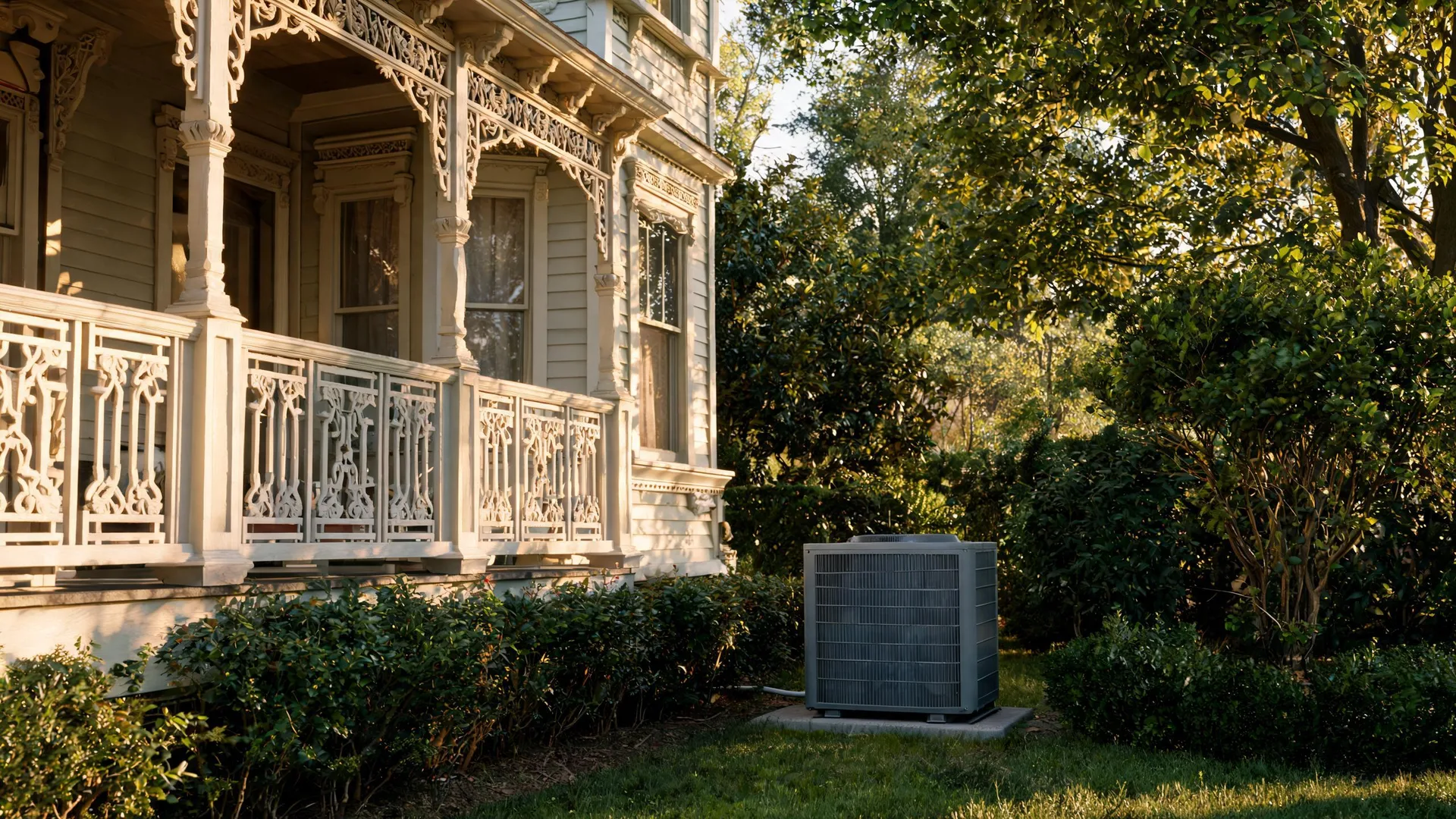
The rating only holds if the installation matches it

A unit reaches its rated SEER2 only when the refrigerant charge is correct, the airflow across the coil is right, and the ductwork can actually move the air the system is built to push. Undersize the ductwork or shortchange the charge and the same unit draws more power to do the same job, no matter what the label says. The rating describes the equipment tested alone in a lab, not the equipment sitting in a particular house connected to particular ducts.

Overhead view of a gray outdoor AC condenser unit on a concrete pad beside a mulched garden bed and a house with vinyl siding.

A higher-efficiency unit would save about $30 a year to run in Knox County compared with a new unit at the federal minimum.

  • A higher-efficiency unit$200 a year
  • A new unit at the federal minimum, 13.4 SEER2$230 a year

Estimates for a typical Knox County home, from EIA household energy data, Illinois fuel prices and NOAA climate normals. Your home will differ.

A load calculation comes before anything gets carried into the house. This walks through every room, the windows, the insulation, and the duct layout to figure out what size unit actually fits, rather than matching whatever was there before. Once the unit is chosen, the outdoor condenser gets set on a pad and the indoor coil goes in above or beside the furnace, tied into the existing ductwork. The refrigerant lines get run, connected, and then pressure tested before anything is charged, since a leak found after the charge means doing part of the work twice. Charging the system means weighing in refrigerant to the exact amount the manufacturer specifies, then checking it against the pressures and temperatures the system shows while it runs. Airflow gets checked across the coil, because a coil that can't get enough air through it will frost up no matter how correct the charge is. The last step is running the system through a full cycle and checking the temperature drop between the air going into the return and the air coming out of the supply.