





A row of dark-clad single-story cottages with gabled roofs behind trimmed hedges, with a mown lawn in the foreground and large leafy trees under an overcast sky.

AC Installation in Oswego, IL

Tell us about the job

Takes about a minute. No obligation.

New system or replacementCentral ACKendall County, IL
Step 1 of 2

What ZIP code is the job in?

Most homes in Kendall County heat with gas, 86.7% of them. If yours is one, you've got a furnace paired with central air, the two sharing the same ducts and the same thermostat. That makes installation straightforward. A new AC goes in as a matched replacement, sized to cool this house and built to work with the furnace already there. Electric heat and propane show up in some homes here too, but gas is what most of the county runs on, and a contractor sizing your system will plan around that from the start.

3 months
June through August, your air conditioner is on duty
83°F
the average summer afternoon it cools against
34 hail events
in ten years, and hail bends the fins on outdoor coils
13.4 SEER2
the federal minimum any new unit must meet
Isometric cutaway illustration of a small home interior with furniture and ducting, showing an indoor air handler connected by lines to an outdoor condenser unit on a pad.
Your air conditioner works hardest from June through August.

NOAA nClimDiv, 1991–2020 normals

Cooling in Kendall County runs June through August.

May is the month to put in a new system, before the first hot stretch asks something of it.

Three summer months, nothing this system can't handle

Cooling runs June through August
Summer afternoons average 83°F
70 damaging wind events from 2015 to 2024

A standard AC sized to this house is what most homes in Kendall County need. There's no local quirk that calls for going bigger or stepping up to a higher-efficiency unit. Electricity here runs 17.94 cents per kilowatt-hour on average, more than a lot of places, which is worth knowing when you're picking between models. A unit sized right for your square footage will run efficiently without the added cost of oversizing equipment you don't need. The bigger factor for your bill is matching the system to the house, not chasing a tier above what the job calls for.

Any new system here has to clear 13.4 SEER2

Kendall County sits in climate zone 5A, a cool zone where heating does more work than cooling, but the air conditioner you put in still has to meet the same federal floor as anywhere else. Any split system under 45,000 Btu an hour built after January 1, 2023 has to hit at least 13.4 SEER2. That's not a feature to look for. It's the minimum a new unit is built to now, so the comparison that matters is what each model does beyond it.

Find a contractor
A man in a dark shirt, tan work pants and a backward cap, seen from behind, carries a waxed canvas tool bag up porch steps toward a dark teal front door with a glass-paned top, beside a potted shrub.
An outdoor residential air conditioning condenser unit mounted on a concrete pad, surrounded by gravel with a blue sky in the background.

What the SEER2 number doesn't tell you

Two systems can carry the same SEER2 number and still work differently in your house. That rating comes from lab testing at a fixed set of conditions, not from how the unit behaves on the hottest day of the year or the mildest one. Ask what the manufacturer's performance data shows at full load and at partial load, since a system spends most of its time doing something less than full blast. Ask whether the compressor is single-stage, two-stage, or variable-speed, because that's what decides whether it runs full tilt every cycle or eases into lower output when the house doesn't need everything it's got. Ask about the blower motor too. A variable-speed blower adjusts airflow to match what the system is doing, which matters for comfort and for noise. And ask who is sizing the unit and how. A contractor should run a load calculation on your actual house, not size off the unit you're replacing, since that one may never have been sized right either.

Sizing is a calculation, not a guess from the old unit

The right size for a new air conditioner comes from a load calculation, a room by room look at square footage, window area, insulation, ceiling height, and what direction the house faces. Swapping in a unit that matches the one coming out just repeats whatever mistake was made the first time. A contractor measures the house as it stands now and sizes to that.

Oversized cools fast and still leaves the house uncomfortable

A unit too big for the house blasts cold air, hits the thermostat's setpoint, and shuts off before it's run long enough to pull moisture out of the air. The house ends up cold and damp instead of just comfortable. It also means the compressor is starting and stopping more often, and that cycling wears on it faster than steady runtime would.

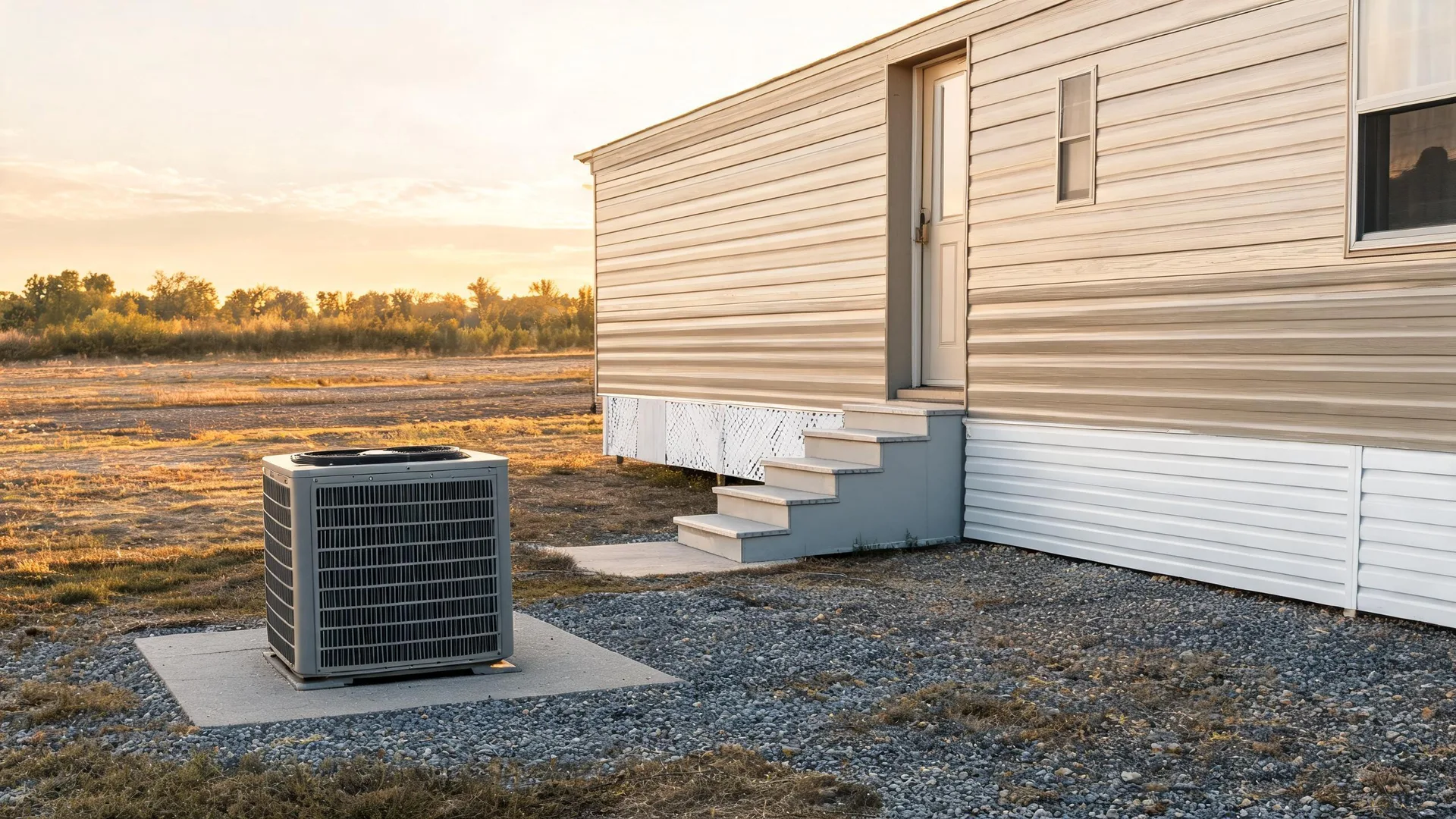
Aerial view of a gray outdoor air conditioning condenser unit mounted on a concrete pad next to a house with vinyl siding.

Going above the federal minimum saves little here, about $20 a year.

  • A higher-efficiency unit$190 a year
  • A new unit at the federal minimum, 13.4 SEER2$210 a year

Estimates for a typical Kendall County home, from EIA household energy data, Illinois fuel prices and NOAA climate normals. Your home will differ.

Kendall County sees its share of rough weather, 130 severe weather events logged between 2015 and 2024, with damaging wind, hail, and tornadoes all part of that count. None of that changes what size or efficiency your new AC needs to be. A load calculation sets the size, and the federal minimum sets the floor, the same as anywhere else. What it does mean is that the unit should be anchored and installed to take wind and hail, not just hot days. Power outages are also part of life here, enough that a notable share of Illinois households lost power for a full day at some point last year, so it's worth asking your contractor how the system comes back on once the power does.