






A row of dark-painted single-story cottages with gabled shingle roofs behind a mowed lawn, a trimmed hedge in the left foreground and large leafy trees overhead under an overcast sky.

AC Installation in Quincy, IL

Tell us about the job

Takes about a minute. No obligation.

New system or replacementCentral ACAdams County, IL
Step 1 of 2

What ZIP code is the job in?

Electricity in Adams County averaged 17.96 cents per kilowatt-hour in 2025, higher than in most US counties. An air conditioner here runs on that rate all summer, every time it cycles on. The air it's working against is heavy, too. The dew point averages 65°F through June, July and August, and that moisture is part of what the system has to pull out of the air along with the heat. A unit that struggles with that load runs longer to get the same result, and every extra hour shows up on the meter at a rate that's already above average. Where power costs this much, the efficiency of the system you install matters more than it would somewhere else.

4 months
June through September, your air conditioner is on duty
85°F
the average summer afternoon it cools against
33 hail events
in ten years, and hail bends the fins on outdoor coils
13.4 SEER2
the federal minimum any new unit must meet
Isometric cutaway illustration of a single-story house showing interior rooms, ceiling ductwork, an indoor air handler, and an outdoor condenser unit connected by lines, in gray and white tones on a white background.
Your air conditioner works hardest from June through August.

NOAA nClimDiv, 1991–2020 normals

Cooling runs June through September here.

Get a new system in before June and it's a planned job, not a scramble in the first heat wave.

Half these homes were built before central air was standard

Half the homes here were built by 1965
Climate zone 5A
Power here costs 17.96 cents per kilowatt-hour
Gas heat, central air58.8% of homes in Adams County heat with gas. The AC going in alongside it is its own system, sized for this house.

Adams County falls under climate zone 5A, a cool zone where the energy code treats heating as the bigger job, though it still counts the humidity. Any split-system air conditioner installed here under 45,000 Btu an hour has to meet the federal minimum of 13.4 SEER2 if it was manufactured on or after January 1, 2023. That number is the floor, not the ceiling, and most contractors carry options well above it. A system that clears the minimum by a wide margin draws less power to do the same job, which matters on a meter already running higher than most of the country. A federal tax credit is available for qualifying energy efficient equipment, worth checking against the specific model before you buy.

The system you pick decides what every summer costs you after this one

A system rated well above the federal minimum costs less to run every month it works, on a rate that's already higher than most of the country. That gap is worth asking a contractor about while you're comparing systems, not after one is already installed.

Find a contractor
A man in a dark shirt and tan work pants climbs concrete porch steps toward a teal front door, carrying a worn canvas and leather tool bag.
A gray cylindrical air conditioning condenser unit mounted on a concrete pad next to a light-colored vinyl-sided house exterior.

An older house, running a new machine

Half the homes in this county were built in 1965 or earlier. If your house is one of them, the ductwork and the electrical panel were sized for whatever heated and cooled it then, not necessarily for the system going in now. A contractor sizing a new install here should be looking at what the house can actually support, not just swapping in a bigger or more efficient unit and assuming it fits. Ask what that means for your ducts and your panel before the work starts, not after.

Sizing decides how it runs

An air conditioner has to match the house it's cooling. Too big and it cools the air fast without running long enough to pull the moisture out, so the house feels clammy even at the right temperature. Too small and it runs constantly, straining to catch up on the hottest days and wearing down faster for it. A contractor sizes the unit with a load calculation that accounts for square footage, windows, insulation and layout, not a guess based on the old system's tonnage.

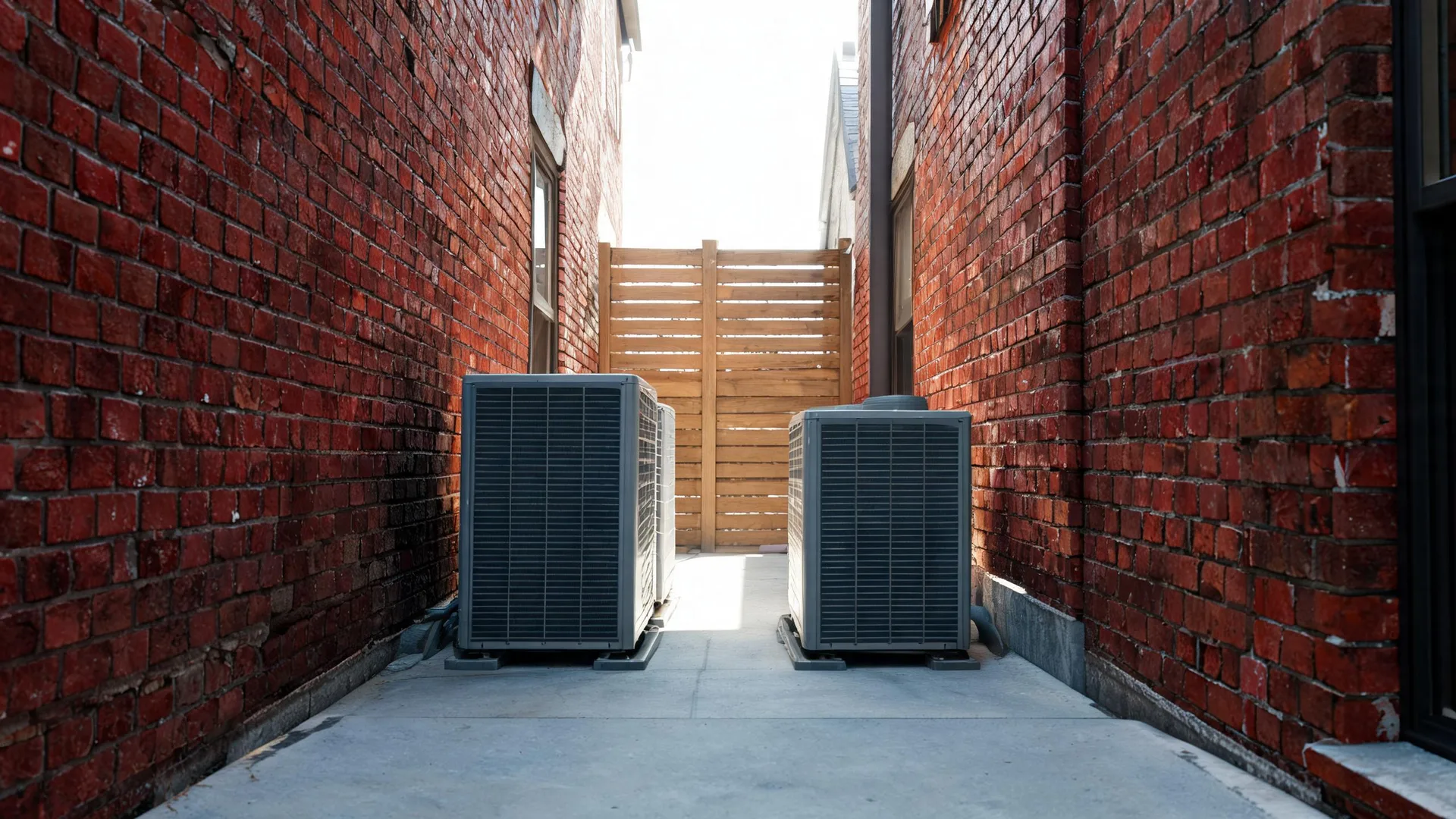
The install is more than the unit

The condenser outside and the coil inside are only part of the job. Line sets have to be the right length and properly charged with refrigerant. The ductwork has to move enough air to the unit's capacity, or the whole system underperforms no matter how good the equipment is. The electrical circuit feeding the unit has to carry what it draws. Skipping any of this to save a step costs more in how the system runs for as long as it's installed.

Overhead view of a gray outdoor AC condenser unit on a concrete pad beside a mulched garden bed and a house with vinyl siding.

A higher-efficiency unit would save about $30 a year to run in Adams County compared with a new unit at the federal minimum.

  • A higher-efficiency unit$250 a year
  • A new unit at the federal minimum, 13.4 SEER2$280 a year

Estimates for a typical Adams County home, from EIA household energy data, Illinois fuel prices and NOAA climate normals. Your home will differ.

Installation starts with the old system coming out, the condenser outside and the coil in the plenum above or beside the furnace. The line set gets replaced or cleaned and pressure tested, since old refrigerant oil left in the lines can contaminate new equipment. Setting the new condenser means a level pad outside and clearances on all sides so it can pull air through properly. Inside, the coil goes in above the furnace and has to match the condenser, since a mismatched pair will never hit its rated efficiency no matter how well it's installed. Once everything's connected, the lines get evacuated with a vacuum pump to pull out air and moisture before refrigerant goes in, and the charge gets weighed in or checked against the manufacturer's spec rather than eyeballed. Last comes airflow testing and a check of the thermostat and controls, because a system that's wired right but moving too little air across the coil will never perform the way it's rated to.