Power here isn't cheap
Electricity in Macoupin County ran 17.72 cents per kilowatt-hour in 2025, more than most US counties pay. An air conditioner that has to work harder than it should turns that rate into a bigger number every month.
Takes about a minute. No obligation.
Electricity in Macoupin County ran 17.72 cents per kilowatt-hour in 2025, more than most US counties pay. An air conditioner that has to work harder than it should turns that rate into a bigger number every month.
A dirty coil or a low refrigerant charge forces the compressor to run longer to cool the same house. Dew points here average 66°F across June, July and August, so the air is already heavy and the system has no slack to spare.
NOAA nClimDiv, 1991–2020 normals
May is when cooling starts in Macoupin County.
Have the AC looked at in April, before it has to work.



A system that has run for years in the same house develops small issues one at a time. A capacitor weakens. A coil picks up a layer of dust that slows the air moving across it. None of that stops the system from running, so nothing tells you it's happening until the day it does. A yearly check is what catches a weak capacitor before it fails, and it's what gets the coil cleaned before it costs you higher bills all summer. If your system came with the house, there's a decent chance it's old enough that this matters. Catching the small thing is the whole point of doing this every year instead of waiting for a reason.
A dirty coil or a weak capacitor makes the compressor run longer than it should, and power here already costs more than most places pay. Getting it looked at now is what keeps the summer's electric use from running higher than it needs to.
Find a contractorBetween visits, the filter is the one thing worth checking on your own. Pull it every month or so during the summer and hold it up to a light. If you can't see light through it, swap it or wash it, depending on which kind you have. A clogged filter starves the coil of airflow, and a coil that can't breathe gets cold enough to ice over. Once ice forms, the system cools worse, not better, until it's shut down and allowed to thaw. Outside, keep the area around the condenser clear. Grass clippings, leaves and mulch pile up against the cabinet and choke the airflow it needs to dump heat. A couple feet of open space on every side is enough. Don't let anything lean against it or sit on top of it. Inside, keep an ear out for changes. A rattle that wasn't there before, a hum that lingers after the unit shuts off, air coming out warmer than it used to. None of that is something to fix yourself, but it's exactly what to mention when someone comes to look at the system. The compressor, the capacitor and the refrigerant charge aren't things to open up or test on your own. Those are checked with gauges and meters, and guessing at them tends to turn a small problem into a bigger one.
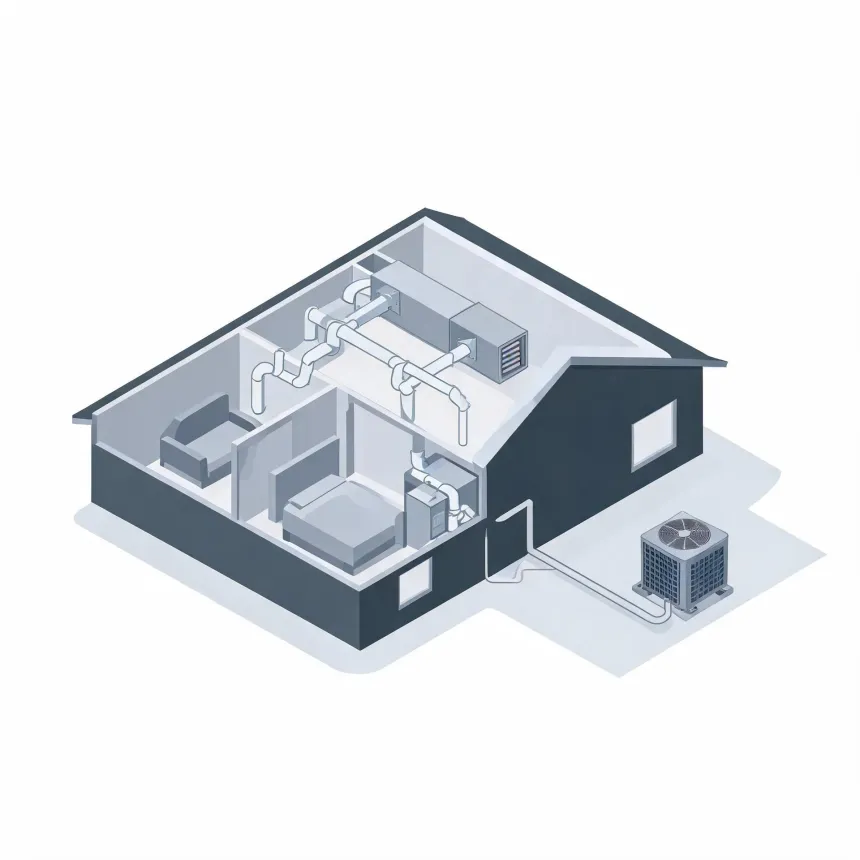
The filter, the coil and the blower all work as one path for air. A filter clogged with dust cuts the air getting through, and the coil needs that air moving across it to do anything. Starve the coil of airflow and it drops below freezing and ices over. Once that happens the system is cooling less, not more, no matter how long the compressor runs.
Cooling air pulls moisture out of it, and that water has to leave through the condensate drain. Algae and dust build up inside that line over time and narrow it until it backs up. A blocked drain means that water backs up into the pan and spills over, sometimes right where the system sits above a ceiling or a closet. A clear drain line is what keeps that water going outside where it belongs.
A tune-up checks the refrigerant charge, cleans the coils, tests the capacitor and tightens the electrical connections.
A tune-up is a set list, not a once-over. The refrigerant charge gets checked against what the system calls for, because too little and the compressor runs long, too much and it runs hot. The capacitor gets tested under load rather than just looked at, since a weak one can still start the compressor and still fail next week. The coil gets inspected and cleaned if it's carrying a layer of dust or mold, because that layer acts like a blanket between the coil and the air that's supposed to cool. The condensate drain gets cleared so the water the system pulls out of the air has somewhere to go. Electrical connections get tightened, since a loose one generates heat right at the connection and that heat damages whatever it touches. None of this is guesswork done by eye. It takes gauges to read the charge and a meter to test the capacitor, which is why this is a visit, not a glance.