






A illuminated two-story red brick house on a quiet residential street at dusk, flanked by mature trees under a deep blue evening sky.

AC Maintenance in Kankakee, IL

Tell us about the job

Takes about a minute. No obligation.

Tune-up, service, or cleaningCentral ACKankakee County, IL
Step 1 of 2

What ZIP code is the job in?

Short cycling is one to catch early. If your AC kicks on and off in quick bursts instead of running a full cooling cycle, something is making it shut down before the job is done. A dirty coil, a weak capacitor, or low refrigerant charge can all cause it. Warm air out of the vents while the system runs tells you the same thing from a different angle. So does ice on the refrigerant line, which usually means airflow is restricted somewhere, often at the filter. None of these stop the system outright, so it's easy to let them ride. But each one makes the compressor work harder than it should, and the compressor is the part you don't want to lose.

3 months
June through August, your air conditioner is on duty
83°F
the average summer afternoon it cools against
21 hail events
in ten years, and hail bends the fins on outdoor coils
99 wind events
in ten years, and wind drives debris into outdoor units
Isometric line illustration of a cutaway house showing interior rooms with ductwork, an indoor air handler, and an outdoor condenser unit connected by lines, on a white background.
Your air conditioner works hardest from June through August.

NOAA nClimDiv, 1991–2020 normals

A dirty filter is the one thing actually in your hands.

Swap it monthly through the summer and the coil behind it stays clean too.

Half the homes here were built by 1972, old enough that a yearly check matters

Half the homes here were built by 1972
Cooling runs June through August
Summer afternoons average 83°F

A dirty coil or a low charge does not just risk the compressor. It makes the system run longer to cool the same house, and that shows up on the bill. Illinois homes paid 15.87 cents per kilowatthour in 2024, and a system working harder than it needs to burns through more of those kilowatthours every time it runs. A tune-up catches the coil and the charge before summer, while the fix is still simple.

Have it checked in May, before June puts it to work

Cooling in Kankakee County runs June through August. May is when a system gets checked before it has to work.

Find a contractor
A man in a dark jacket, brown pants and cap carries a worn canvas tool bag up porch steps toward a dark teal front door, with a potted shrub in a blue glazed planter beside him.
An outdoor air conditioning condenser unit mounted on a concrete pad beside a house, with electrical conduit running to a wall-mounted disconnect box.

The older the system, the more a yearly check finds

A system installed when the house was built has had more years to drift out of tune than one put in last summer. The yearly check is what catches that drift, the weak capacitor or the low charge, before either one takes the compressor with it. If you don't know when yours went in, that's reason enough to get it looked at this year.

The strain adds up quietly

Skip the yearly check and nothing fails right away. The coil collects a little more dust, the charge drifts down a little further, the capacitor weakens another notch. The system keeps running through all of it because it has to. Nobody sees the extra load building until the day the compressor can't carry it anymore.

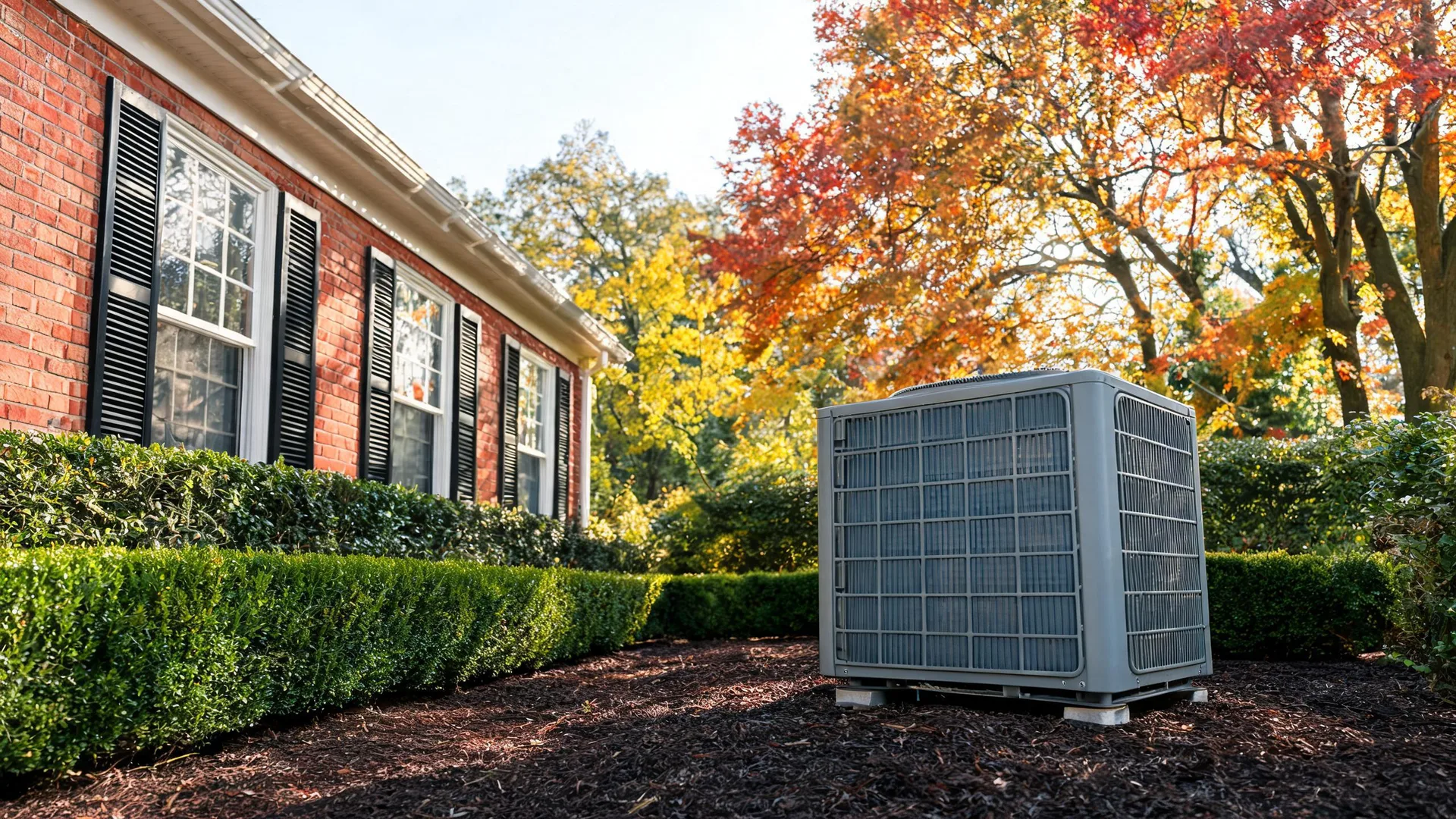
The compressor rarely gives warning

By the time a worn capacitor or a low charge finally takes the compressor out, the system usually ran fine the day before. That part doesn't fail slowly in a way you'd notice from the house. A tune-up is what catches the thing that's about to go, while it's still a capacitor swap instead of a compressor replacement.

Aerial view of a residential air conditioning condenser unit mounted on a concrete pad next to a house with vinyl siding and a sliding glass door.

Book your AC tune-up in May, before homes here start needing cooling in June.

  1. Jan
  2. Feb
  3. Mar
  4. Apr
  5. May
  6. Jun
  7. Jul
  8. Aug
  9. Sep
  10. Oct
  11. Nov
  12. Dec

A tune-up checks the refrigerant charge, cleans the coils, tests the capacitor and tightens the electrical connections.

A proper tune-up starts with the coils. The tech cleans the outdoor condenser coil and the indoor evaporator coil, since dust and grime on either one makes the system work harder to move heat. From there it's the refrigerant charge, checked against what the system calls for and adjusted if it's low. The capacitor and contactor get tested, since those are the parts that wear down quietly and take the compressor with them when they fail. The tech also checks the blower motor, clears the condensate drain so it isn't backing up, and confirms the thermostat is actually telling the system what you think it's telling it. None of this is guesswork. Each check is there because that part has a known way of failing, and catching it early is the whole point.