Overhead view of a gray residential air conditioning condenser unit mounted on a concrete pad beside a house with asphalt shingle roofing.

AC Maintenance in Morris, IL

Tell us about the job

Takes about a minute. No obligation.

Tune-up, service, or cleaningCentral ACGrundy County, IL
Step 1 of 2

What ZIP code is the job in?

Three months of real work

Your AC in Grundy County only runs June through August, with afternoon highs averaging 83°F. That's a short stretch compared to what the same machine would face further south, and the rest of the year it sits idle while the furnace carries the load.


Light duty still needs a yearly look

A system that isn't straining every day is less likely to fail from overwork, but parts still age, refrigerant still slips, and dust still builds on the coil whether the unit runs hard or not. A yearly check catches that before it turns into a breakdown in July.

3 months
June through August, your air conditioner is on duty
83°F
the average summer afternoon it cools against
11 hail events
in ten years, and hail bends the fins on outdoor coils
54 wind events
in ten years, and wind drives debris into outdoor units
Isometric grayscale illustration of a cutaway house showing interior rooms, ductwork, an indoor air handler, and an outdoor condenser unit on a pad connected by lines.
Your air conditioner works hardest from June through August.

NOAA nClimDiv, 1991–2020 normals

Half the homes in Grundy County were built in 1990 or later.

A system that new still needs a yearly check to stay working this well.

A neglected AC costs more to run here, at 15.87 cents a kWh

Power costs 15.87 cents a kWh statewide
Cooling runs June through August
Summer afternoons average 83°F
June starts it workingCooling in Grundy County runs June through August. May is the month to get it checked.

A yearly check before summer makes sense here. The technician cleans the coil, checks the refrigerant charge, and tests the capacitor while the system is still idle, so nothing is caught mid-summer when a repair means days without cooling. Grundy County has also seen its share of damaging wind and hail, 54 wind events and 11 hail events over the past decade, and an outdoor unit sitting through that needs a look to make sure nothing was bent or knocked loose. Catching a weak part before June beats losing the system in July.

Keep up the yearly check

Easy duty still wears parts. A yearly check keeps it going a long time.

Find a contractor
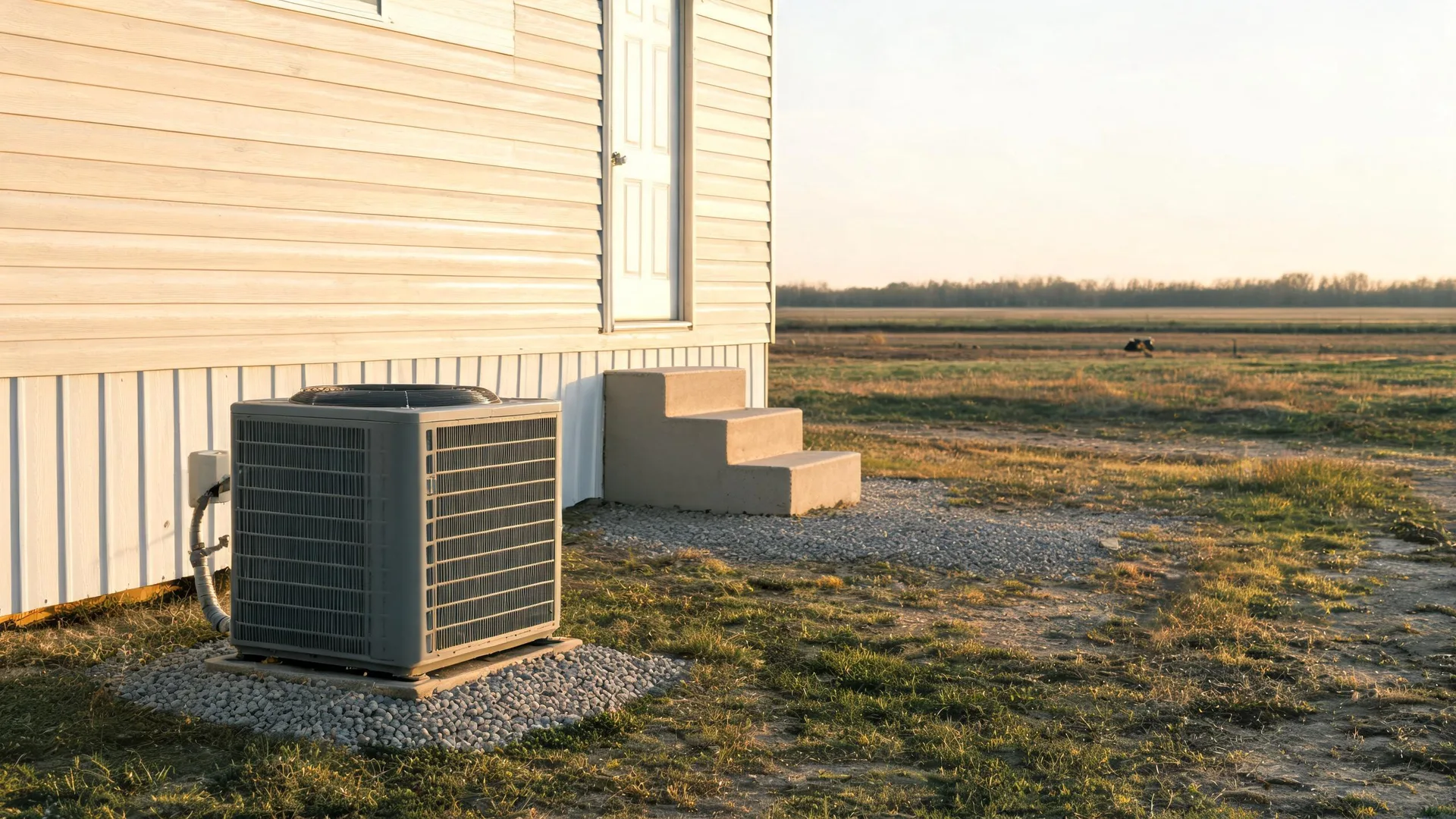
A gray residential air conditioner condenser unit mounted on a concrete pad in an open grass field.

What you can check yourself

Between visits, keep the area around the outdoor unit clear. Grass clippings, leaves, and seed pods pile up on the coil fins and block airflow, and the unit needs open space on every side to breathe. Check the air filter and swap it when it looks gray or clogged. A dirty filter is one of the easiest ways to cause a system to freeze up or run longer than it should. If the condensate drain line has an access port, pouring distilled vinegar down it now and then keeps algae from clogging it before it backs up and shuts the system off. Keep supply vents inside the house open and clear of furniture or rugs so air moves the way it was designed to. Past that, leave the refrigerant charge, the wiring, and the capacitor alone. Those are jobs for the yearly check, not for in between.

Each part depends on the one before it

The filter keeps dust off the coil. The coil has to stay clean to pull heat out of the air passing over it. The drain carries off the water the coil collects while it does that. If one of them gets neglected, the strain shows up in the others before long.

A dirty coil or clogged drain rarely announces itself

A coil caked with dust loses its ability to cool the air, so the system runs longer to reach the same temperature. A clogged drain does not back up right away, it backs up once the pan fills, and by then water is finding its way somewhere it shouldn't. A yearly check catches both while they're still minor.

An outdoor air conditioning condenser unit mounted on a concrete pad next to a blue-sided residential house at sunset.

Book your AC tune-up in May, before homes here start needing cooling in June.

  1. Jan
  2. Feb
  3. Mar
  4. Apr
  5. May
  6. Jun
  7. Jul
  8. Aug
  9. Sep
  10. Oct
  11. Nov
  12. Dec

A tune-up checks the refrigerant charge, cleans the coils, tests the capacitor and tightens the electrical connections.

A tune-up starts with the thermostat calling for cooling, then a technician watches the whole cycle run instead of just glancing at the unit. The capacitor gets tested under load, not just eyeballed, since a capacitor can look fine and still be weak enough to make the compressor struggle on startup. The refrigerant charge gets checked against what the system is designed to hold, because too little and too much both make it work harder and cool less. Electrical connections get tightened, since a loose connection generates heat and that heat damages the parts around it over time. The blower wheel and motor get checked for wear, and the condensate drain gets cleared so it can carry water away without backing up. None of this takes long when the system is in good shape, but skipping it means the first sign of trouble is the system not keeping up on a hot day.