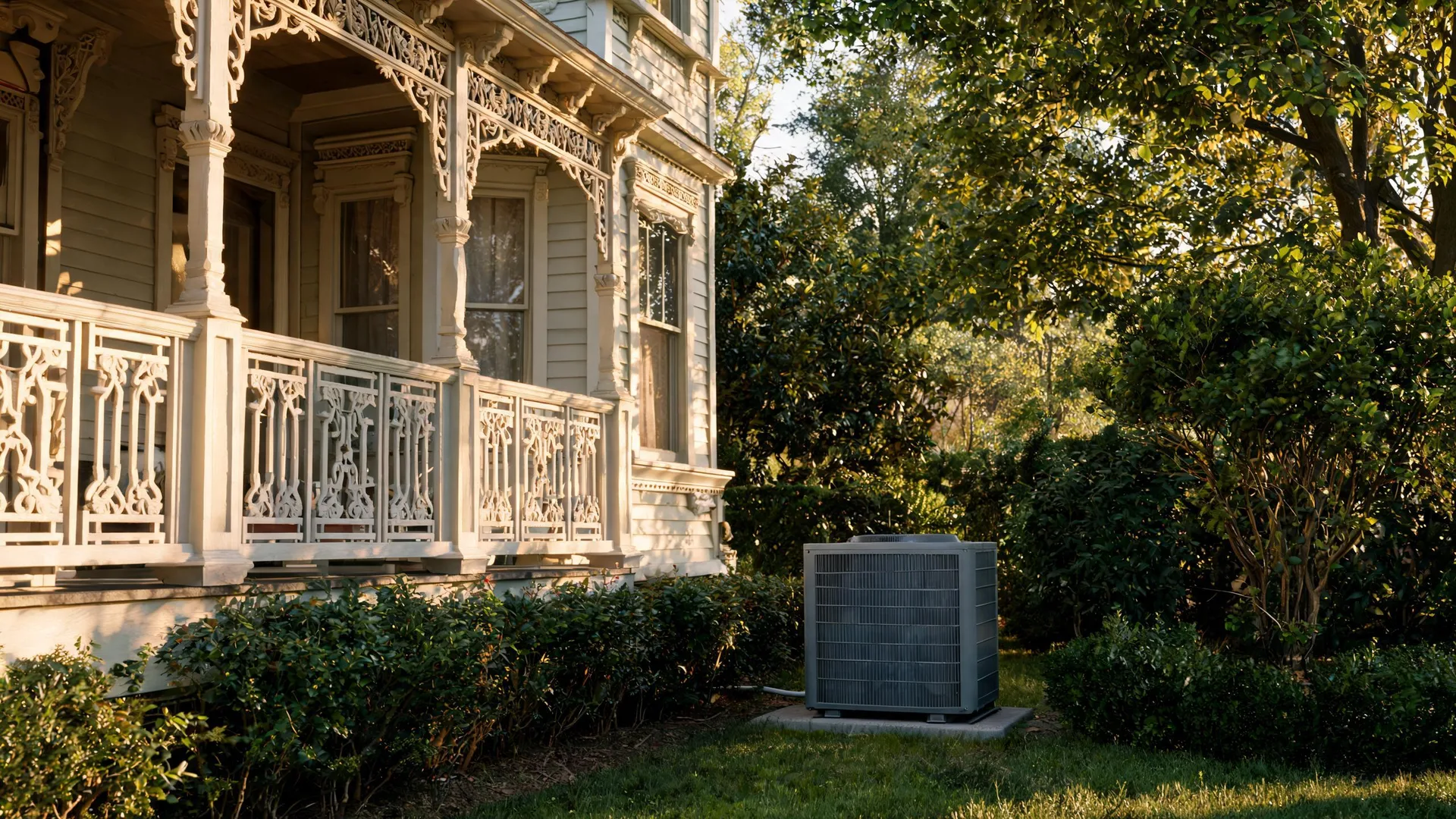
Aerial view of a residential air conditioning condenser unit mounted on a concrete pad next to a house with vinyl siding and a sliding glass door.

AC Maintenance in Mount Vernon, IL

Tell us about the job

Takes about a minute. No obligation.

Tune-up, service, or cleaningCentral ACJefferson County, IL
Step 1 of 2

What ZIP code is the job in?

Electricity here isn't cheap

Jefferson County homes paid an average of 17.36 cents per kilowatt-hour in 2025, more than most US counties pay. A dirty coil or a low charge makes the compressor work harder to do the same job, and every extra minute it runs gets billed at that rate.


The air here makes the AC work harder

The summer dew point in Jefferson County averages 66°F, higher than most of the country sees. Heavy air like that means the system pulls moisture as well as heat, so a unit that's falling behind on either job runs longer to keep the house comfortable.

5 months
May through September, your air conditioner is on duty
86°F
the average summer afternoon it cools against
15 hail events
in ten years, and hail bends the fins on outdoor coils
71 wind events
in ten years, and wind drives debris into outdoor units
Isometric grayscale illustration of a cutaway house interior showing a furnace with ductwork, interior rooms with furniture, and an outdoor condenser unit connected by lines at the exterior wall.
Your air conditioner works hardest from June through August.

NOAA nClimDiv, 1991–2020 normals

A capacitor can be weeks from failing and still start the compressor every time you ask it to.

A gauge set catches that weak capacitor before it leaves you without cooling.

May is when this system starts earning its keep

Cooling runs May through September
Summer afternoons average 86°F
71 damaging wind events from 2015 to 2024

A real tune-up starts outside at the condenser coil. If it's coated in dirt or grass clippings, heat can't move off the refrigerant the way it should, so the coil gets cleaned, not just rinsed from the top. The refrigerant charge gets checked against what the system calls for, because too little and the compressor runs long and cold, too much and it runs hot and strained either way. Electrical connections get tightened, since a loose one builds resistance and that resistance builds heat. The contactor and capacitor get tested under load rather than just looked at, because a capacitor can measure fine sitting still and still fail the moment the compressor asks it to start. Inside, the blower wheel gets checked for dirt buildup, since a dirty wheel moves less air even when the motor runs exactly as it should. Last, the condensate drain gets cleared, so the system can shed the moisture it pulls out of the air instead of backing it up.

A tune-up is what keeps that rate from working against you

A technician can clean that coil, check the charge, and test the capacitor under load before any of it costs you a degree of comfort or a longer run time. That's the part worth getting ahead of.

Find a contractor
A gray cylindrical air conditioning condenser unit mounted on a concrete pad next to a light-colored vinyl-sided house exterior.

Every season it runs without being checked is a season it works harder than it has to

A system that never gets opened up still runs, right up until the day it doesn't. Dust and grass fiber build up on the condenser coil a little at a time, so the drop in airflow never shows up as a sudden change, just a slow climb in run time that's easy to miss from inside the house. The same goes for the blower wheel: a thin coat of dust on the blades changes how much air they move, and the motor has no way to tell you it's working harder to push less air through the ducts. A capacitor weakens the same way, losing a little capacity each season until the one day it can't kick the compressor over. None of this looks like a breakdown while it's happening. It looks like a system doing its job, just worse than it used to, for longer than it used to. By the time something actually fails, the parts around it have usually been carrying that extra strain for a while.

Three places trouble starts

The filter is the first line of defense. Once it loads up with dust, airflow across the whole system drops, and the evaporator coil behind it can get cold enough to ice over. The condensate drain is the quiet one. It's just a small tube, and algae or sludge can plug it in one season, which backs water up into the pan it was meant to carry away.

Why a clean system runs shorter

A coil caked with dirt can't shed heat the way a clean one does, so the compressor stays on longer to reach the same temperature. A clogged drain can trip the float switch some systems use to shut the unit down before it overflows, which means no cooling at all until the blockage clears. Keeping all three clear is what lets the system do its job in the time it's supposed to take.

Overhead view of an air conditioning condenser unit on a concrete pad next to a house with asphalt shingle roofing and vinyl siding.

Book your AC tune-up in April, before homes here start needing cooling in May.

  1. Jan
  2. Feb
  3. Mar
  4. Apr
  5. May
  6. Jun
  7. Jul
  8. Aug
  9. Sep
  10. Oct
  11. Nov
  12. Dec

A tune-up checks the refrigerant charge, cleans the coils, tests the capacitor and tightens the electrical connections.

The easiest way to tell is what the technician touches, not what they say. A quick visit checks that the system turns on, reads the temperature at a vent, and calls it done. A thorough one pulls the panel off the condenser, not just glances at it, and checks refrigerant pressure against gauges rather than guessing from how cold the air feels. It tests the capacitor and contactor under load, because both can look fine sitting still and still fail the moment the compressor asks them to work. It checks amp draw on the compressor and fan motor, since a motor pulling more current than it should is wearing out even while it still runs. Ask what was actually measured. If the answer is numbers from a gauge or a meter, that was a real tune-up. If the answer is that everything looked fine, it probably wasn't.