Aerial view of a square outdoor air conditioning condenser unit on a concrete pad beside a house wall with a sliding glass door.

AC Maintenance in Springfield, IL

Tell us about the job

Takes about a minute. No obligation.

Tune-up, service, or cleaningCentral ACSangamon County, IL
Step 1 of 2

What ZIP code is the job in?

Electricity here isn't cheap

Illinois households paid 15.87 cents per kilowatthour in 2024. A dirty coil or a low refrigerant charge makes the compressor run longer to reach the same temperature, and every extra minute it runs gets billed at that rate.

A tune-up catches it early

A technician checking the refrigerant charge, the coil and the airflow during a maintenance visit finds the kind of wear that makes a system work harder before it shows up as a warm house or a stuck breaker.

5 months
May through September, your air conditioner is on duty
85°F
the average summer afternoon it cools against
110 hail events
in ten years, and hail bends the fins on outdoor coils
198 wind events
in ten years, and wind drives debris into outdoor units
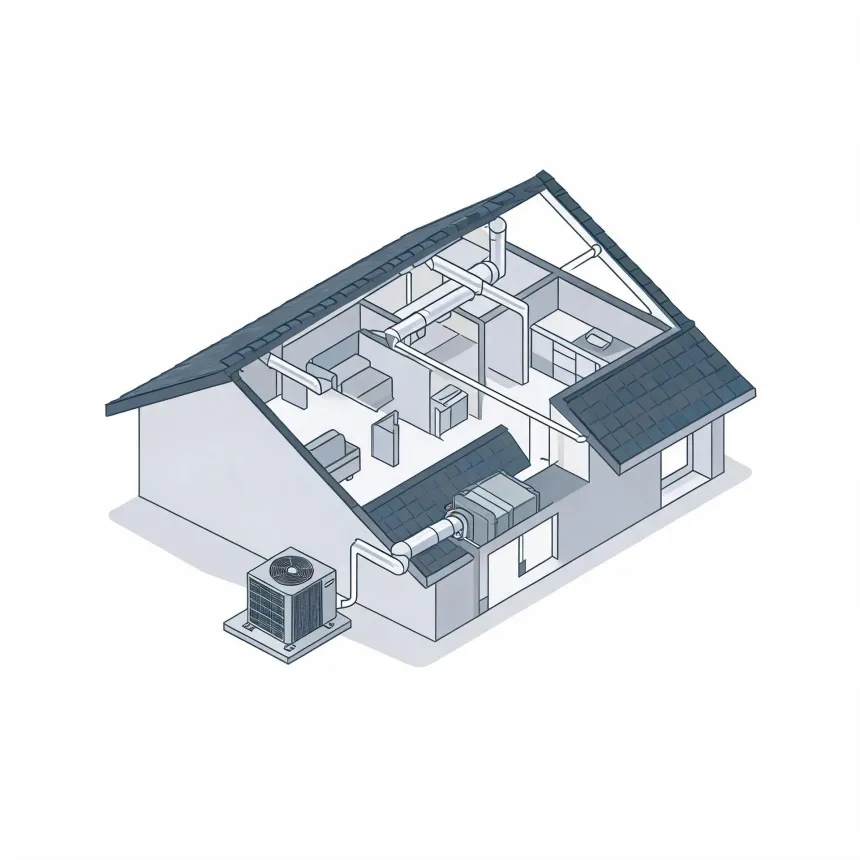
Isometric line illustration of a cutaway single-story house showing interior rooms, ceiling ductwork and an air handler, connected to an outdoor condenser unit on a pad beside the building.
Your air conditioner works hardest from June through August.

NOAA nClimDiv, 1991–2020 normals

A quick tune-up is a filter check and a glance at the thermostat.

A thorough one opens the cabinet, checks the refrigerant charge against the manufacturer spec, and pulls an amp reading on the compressor.

May is the first month it runs here, and the first month it works hardest

Cooling runs May through September
Summer afternoons average 85°F
198 damaging wind events from 2015 to 2024

The filter is the first thing worth checking and the easiest to get wrong. A clogged one starves the system of airflow, and the evaporator coil behind it needs that airflow moving across it to stay warm enough to absorb heat but not so cold it ices over. Once ice builds on the coil, it blocks airflow further and the problem feeds itself until the coil is solid and the house stops cooling at all. The condensate drain matters just as much, since the same coil that pulls heat from the air also pulls moisture out of it, and that water has to go somewhere. A drain line clogged with algae backs up into the pan under the coil, and from there it finds the nearest ceiling or closet floor. None of this announces itself ahead of time. A dirty filter or a slow drain looks fine from across the room right up until it doesn't.

A tune-up pays for itself here

A neglected system uses more power, and power costs more here. A tune-up pays for itself.

Find a contractor
A man in a cap, dark shirt and tan work pants climbs porch steps toward a dark teal door, carrying a canvas tool bag filled with hand tools.
A gray cylindrical air conditioning condenser unit mounted on a concrete pad next to a light-colored vinyl-sided house exterior.

What shows up before the system quits

A system that needs a check rarely stops outright. It gives smaller warnings first. The compressor cycles on and stays on longer than it used to, because a weak capacitor or a loose electrical connection makes it work harder to hit the same setpoint. The outdoor fan might hesitate before it kicks on, or hum without turning at all, which points to a motor or capacitor on its way out. Airflow from the vents can drop off room by room before anything fails outright, so part of the house cools fine while another part lags behind. A technician checking amp draw on the compressor and motor during a maintenance visit catches this kind of strain while it is still just strain, not a breakdown.

Keep the filter on a schedule

Check it monthly and hold it up to the light. If you can't see light through it, swap it. A clean filter is the one thing between visits that actually changes how hard the system works.

Keep the area around the outdoor unit clear

Grass clippings, leaves and shrubs packed against the outdoor unit block the airflow it needs to release heat. Leave a couple feet of open space on every side, and keep the top clear so nothing is sitting on it.

Overhead view of a gray outdoor AC condenser unit on a concrete pad beside a mulched garden bed and a house with vinyl siding.

Book your AC tune-up in April, before homes here start needing cooling in May.

  1. Jan
  2. Feb
  3. Mar
  4. Apr
  5. May
  6. Jun
  7. Jul
  8. Aug
  9. Sep
  10. Oct
  11. Nov
  12. Dec

A tune-up checks the refrigerant charge, cleans the coils, tests the capacitor and tightens the electrical connections.

A tune-up covers the parts of the system a homeowner can't check from across the room. A technician measures refrigerant charge against the manufacturer's spec, since a system low on refrigerant can't absorb heat properly no matter how clean everything else is. They check the capacitor and contactor, because a weak capacitor is one of the most common reasons a compressor or outdoor fan struggles to start. They clean the condenser coil outside and the evaporator coil inside, since a coil caked with dirt can't transfer heat the way it needs to. They check the blower wheel for dust buildup, test the thermostat's calling and cycling, and clear the condensate drain so it isn't sitting one clog away from backing up. Each piece gets checked on its own, because a system can look fine running and still have one part quietly working harder than it should.