





A nighttime view of a tree-lined residential street with illuminated two-story brick houses and street lamps.

AC Repair in Belleville, IL

Tell us about the job

Takes about a minute. No obligation.

RepairCentral ACSt. Clair County, IL
Step 1 of 2

What ZIP code is the job in?

Summer here runs May through September, with afternoon highs averaging 87 through June, July and August. That's a normal stretch of heat for an air conditioner to handle, nothing extreme. If your AC is struggling or not cooling right, the cause is usually something ordinary. A weak capacitor. A low refrigerant charge. A dirty coil or a clogged filter choking off airflow. A tech who checks the system properly will find it. Wind and hail show up in this county too, so if your unit sits outside exposed, it's worth having the cabinet and fins checked for damage along with whatever else is going on.

5 months
May through September, your air conditioner is on duty
87°F
the average summer afternoon it cools against
43 hail events
in ten years, and hail bends the fins on outdoor coils
84 wind events
in ten years, and wind drives debris into outdoor units
Isometric cutaway illustration of a single-story house showing interior rooms with furniture, overhead ductwork, an indoor air handler unit, and an outdoor condenser unit connected by lines at the side of the building.
Your air conditioner works hardest from June through August.

NOAA nClimDiv, 1991–2020 normals

A thermostat set to cool but a system that won't kick on is often just a breaker or a filter.

Check both before you call, because a contractor can't fix a tripped switch you forgot to flip back.

At 15.87 cents a kilowatt-hour, a struggling AC runs up your bill all summer

Power costs 15.87 cents a kWh statewide
Cooling runs May through September
Summer afternoons average 87°F

May is when cooling starts in St. Clair County, and it's also when a weak system tends to show itself. A capacitor that limped through last September often won't start the unit at all once the first real load hits it this spring. The same goes for a coil that was already dirty when the system shut off last fall. Getting it looked at in April, before those five months of running start, catches the weak part before it fails on the first hot day instead of during it.

Find out what's actually wrong with your AC

Half the homes in St. Clair County were built in 1975 or earlier, half after. House age doesn't tell a tech what's wrong with your AC. A capacitor, a coil, a low charge, these fail in old houses and new ones alike. What matters is getting the right part checked so it gets fixed once.

Find a contractor
An outdoor air conditioning condenser unit mounted on a concrete pad surrounded by gravel, photographed against a partly cloudy blue sky.

Left alone, a small problem runs the whole system harder

A system low on refrigerant doesn't just cool poorly, it runs the compressor harder trying to make up for it. Keep it running that way and the compressor can overheat. A dirty coil causes the same chain reaction. Airflow drops, the system runs longer to hit the same temperature, and heat that should move outside backs up into parts not built to handle it. Even a clogged filter restricts airflow enough that the evaporator coil can ice over, and once ice forms, the system cools less while running more. None of these start out serious. They get that way because the system keeps trying to do a job it can no longer do.

Warm air from the vents means it's not keeping up

If the thermostat says it's running but the air at the vent isn't noticeably cold, something in the cooling process has already failed. It could be the compressor not building pressure right, or refrigerant low enough that there's nothing left to absorb the heat. The blower still pushes air, so it feels like the system is working. It's just pushing air that was never cooled.

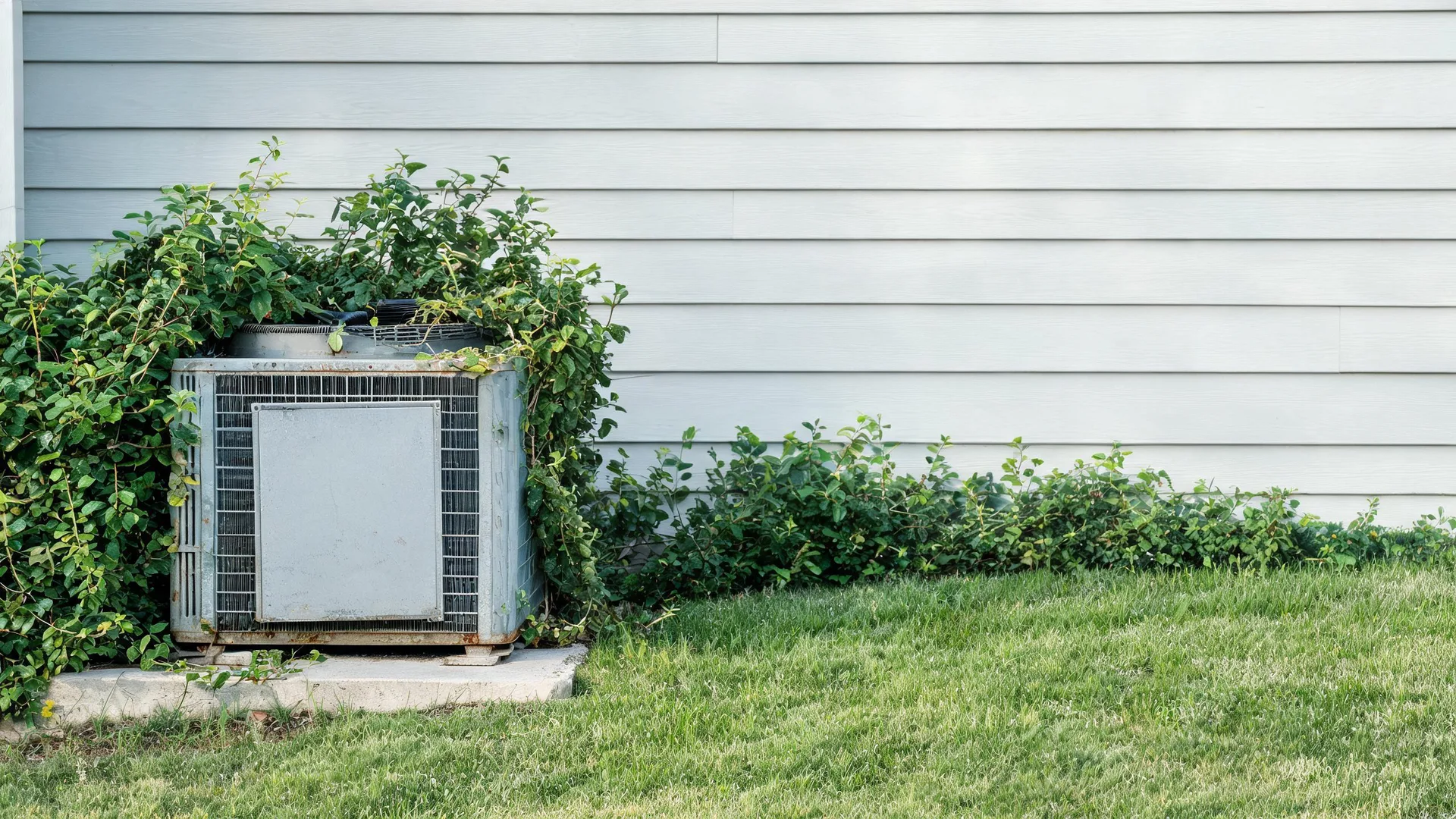
Short cycling wears out the parts that start the system

A system that shuts off a few minutes after it starts, then kicks back on soon after, is short cycling. Every start draws a hard jolt through the capacitor and the compressor. A system that short cycles is putting that load on those parts over and over instead of running one steady cycle and resting. The part that fails next is usually whichever one was already weakest.

An outdoor air conditioning condenser unit mounted on a concrete pad next to a blue-sided residential house at sunset.

A new air conditioner would save little on running costs in St. Clair County, so the repair decision comes down to the unit's condition.

  • A new one at the federal minimum, 13.4 SEER2$360 a year
  • An older air conditioner$380 a year

Estimates for a typical St. Clair County home, compared with an older unit built to the previous federal minimum, from EIA household energy data, Illinois fuel prices and NOAA climate normals. Your home will differ.

Repair makes sense when a part like a capacitor or contactor has failed.

Replacement makes sense when the compressor has failed or the system uses R-22 refrigerant, which is no longer made.

A compressor is the expensive part, and it's the one that decides this question more than any other. If the compressor is still good, most other repairs are worth doing. A capacitor, a fan motor, a coil, these can be replaced on their own and the system goes back to running like it did before. If the compressor is failing, that changes. It's sealed inside the unit and not something replaced cheaply on its own, so a failing compressor usually means pricing the repair against a new system rather than against nothing. Age factors in too, not because an old unit is doomed but because parts for it get harder to find and the rest of the system has had the same years of wear as the part that just failed. A tech who's straight with you will tell you which case you're in before doing any work, not after.