




A dark two-story house with a covered porch stands behind a hedge and large deciduous trees, viewed from a low angle across a mowed lawn under an overcast sky.

AC Repair in Bloomington, IL

Tell us about the job

Takes about a minute. No obligation.

RepairCentral ACMcLean County, IL
Step 1 of 2

What ZIP code is the job in?

Bloomington runs its air conditioning from June through September, with afternoon highs averaging 84 degrees through the summer. That is a normal cooling load, not a harsh one. Your AC isn't working any harder here than the same unit would in most of the country. So when it starts short cycling, blows warm air, or trips its breaker, the cause is usually something ordinary. A weak capacitor. A low refrigerant charge. A dirty coil. A clogged filter choking airflow. A tech's job is to find which one it actually is and fix that part, not guess.

4 months
June through September, your air conditioner is on duty
84°F
the average summer afternoon it cools against
47 hail events
in ten years, and hail bends the fins on outdoor coils
136 wind events
in ten years, and wind drives debris into outdoor units
Isometric line illustration of a cutaway single-story building showing interior rooms, ceiling ductwork, an indoor air handler, and an outdoor condenser unit connected by a line set.
Your air conditioner works hardest from June through August.

NOAA nClimDiv, 1991–2020 normals

A weak capacitor makes the compressor struggle to start, and every failed start heats the motor windings a little more.

Keep running it on a bad start and the fix goes from swapping a capacitor to replacing the compressor.

June is when a weak part finally gives out

Cooling runs June through September
Summer afternoons average 84°F
136 damaging wind events from 2015 to 2024

McLean County gets its share of severe weather, with damaging wind the most common kind. None of that is what's wrong with your AC. A tree limb or a power blink can trip a breaker or knock a unit out of line, but that's a different problem than a system that's been short cycling or blowing warm air on its own. If your outdoor unit took a hit in a storm, mention it when the tech comes out. Otherwise this is a straightforward repair, not a storm job.

A newer home usually means a system still worth fixing

Half the homes in McLean County were built in 1981 or later. If yours is one of them, the system behind this problem hasn't necessarily earned a replacement yet. A capacitor, a coil, a charge, those get fixed on a unit with plenty of life left in it.

Find a contractor
An outdoor air conditioning condenser unit mounted on a concrete pad beside a house, with electrical conduit running to a wall-mounted disconnect box.

Most of this unit's life is still ahead of it

If the house came with a system installed around when it was built, check the paperwork or the sticker on the unit before deciding anything. A compressor or a coil has years left in it most of the time, and the time-lapse here is just one day. Multiply it by the years ahead of this unit, not behind it, before you write it off.

Most failures start with wear on one part

A capacitor loses its charge over years of starting the compressor and fan motor. A contactor's points pit from the arcing every time it closes. A coil gets coated in dust and grime until it can't shed heat the way it should. None of these fail because the system is being pushed too hard. They fail because they've cycled on and off thousands of times, same as any part that works for a living.

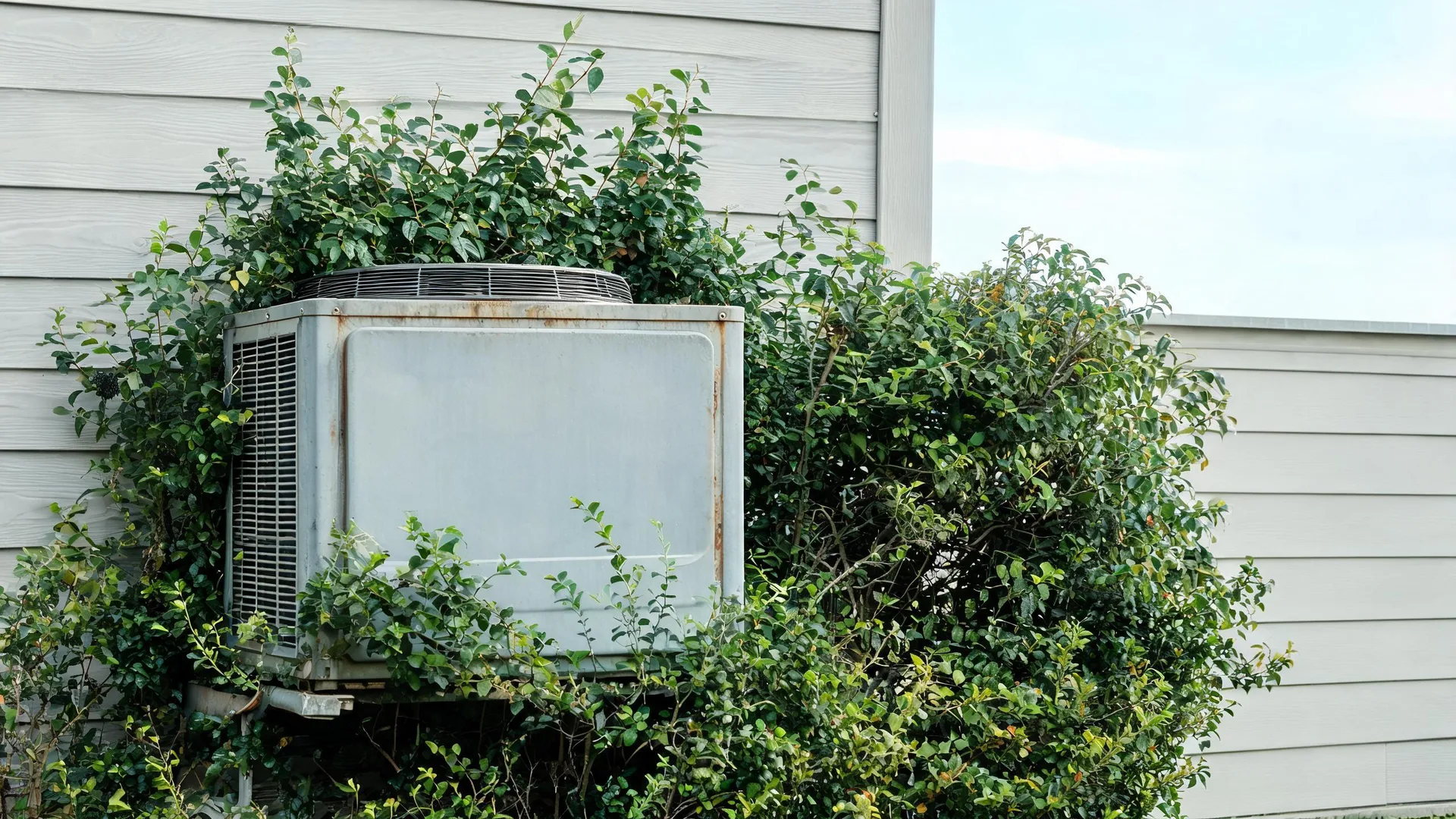
Airflow problems cause damage that isn't airflow

A clogged filter is the start of a chain, not the end of one. Starve the system of air and the evaporator coil gets too cold and ices over. Run it long enough that way and liquid refrigerant can come back to the compressor instead of vapor, and that's what actually ends compressors. Checking the filter is the easiest way to head off a much bigger repair.

An outdoor air conditioning condenser unit on a concrete pad next to the gray vinyl siding of a residential home.

A new air conditioner would save little on running costs in McLean County, so the repair decision comes down to the unit's condition.

  • A new one at the federal minimum, 13.4 SEER2$240 a year
  • An older air conditioner$250 a year

Estimates for a typical McLean County home, compared with an older unit built to the previous federal minimum, from EIA household energy data, Illinois fuel prices and NOAA climate normals. Your home will differ.

Repair makes sense when a part like a capacitor or contactor has failed.

Replacement makes sense when the compressor has failed or the system uses R-22 refrigerant, which is no longer made.

A diagnostic starts with questions, not tools. When did it start. Is it doing it all the time or only in the afternoon. Did you hear anything when it quit. Then the tech checks the easy things first. The thermostat setting, the breaker, the filter. Outside, gauges go on the lines to read the refrigerant pressure. A meter checks the capacitor's output against what it should be. The contactor gets a look too, since the points on it wear out. A dirty coil shows up fast in the readings, since it can't pull heat out of the air the way it should. The pressures and the electrical readings point to the failed part directly, and that's what gets replaced.