







Three lit brick homes on a tree-lined residential street photographed at dusk.

AC Repair in Carlinville, IL

Tell us about the job

Takes about a minute. No obligation.

RepairCentral ACMacoupin County, IL
Step 1 of 2

What ZIP code is the job in?

Carlinville runs its AC hard from May through September, with afternoon highs averaging 85 in June, July and August. That's a real stretch of summer, but it's nothing extreme, and it doesn't point to any one cause when a system starts acting up. A unit that's short cycling or blowing warm air here is most likely dealing with the same handful of problems a tech sees anywhere. A weak capacitor. A low charge. A clogged filter choking off airflow. The job is finding which one it actually is, not guessing based on the weather.

5 months
May through September, your air conditioner is on duty
85°F
the average summer afternoon it cools against
28 hail events
in ten years, and hail bends the fins on outdoor coils
39 wind events
in ten years, and wind drives debris into outdoor units
Isometric cutaway illustration of a single-story house showing interior rooms with furniture, attic ductwork connected to an indoor air handler, and an outdoor condenser unit on a pad linked by refrigerant lines.
Your air conditioner works hardest from June through August.

NOAA nClimDiv, 1991–2020 normals

A dirty condenser coil can't shed heat, so the system runs longer and still falls short.

Clean the coil and the unit stops straining to do a job it could already do.

Cooling starts in May, and that's when the weak parts give out

Cooling runs May through September
Summer afternoons average 85°F
28 hail events from 2015 to 2024
Power here isn't cheapIllinois homes paid 15.87 cents per kilowatthour in 2024, and a struggling AC runs up every month it's broken.

Before anyone comes out, there are a few things worth checking yourself. Go to the thermostat and make sure it's set to cool and set lower than the room temperature, since a setting bumped by accident looks exactly like a dead system. Check the breaker box for a tripped breaker, the AC has its own, and it can trip without taking out anything else in the house. Pull the filter and hold it up to a light. If you can't see light through it, airflow is choked and that alone can cause warm air or a coil that ices over. Walk outside and look at the outdoor unit. If it's running but the fan isn't turning, or you hear it humming without spinning, that's not something to poke at, that's a call for a tech. None of this fixes a bad capacitor or a low charge, but it rules out the simple stuff first.

The longer it runs broken, the more it costs

A broken AC doesn't pause your electric bill. At 15.87 cents a kilowatthour, a system running long or short cycling to compensate is costing you whether it's cooling the house or not. Get the actual problem found and fixed, and it stops costing you.

Find a contractor
A man in a dark shirt, tan work pants and a backward cap, seen from behind, carries a waxed canvas tool bag up porch steps toward a dark teal front door with a glass-paned top, beside a potted shrub.
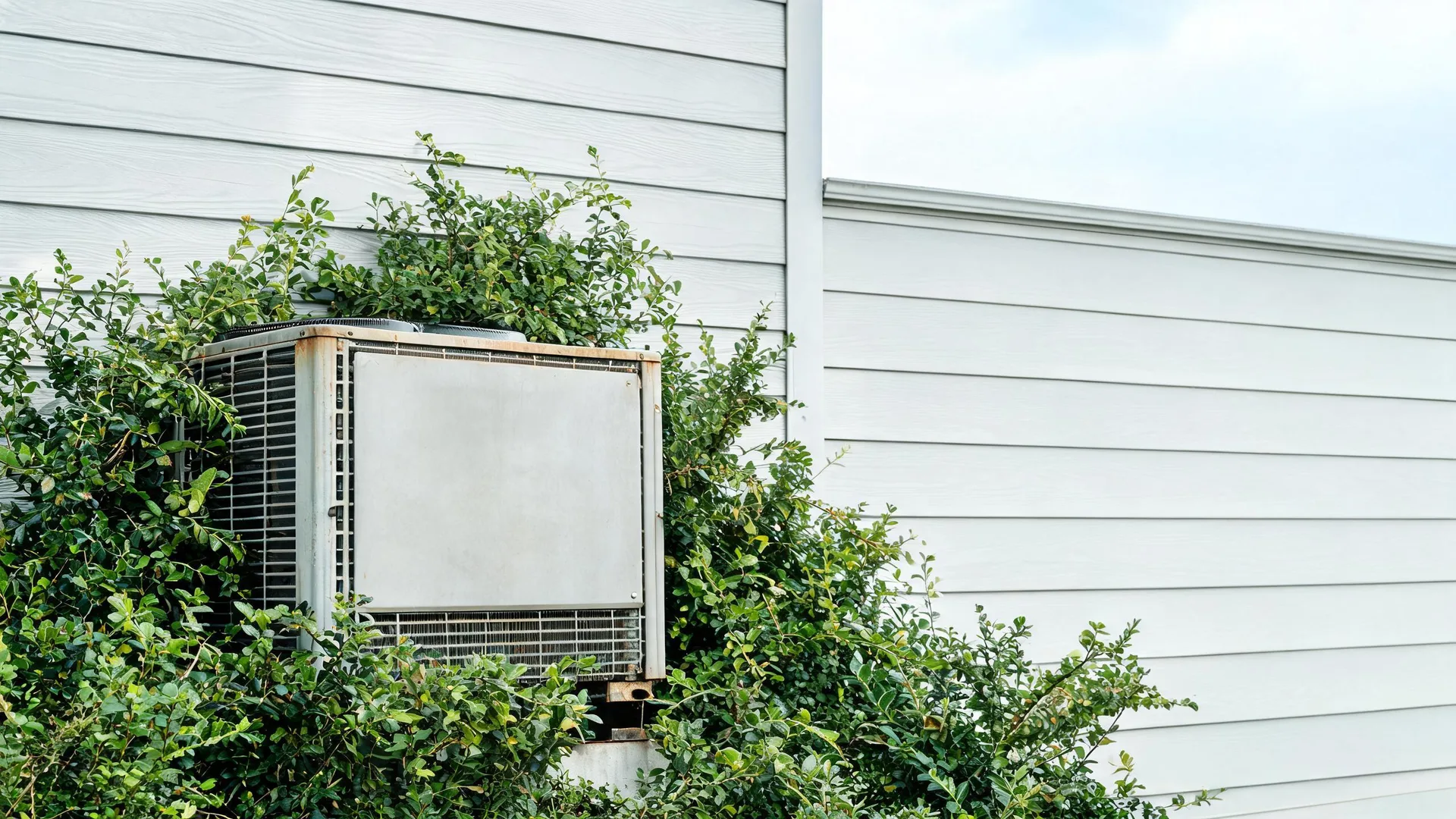
An outdoor residential air conditioning condenser unit mounted on a concrete pad, surrounded by gravel with a blue sky in the background.

The longer it runs each day, the sooner something wears out

An AC left running all day doesn't fail the same way one that cycles a few times and shuts off does. Long runtimes wear on the parts that start the compressor and keep it going, and those are usually the first to go. If the unit is cycling on and off every few minutes instead of running a steady stretch, something is already working harder than it should, often the capacitor or the contactor. A system that used to keep up and now runs most of the day without quite cooling the house is losing ground somewhere, and that's worth catching before the compressor itself takes the damage.

A low charge gets worse on its own

A system low on refrigerant doesn't just cool less, it runs colder on the coil than it should, and that coil can ice over. Once ice builds up, airflow drops even further, and the compressor keeps working against a coil that can't absorb heat anymore. What started as a slow leak turns into a frozen coil and a system that stops cooling altogether.

Waiting turns a part into a system

A failing capacitor makes the compressor struggle to start, and every hard start heats the compressor windings more than a normal one does. Run it long enough in that state and the compressor itself can fail. A capacitor is a small, inexpensive part. A compressor is not, and it's usually not worth replacing on its own.

Aerial view of a gray outdoor air conditioning condenser unit mounted on a concrete pad next to a house with vinyl siding.

A new air conditioner would cut about $30 a year off cooling for a typical Macoupin County home.

  • A new one at the federal minimum, 13.4 SEER2$290 a year
  • An older air conditioner$320 a year

Estimates for a typical Macoupin County home, compared with an older unit built to the previous federal minimum, from EIA household energy data, Illinois fuel prices and NOAA climate normals. Your home will differ.

Repair makes sense when a part like a capacitor or contactor has failed.

Replacement makes sense when the compressor has failed or the system uses R-22 refrigerant, which is no longer made.

A diagnostic starts with questions. What was the system doing before it quit, blowing warm, cycling fast, not turning on at all. Then it's gauges on the lines to check the charge, a meter on the capacitor and compressor to see what's pulling too much current or too little, and a look at the contactor for pitting or burn marks. The filter and the coils get checked too, since restricted airflow can look like a failing part when it isn't. A tech who's done this a long time usually has a guess before the gauges even come out, but the readings are what confirm it. Nobody replaces a part on a hunch.