






A quiet suburban street at twilight featuring two-story brick homes with illuminated windows and large trees lining the sidewalk.

AC Repair in Champaign, IL

Tell us about the job

Takes about a minute. No obligation.

RepairCentral ACChampaign County, IL
Step 1 of 2

What ZIP code is the job in?

Champaign County sees its share of rough weather. Between 2015 and 2024, the county recorded 223 damaging wind events, 70 hail events, and 13 tornadoes touching down. An outdoor AC unit sits outside through all of it, with nothing but a thin metal cabinet around the coil and fan. Hail dents the fins and bends the housing. Wind throws branches and debris into the grille. None of that always stops the unit from running, at least for a while, but it can mean a slow leak or a motor working harder than it should. If a storm has come through and your system still starts up fine, that's not proof it came through clean.

4 months
June through September, your air conditioner is on duty
84°F
the average summer afternoon it cools against
70 hail events
in ten years, and hail bends the fins on outdoor coils
223 wind events
in ten years, and wind drives debris into outdoor units
Isometric line illustration of a cutaway single-story house showing interior rooms, attic ductwork and an air handler, connected by a line to an outdoor condenser unit on a pad.
Your air conditioner works hardest from June through August.

NOAA nClimDiv, 1991–2020 normals

Summer here runs June through September with afternoon highs averaging 84°F and dew points around 64°F.

That kind of stretch wears an AC down faster, so the same problem tends to show up sooner here than it would somewhere milder.

A struggling AC costs more here than most places

Power here costs 17.53 cents per kilowatt-hour
Climate zone 5A
Cooling runs June through September

Half the homes in Champaign County were built in 1981 or later. If yours is one of them, the system behind it is probably not as old as the house two doors down. Compressors and condensers that are still within their working life are usually worth repairing rather than replacing outright. A technician can check the age and condition of your unit against what's typical for its stage, and most of the time a repair gets you back to cool air without starting over. If your system came with the house, it's worth finding out when that was.

After a storm, have the outdoor unit checked

If your AC took a hit this year, running fine right now doesn't settle it. A bent fin or a cracked line can sit quiet for weeks before it shows up as a bigger repair. Worth having someone look at the outdoor unit after any storm that came through hard.

Find a contractor
A man in a cap, dark long-sleeved shirt and tan work pants climbs porch steps toward a teal front door, carrying a worn canvas tool bag beside a potted shrub.
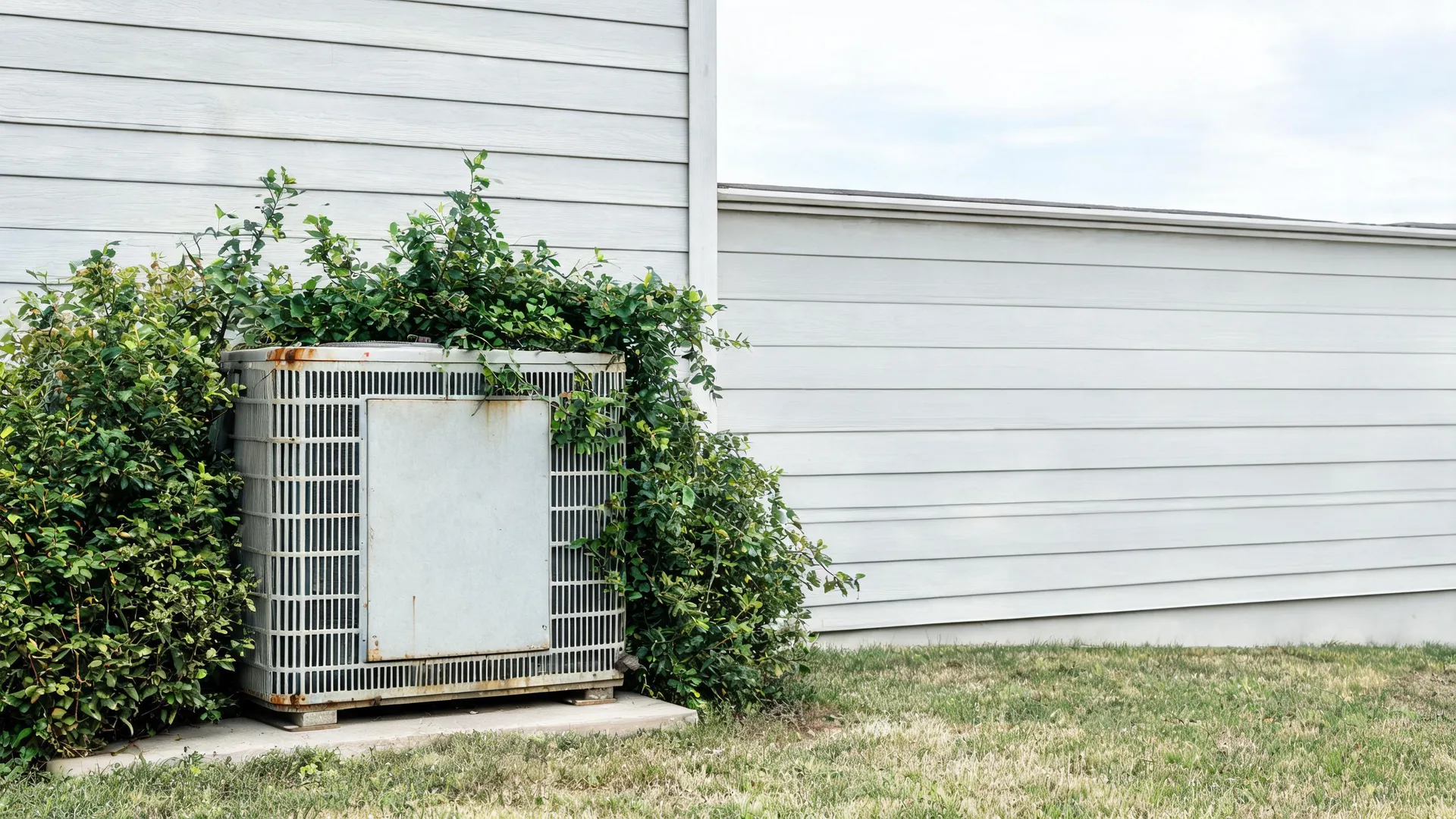
A gray cylindrical air conditioning condenser unit mounted on a concrete pad next to a light-colored vinyl-sided house exterior.

The first hot week finds what winter hid

Cooling runs June through September here, so May is when a lot of systems get asked to start up again after sitting all winter. A part that was already weak, a capacitor losing its charge, a contactor worn from years of cycling, usually doesn't fail while it's idle. It fails under load, in the first real heat. That's why the first hot stretch in June is when a lot of service calls come in, not because anything new broke, but because the system is finally working hard enough to show what was already wrong with it.

What you can check yourself

Look at the outdoor unit first. Make sure nothing is blocking the sides, leaves, a fallen branch, grass clippings packed into the fins. Check that the circuit breaker for the AC hasn't tripped. Go inside and swap the air filter if it's dirty, a clogged filter starves the system of airflow and can shut it down on its own. Check the thermostat has power and is actually set to cool, below room temperature. None of that needs tools or training.

What tells you to stop and call someone

If the outdoor unit is humming but the fan isn't spinning, don't poke at it, that's a capacitor or motor problem and the capacitor can hold a charge even with the power off. Ice on the indoor coil or lines means something is restricting airflow or the refrigerant charge is low, and running it iced up can damage the compressor. Water pooling near the indoor unit points to a clogged drain line. Any burning smell or a breaker that trips again after you reset it once means stop and get a technician out.

An outdoor air conditioning condenser unit positioned on a concrete pad next to a blue-sided house, surrounded by green shrubs and flowering hydrangeas at sunset.

A new air conditioner would save little on running costs in Champaign County, so the repair decision comes down to the unit's condition.

  • A new one at the federal minimum, 13.4 SEER2$250 a year
  • An older air conditioner$270 a year

Estimates for a typical Champaign County home, compared with an older unit built to the previous federal minimum, from EIA household energy data, Illinois fuel prices and NOAA climate normals. Your home will differ.

Repair makes sense when a part like a capacitor or contactor has failed.

Replacement makes sense when the compressor has failed or the system uses R-22 refrigerant, which is no longer made.

A repair makes sense when the part that failed is a part on its own: a capacitor, a contactor, a fan motor. Those wear out one at a time, and swapping one doesn't say anything about the rest of the system. A compressor is different. It's the one part that's expensive enough and central enough that its failure changes the math, especially on a unit that's already older. At that point you're not just fixing what broke, you're asking an old system to keep going on everything else too. Age matters less than how the unit has been running up to now. A system that's been cooling fine and starts short cycling or tripping its breaker is usually telling you about one failed part. A system that's needed a few different repairs over a couple of years is telling you something broader is wearing out.