




A row of dark-clad single-story houses with gabled roofs behind trimmed hedges, lawn and leafy trees under an overcast sky.

AC Repair in Granite City, IL

Tell us about the job

Takes about a minute. No obligation.

RepairCentral ACMadison County, IL
Step 1 of 2

What ZIP code is the job in?

April is the month to get a struggling AC looked at here, before cooling starts in May. Systems in Madison County run May through September, and the first real stretch of heat is when a weak part tends to fail. A capacitor or contactor that was barely getting by last September often cannot handle the first warm week in May. Waiting until the house is already hot usually means a longer line for repair and a longer wait for relief. Catching it in April means the fix happens before you actually need the system.

5 months
May through September, your air conditioner is on duty
86°F
the average summer afternoon it cools against
40 hail events
in ten years, and hail bends the fins on outdoor coils
86 wind events
in ten years, and wind drives debris into outdoor units
Isometric cutaway illustration of a single-story house showing interior rooms with furniture, attic ductwork connected to an indoor air handler, and an outdoor condenser unit on a pad linked by refrigerant lines.
Your air conditioner works hardest from June through August.

NOAA nClimDiv, 1991–2020 normals

Summers here run May through September, with afternoon highs averaging 86 degrees.

Five months of steady work is normal wear, and the usual parts are the ones that give out first.

At 15.87 cents a kWh, a struggling AC runs up your bill every month it limps along

Power costs 15.87 cents a kWh statewide
Cooling runs May through September
Summer afternoons average 86°F

Half the houses in Madison County were built in 1971 or earlier. If your AC came with a house that old, it's probably not the original unit, but it may still be older than you'd like, especially if nobody's replaced it since. An aging system can run fine for years and then start struggling once a part wears down. Ask whoever comes out to look at it how much life is left in the unit before you put money into a major repair.

Most AC problems here have an ordinary cause

Madison County has seen its share of storms, 86 damaging wind events and 40 hail events in the last ten years. That's ordinary weather for this area, nothing about it singles out your AC. A struggling unit here is almost always a worn capacitor, a low charge, or a part that's reached the end of its run. Get it looked at and fixed.

Find a contractor
A gray residential air conditioning condenser unit mounted on a concrete pad outdoors, surrounded by green grass under a partly cloudy blue sky.

Ask the unit's age before you approve the repair

If the unit is old enough to be near the end of its life, that's worth knowing before a tech starts replacing parts on it. Ask for the unit's age and condition before you approve anything past a basic fix. A tech who's actually looked at the unit can tell you whether it's worth putting money into, and that answer should come before the repair, not after.

Check these before you call

Look at the outdoor unit first. If the fan isn't spinning but you hear a hum, that's often a bad capacitor or a seized motor, not something to force. Check the thermostat batteries and make sure it's set to cool, below room temperature. Go to the breaker panel and look for a tripped breaker on the AC circuit. Pull the air filter and hold it up to light. If you can't see through it, replace it. A clogged filter can starve the system enough to make it act like something more serious is wrong.

What to leave alone

Don't pull the panel off the outdoor unit or touch anything inside it. The capacitor in there can hold a charge even with the power off. If you see ice on the refrigerant lines, turn the system off and let it thaw before anyone works on it, but don't try to chip it off or add refrigerant yourself. A system low on charge has a leak somewhere, and that's a repair, not a top-off.

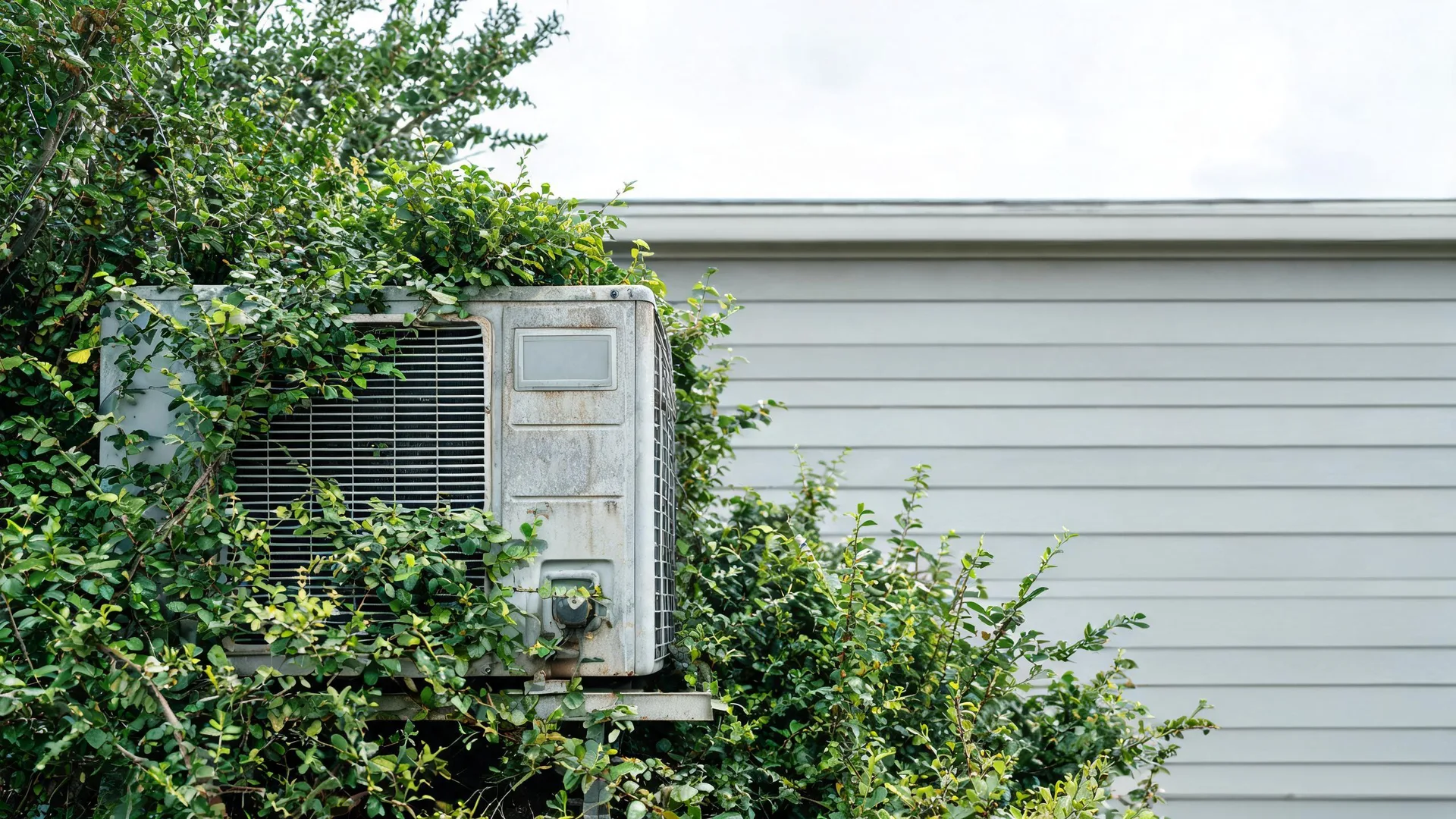
An outdoor air conditioning condenser unit positioned beside a blue-sided house at sunset.

A new air conditioner would save little on running costs in Madison County, so the repair decision comes down to the unit's condition.

  • A new one at the federal minimum, 13.4 SEER2$340 a year
  • An older air conditioner$360 a year

Estimates for a typical Madison County home, compared with an older unit built to the previous federal minimum, from EIA household energy data, Illinois fuel prices and NOAA climate normals. Your home will differ.

Repair makes sense when a part like a capacitor or contactor has failed.

Replacement makes sense when the compressor has failed or the system uses R-22 refrigerant, which is no longer made.

A tech starts outside at the unit, before any panel comes off. First the fan, making sure it spins freely and isn't dragging. Then the compressor, listening for it to kick on and run steady. From there it's the electrical side. The capacitor gets tested for its charge, the contactor gets checked for pitting or burn marks. Gauges go on the lines next to check the refrigerant charge, since a system running low almost always means a leak somewhere in the coils or lines. Airflow gets checked too. A weak return or a blocked coil can look a lot like a failing compressor if you don't rule it out first. None of this is guesswork. By the time the panel goes back on, the tech usually knows exactly what's wrong and why.