A two-story black house with a covered porch, framed by large deciduous trees and trimmed hedges, photographed from a low angle across a lawn with blurred grass in the foreground.

AC Repair in Kankakee, IL

Tell us about the job

Takes about a minute. No obligation.

RepairCentral ACKankakee County, IL
Step 1 of 2

What ZIP code is the job in?

Three months of real work

Kankakee summers run June through August, with afternoons averaging 83°F. That's a short season, but the system still has to hold up through it, and a unit that's struggling now will keep struggling until someone finds the actual cause.

Nothing unusual to blame

Kankakee County doesn't put extra strain on an air conditioner. No long stretch of extreme heat, no odd climate quirk working against the equipment. When a system here breaks down, it's almost always a known problem with a known fix, not something specific to this county.

3 months
June through August, your air conditioner is on duty
83°F
the average summer afternoon it cools against
21 hail events
in ten years, and hail bends the fins on outdoor coils
99 wind events
in ten years, and wind drives debris into outdoor units
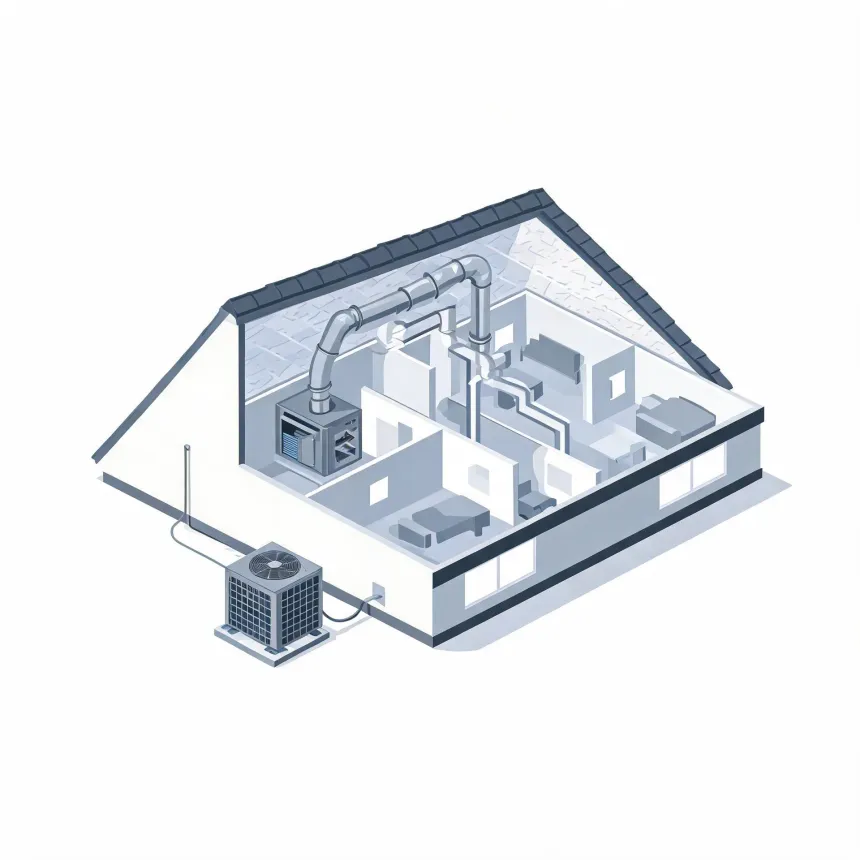
Isometric illustration of a cutaway house showing interior rooms, an attic furnace with large ducts, and an outdoor condenser unit connected by a line set, on a white background.
Your air conditioner works hardest from June through August.

NOAA nClimDiv, 1991–2020 normals

June is when cooling starts in Kankakee County.

The first hot stretch finds whatever part was already weak.

At 15.87 cents a kWh, a struggling AC runs up the bill until it's fixed

Power costs 15.87 cents a kWh statewide
Cooling runs June through August
Summer afternoons average 83°F

Electricity in Illinois ran 15.87 cents per kilowatthour in 2024. An air conditioner that's short on refrigerant or struggling to start pulls more power to do the same job, so a unit with a real problem costs more to run every month it's left alone. That cost doesn't show up as one big number, just a higher bill all summer. Getting the actual cause fixed stops that, and it's a short season to begin with, so there isn't much of it to waste.

Get the real cause fixed, not just the symptom

Storms pass through Kankakee County same as anywhere in this part of Illinois, and most of what knocks out a window unit or trips a breaker on a central system has nothing to do with the weather at all. When the power drops and comes back, most air conditioners start up on their own. If yours isn't cooling, it's worth finding out why before the next hot stretch finds the same weak part again.

Find a contractor
A gray residential air conditioning condenser unit mounted on a concrete pad outdoors, surrounded by green grass under a partly cloudy blue sky.

One visit, a handful of checks, one answer

A tech starts outside at the condenser, checking that the fan turns freely and the coil isn't packed with dirt or leaves. Gauges go on next to read the refrigerant pressure on both sides of the system. That reading alone narrows things down fast. Low pressure points to a leak. High pressure with the fan running fine points to a dirty coil that can't shed heat. A compressor drawing more amps than it should points to a weak capacitor or a failing start component. Inside, they'll check the coil in the air handler for ice, since a frozen coil can come from low refrigerant or just a filter so dirty it's choking off airflow. They'll check the condensate line too. A clogged drain trips a safety switch and shuts the whole system down even when every mechanical part is fine. None of this is guesswork. The pressures and the amp draw either match what the equipment is built to run at or they don't, and that's what tells a tech which part is actually failing instead of just chasing the symptom.

A weak part doesn't stay weak

A capacitor that's starting to fail still gets the compressor running, just with more strain each time. A compressor low on refrigerant still runs, just hotter than it should. Neither one shuts the system down right away. They wear harder every cycle until the part that was struggling is the part that fails.

One problem pulls in the next

A dirty coil forces the compressor to run longer to cool the same space. That extra runtime heats the compressor past what it was built for, and heat is what wears a compressor out. Left alone, the first problem starts damaging whatever's working hardest around it, so the repair gets bigger the longer the system keeps running on it.

An outdoor air conditioning condenser unit positioned beside a blue-sided house at sunset.

A new air conditioner would save little on running costs in Kankakee County, so the repair decision comes down to the unit's condition.

  • A new one at the federal minimum, 13.4 SEER2$220 a year
  • An older air conditioner$240 a year

Estimates for a typical Kankakee County home, compared with an older unit built to the previous federal minimum, from EIA household energy data, Illinois fuel prices and NOAA climate normals. Your home will differ.

Repair makes sense when a part like a capacitor or contactor has failed.

Replacement makes sense when the compressor has failed or the system uses R-22 refrigerant, which is no longer made.

A repair is worth doing when it fixes one part and the rest of the system is sound. A capacitor, a contactor, a fan motor, these fail on their own and don't say anything bad about the compressor or the coil. Replacement starts to make sense when the compressor itself is the problem, since that's the most expensive part in the unit and the most labor to swap. It also makes sense when the refrigerant in it is on its way out, since equipment built for that refrigerant is getting harder to service. A contractor can tell you which kind of problem you have before any work starts. That answer matters more than the repair itself.