





A quiet suburban street at twilight featuring two-story brick homes with illuminated windows and large trees lining the sidewalk.

Mini Split Installation in Aurora, IL

Tell us about the job

Takes about a minute. No obligation.

New system or replacementMini-splitKane County, IL
Step 1 of 2

What ZIP code is the job in?

Kane County saw 298 severe weather events between 2015 and 2024. Most of that was wind, 190 events, with 65 hail events and 23 tornadoes in the same stretch. A mini split's outdoor unit sits outside through all of it, exposed to whatever the wind throws at it and whatever the hail drops on it. Statewide, 16% of Illinois households lost power for a day or more in 2024. A mini split runs on electricity, both the outdoor compressor and the indoor heads, so when the power goes, so does your heat or cooling until it comes back.

8 months
October through May, your system heats
3 months
June through August, it cools
18°F
the average winter night it heats against
82°F
the average summer afternoon it cools against
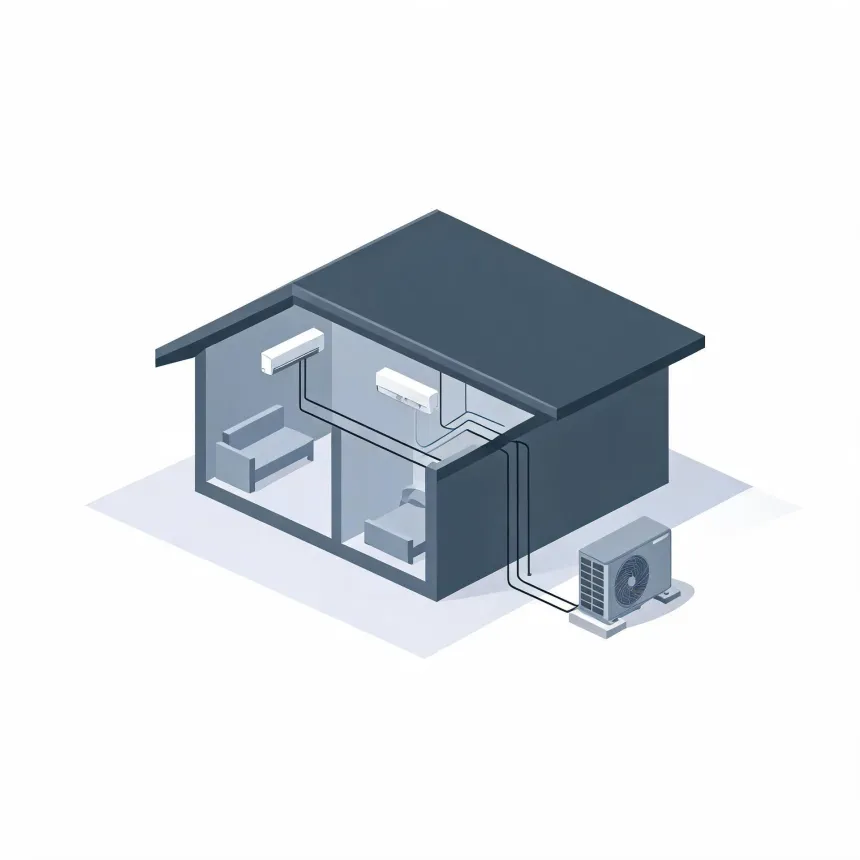
Isometric illustration of a cutaway house showing two wall-mounted mini-split indoor units connected by line sets to an outdoor condenser on a pad outside.
Your system heats October through May and cools June through August.

NOAA nClimDiv, 1991–2020 normals

A mini split has no backup heat source built in, unlike a furnace paired with AC.

Ask what happens to the house when the power cuts out and the compressor stops.

Get it installed before June, so a summer storm isn't the first test it faces

Cooling runs June through August
Summer afternoons average 82°F
190 damaging wind events from 2015 to 2024
Gas still does the work here86.1 percent of homes in Kane County heat with gas, which is why most mini split jobs here add cooling and backup heat, not a full replacement

Kane County falls under zone 5A in the 2021 energy code, a cool, fairly humid zone where heating carries more of the load than cooling. A ductless mini-split heat pump counts as a split system under the federal standard. Any unit manufactured on or after January 1, 2023 has to remove at least 14.3 Btu of heat per watt-hour over the summer and deliver at least 7.5 Btu of heat per watt-hour over the winter, the same floor set for any split-system heat pump. There's no separate, lower bar for ductless equipment. That rules out the cheapest units on the market and narrows what a contractor can legally put on your wall or outside your house. A system built to clear that number is also built to carry the heating load this zone actually asks of it, not just keep the place cool.

Plan for the weather before the install, not after it

Where the outdoor unit goes and how it's mounted is part of the install, not an afterthought. A contractor can set it where hail and wind debris are less likely to reach it and raise it clear of snow and ice. Ask about backup heat too, since a power cut takes the compressor down with it. That's a decision for before the crew shows up, not after a storm.

Find a contractor
A beige split-system air conditioner outdoor condenser unit mounted on metal wall brackets atop a stucco wall.

This runs through every season, not just one

A mini split runs for both heating and cooling, so the compressor outside is working most months of the year instead of sitting idle half the time like an air conditioner does. That's more total hours of cycling on and off, more hours of the fan motor turning, more hours of refrigerant moving through the coils. Long runtime by itself isn't a problem for a well-installed system. What matters more is how it was set up to begin with. A line set that's too long or has too many bends makes the compressor work harder to move refrigerant, year after year. A unit sized too big for the room will short cycle, switching on and off more often than it should, and that wear adds up faster than steady running would. Good installation work up front is what lets a mini split rack up years of runtime without the compressor giving out early.

SEER2 and HSPF2 tell you two different things

SEER2 measures cooling efficiency, how much heat the system moves out of the house per unit of electricity it burns over summer. HSPF2 measures the same thing for heat pump mode in winter. A mini split carries both numbers because it does both jobs. A higher SEER2 doesn't tell you anything about how it performs heating the house when it's cold out, and the reverse is true too. Look at both, not just the one that's easier to find on the label.
The rating is a seasonal average, not a guarantee

That number comes from lab tests run across a range of conditions meant to represent a typical season, not the coldest night or the hottest afternoon the unit will ever see. A mini split works hardest and runs least efficiently right at the extremes, which is exactly when you're leaning on it most. Sizing and installation decide how it actually performs on those days far more than the rating on the box does.

Replacing a window unit or old ductless system means dealing with what's already mounted on the wall and the refrigerant line running outside. A contractor has to recover the refrigerant from the old system before touching anything, since it can't legally be vented into the air. The old indoor head comes off its mounting plate, and that plate usually comes off too rather than getting reused, since a new unit rarely lines up with the same holes. Outside, the old compressor gets disconnected and hauled off, along with the line set if it's not being reused. If the wall sleeve or the hole the old line ran through isn't the right size for the new equipment, that gets patched or redone rather than forced to fit. None of this is salvage work. It's clearing the wall and the slab so the new system goes in clean instead of working around what the last one left behind.

Installation starts with where the lines run, not where the indoor head hangs. A technician maps the path from the indoor unit to the outdoor compressor before mounting anything, since that line set carries both refrigerant lines and the wiring that lets the two talk to each other. A hole gets drilled through the wall for the line set, sized and sealed so air and moisture can't follow the lines back inside. The indoor head mounts to a plate fixed to studs, not just drywall, because that unit has to stay put for years of vibration from the fan. Outside, the compressor sits on a pad or bracket away from the wall, with clearance on all sides so it can pull in air and push out heat without choking on its own exhaust. Once everything is connected, the system gets pressure tested for leaks before any refrigerant goes in, then evacuated to pull moisture and air out of the lines. Only after that passes does the technician charge the line set and run the unit through both heating and cooling to check it's moving air and holding temperature the way it should.