




A tabby cat sleeps on a dark quilted bed in a moody, minimalist bedroom with a black wall-mounted air conditioning unit.

Mini Split Installation in Belvidere, IL

Tell us about the job

Takes about a minute. No obligation.

New system or replacementMini-splitBoone County, IL
Step 1 of 2

What ZIP code is the job in?

Most homes in Boone County heat with gas, 78.2 percent of them. A mini split works differently than the furnace already in the house. It runs on electricity and handles both heating and cooling from the same unit, so it's common to add one for a room a furnace doesn't reach well, or to cover a space without extending ductwork. Some homeowners use one alongside the gas furnace rather than replacing it outright. Either way, the existing heat source matters when deciding how the mini split fits into the house, so it's worth knowing what you have before comparing options.

8 months
October through May, your system heats
3 months
June through August, it cools
16°F
the average winter night it heats against
81°F
the average summer afternoon it cools against
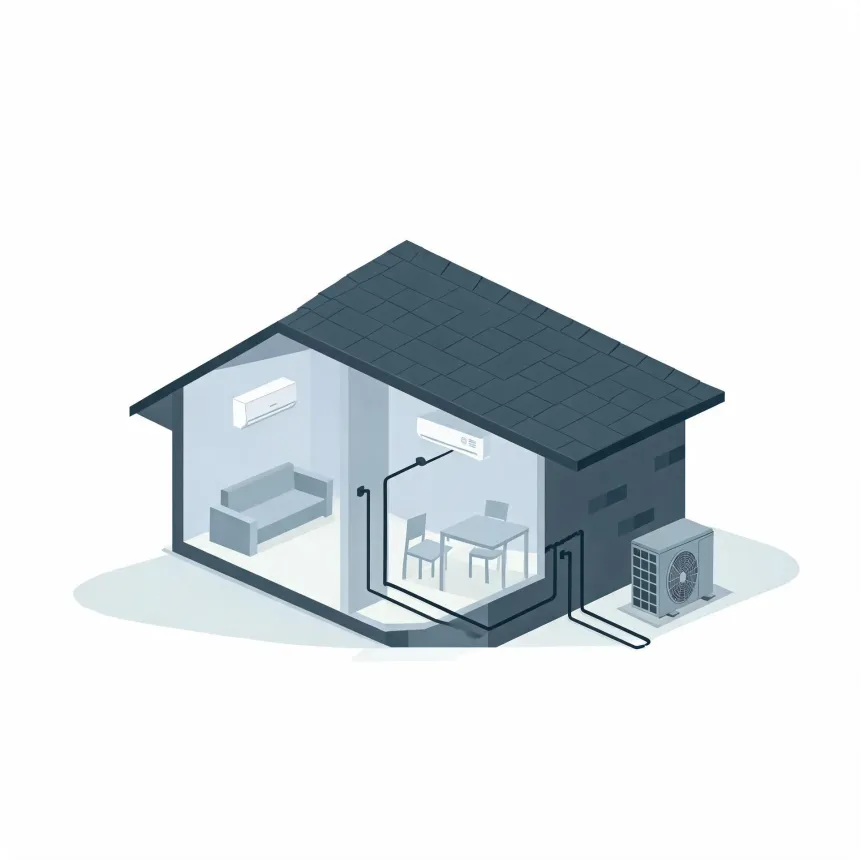
Isometric illustration of a cutaway single-story house showing two wall-mounted mini-split indoor units connected by line sets to an outdoor condenser beside the building, with a sofa, table and chairs inside.
Your system heats October through May and cools June through August.

NOAA nClimDiv, 1991–2020 normals

Cooling runs about three months here, June through August, with afternoon highs around 81°F.

A mini split here isn't working against hot weather most of the year, so a mid-range unit can do the job fine.

Nothing about Belvidere pushes you toward a bigger or pricier unit

Power costs 15.87 cents a kWh statewide
Cooling runs June through August
Summer afternoons average 81°F
Get it in before JuneCooling starts in June here, so May is the time to put a mini split in.

Belvidere falls under climate zone 5A, a cool zone where heating is the bigger load. Any mini split installed here has to meet the federal minimum that comes with that zone. For a ductless heat pump, that means at least 14.3 SEER2 for cooling and 7.5 HSPF2 for heating. A unit rated below that can't go in. Above that floor, the choice comes down to the room and how you want to run it, not the zone. A federal tax credit is also available for systems that qualify, worth checking against the model you're considering.

Pick the unit that fits the room, not the top of the lineup

A mid-range mini split only has three months of real cooling work to do here. Spending more for a higher-tier unit will not buy you anything in a climate this mild. Put the money toward a model that fits the room and skip the upgrade.

Find a contractor
A beige split-system air conditioner outdoor condenser unit mounted on metal wall brackets atop a stucco wall.

Sizing is about the room, not a guess

Size comes from a room by room heat load calculation, not square footage alone. A contractor looks at wall and window area, insulation, ceiling height, how many exterior walls a room has, and which way it faces. That tells them how much heat the space gains in summer and loses in winter, and that number is what decides the unit size. People lean toward oversizing, thinking bigger means more comfort. A unit too large for the room cools the air fast and shuts off before it pulls the moisture out, so the room ends up cold and damp instead of comfortable. It also cycles on and off more than it should, and that extra starting and stopping wears on the compressor over time. Undersized has the opposite problem. The unit runs constantly trying to reach the set temperature and still falls short on the hottest or coldest days. Get the size right and the unit runs long, steady cycles, which is how it's meant to work and what keeps the compressor lasting.

The old furnace usually stays put

When a mini split goes in alongside an existing gas furnace, there's nothing to remove. The furnace keeps heating the rest of the house the way it always has, and the mini split covers whatever room or space it was put in for. One runs on gas and ductwork, the other on electricity and a line set, so they don't interfere with each other.
Full replacement is a different job

If the plan is to pull the furnace out entirely and heat the whole house with mini splits, that means capping the gas line and decommissioning the old venting, not just unplugging something and walking away. A gas line left capped but not properly sealed is a hazard, so that part of the work falls to whoever is licensed to handle gas, same as the original install did.

SEER2 and HSPF2 are both ratios, not a size. SEER2 measures how much cooling you get out of the electricity you put in, and HSPF2 does the same for heating. A higher number means the unit pulls more comfort out of the same amount of power, nothing more. It says nothing about how big a room the unit can handle, so mini splits with the same rating can still be sized completely differently for the space they're going into. The rating also assumes the unit is sized right for that room. Put a high-rated unit somewhere it doesn't fit and the number on the label stops meaning much, because it never gets to run the long steady cycles the rating was measured on.

Comparing mini splits means comparing a few things at once, not just the price tag. Ask how many zones the system supports and whether the outdoor unit can run more than one indoor head, since a single-zone and multi-zone setup draw from different equipment entirely. Ask about the sound rating of the indoor unit, since some run quiet enough for a bedroom and others don't. Ask what the warranty covers on the compressor versus the rest of the parts, because those terms often differ and the compressor is the expensive piece to replace. Ask who does the line set work and whether that's included, since a clean line set hookup affects how well the system runs for years. A contractor who answers these plainly, without steering you toward the most expensive option, is worth paying attention to.