





A lit brick residential street at dusk showing a row of two-story homes with covered porches and mature trees.

Mini Split Installation in Centralia, IL

Tell us about the job

Takes about a minute. No obligation.

New system or replacementMini-splitMarion County, IL
Step 1 of 2

What ZIP code is the job in?

Electricity in Marion County runs 17.22 cents per kilowatt-hour on average, higher than most of the country pays. A mini-split moves heat instead of burning fuel to make it, so it gets more cooling and heating out of every kilowatt-hour than older equipment does. That matters more here than in a place with cheap power, because the rate you pay multiplies whatever the system draws. The efficiency rating on the unit you install is not a label for the box. In this county, it is what decides how much that rate costs you every month.

7 months
October through April, your system heats
5 months
May through September, it cools
25°F
the average winter night it heats against
86°F
the average summer afternoon it cools against
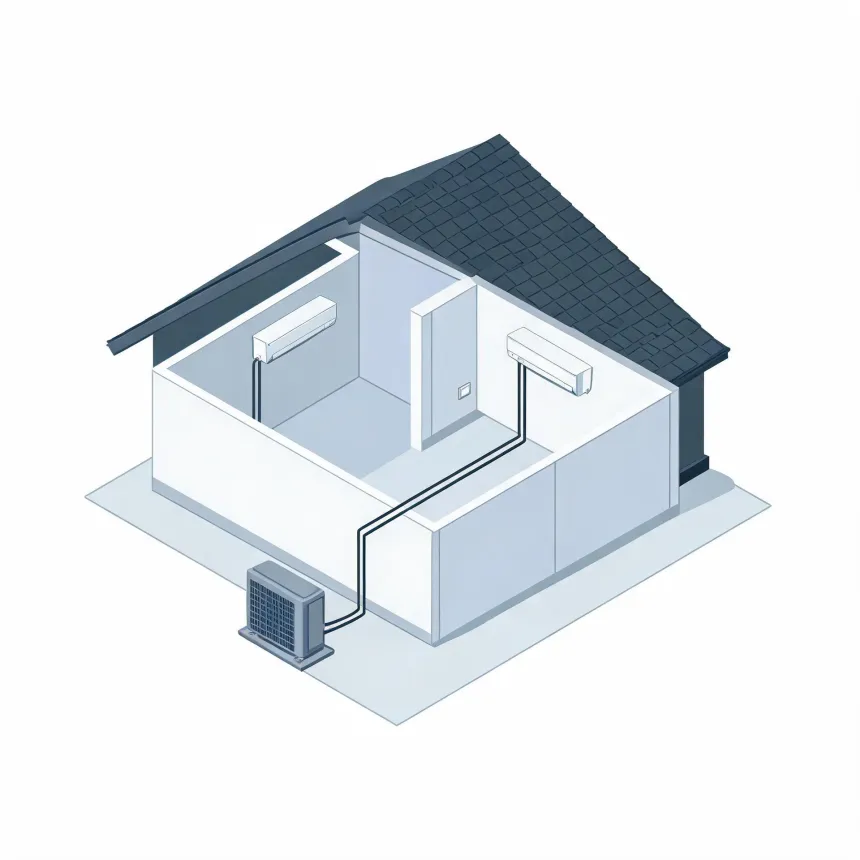
Isometric cutaway illustration of a small house with a dark shingled roof, showing two wall-mounted indoor air conditioning units in separate rooms connected by lines to an outdoor condenser unit on the ground outside.
Your system heats October through April and cools May through September.

NOAA nClimDiv, 1991–2020 normals

Half the homes in Marion County were built in 1973 or earlier.

A mini-split going into one of those houses has to match the house, not just the room it's cooling.

May starts cooling season here, so install before April is out

Cooling runs May through September
Climate zone 4A
Power here costs 17.22 cents per kilowatt-hour

Gas heats 52.5% of homes in Marion County, more than any other fuel, with electric furnaces and heat pumps covering most of the rest. A mini-split doesn't replace that gas furnace. It works alongside it, handling cooling in summer and taking some of the load off the furnace in the shoulder months when it doesn't make sense to fire up the gas. Some homeowners run the mini-split for heat too, down to whatever temperature the unit is rated for, and let the furnace cover the coldest stretches of winter. Either way, the furnace stays as backup, so the mini-split gets sized for the room or zone it serves, not the whole house.

Match the unit to your rate before it goes in, not after

Get the efficiency rating matched to your home now, and it sets what you pay on every bill for as long as the unit runs. Get it wrong and the rate works against you every month after. This is the one step in the job worth getting right before the install, not after.

Find a contractor
A man in a navy shirt, tan work pants and a cap, seen from behind, climbs porch steps toward a dark teal front door while carrying a canvas tool bag.
A white mini-split air conditioner outdoor condenser unit mounted on metal brackets against a beige stucco exterior wall, with a blue sky and scattered clouds in the background.

This runs for years in a house older than the unit itself

Half the homes in this county were built in 1973 or earlier. A mini-split going into a house that old is going in years after the walls, windows and whatever insulation is behind them were already decided. None of that was built with this system in mind. A contractor sizing the unit has to work from what's actually in the room or zone it will serve, not a square footage estimate, which means measuring the space rather than guessing at it. A unit sized wrong runs longer than it needs to just to hold a temperature, and every one of those extra hours shows up on the power bill.

A unit too big still runs up your bill

An oversized mini-split cools the room fast, shuts off, then starts again a few minutes later. It never runs long enough to pull moisture out of the air, so the room feels cool but damp. All that stopping and starting is also when the compressor draws the most power and wears the hardest. Bigger isn't the safe choice here. It's just a different way to spend more.
The load calculation is the actual job

Getting the size right means a contractor works out the heat gain and heat loss for the specific space, the windows, the exterior walls, the ceiling height, what's on the other side of each wall. That's a room by room or zone by zone calculation, not a chart matched to square footage. Skip it and you're guessing at the one number that decides how the unit runs every day after it's installed.

The efficiency rating on a mini-split is a ratio, not a fixed amount of power. It tells you how much heating or cooling the unit produces for the energy it draws, measured across a season of use rather than at one moment. A higher rated unit does the same work with less electricity, every hour it runs. That rating is tested across a range of outdoor temperatures, so it reflects the swing a unit actually sees over a year, not just mild conditions. Two units can look the same size on paper and carry different ratings, and the one with the lower rating will cost more to run every month it's in use, for as long as it's in the house. The rating is also not something a contractor can fix after the unit is mounted. It comes from the compressor and coil design inside that specific model, so the only point where it matters is before the unit is chosen.

Marion County falls in climate zone 4A, which the energy code treats as mixed: real heat to deal with in summer, real cold in winter, and humidity working against you most of the year. A mini-split sold for installation here has to meet the federal minimum for that kind of equipment, 14.3 for cooling and 7.5 for heating under the current standard, measured the same way across every brand. That floor applies whether the unit is a single room head or a multi-zone setup. Anything below it can't be sold as new for this use, so the comparison between units starts above that line, not at it. A system that clears the minimum by a wide margin may also qualify for a federal tax credit, worth checking against the specific model before you buy.