





A white wall-mounted split-system air conditioner on a blue-grey wall, with a full moon visible through a curtained window at night.

Mini Split Installation in Champaign, IL

Tell us about the job

Takes about a minute. No obligation.

New system or replacementMini-splitChampaign County, IL
Step 1 of 2

What ZIP code is the job in?

Champaign County saw 317 severe weather events between 2015 and 2024. Most of that was wind, 223 events, with 70 hail events and 13 tornadoes mixed in. An outdoor condenser sits outside year round, so it takes whatever comes through, hail dents on the housing, debris against the fan blades, wind-driven branches. Winter storms hit less often, 11 times in that same stretch, but ice and heavy snow are their own problem for a unit mounted outside. Across Illinois, 16% of households lost power for a day or more in 2024. A mini split with no backup plan for that stops heating and cooling right when the weather outside is the reason you need it most.

8 months
October through May, your system heats
4 months
June through September, it cools
21°F
the average winter night it heats against
84°F
the average summer afternoon it cools against
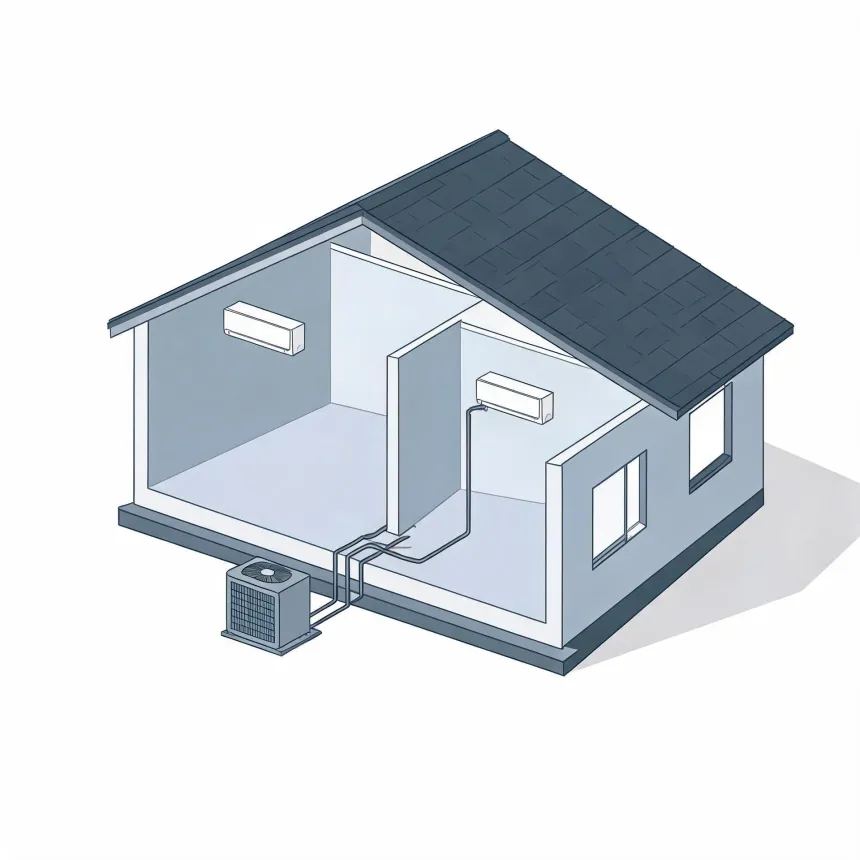
Isometric cutaway illustration of a small house with a dark shingled roof, showing two wall-mounted indoor units connected by lines running to an outdoor condenser unit beside the building.
Your system heats October through May and cools June through September.

NOAA nClimDiv, 1991–2020 normals

Cooling starts in June here and runs through September.

Get a mini split installed in May and it's already proven before the first hot week hits.

Electricity here runs 17.53 cents a kilowatt-hour, and this machine will run on it for years

Power here costs 17.53 cents per kilowatt-hour
Cooling runs June through September
Summer afternoons average 84°F
Most homes here still heat with gasGas heats 54.2% of homes in Champaign County, electricity heats 40.6%

Champaign County falls in climate zone 5A, a cool zone where the heating load matters more than the cooling load. Any mini split heat pump installed here has to clear the federal minimum for that: at least 7.5 Btu of heat moved for every watt-hour it uses over a winter, and at least 14.3 on the cooling side. That standard applies to units built from January 2023 on, and it covers ductless systems the same as any other split system, there's no separate, looser bar for them. A unit that clears the minimum on paper still has to be sized for this heating load specifically, not just dropped in because it fits the wall. There's also a federal tax credit available for qualifying heat pump installations, worth checking against the system a contractor proposes before you sign off on it.

Plan the install around the weather it'll have to survive

Ask about where the outdoor unit will sit before install day. A spot with some cover from wind and falling branches beats one that takes the weather head on. Ask too what happens to heat and hot water if the power drops. That's a install-time decision, not something to work out after a storm already knocked the power out.

Find a contractor
A man in a cap, navy T-shirt and brown work pants, seen from behind, carries a worn canvas tool bag up steps toward a dark teal front door beside a potted shrub.
A white mini-split air conditioner outdoor condenser unit mounted on metal brackets against a beige stucco exterior wall, with a blue sky and scattered clouds in the background.

What You're Really Paying For

A mini split installation is really two jobs, not one. There's the equipment itself, the outdoor unit and the indoor head or heads, and there's everything that connects them: the line set carrying refrigerant, the wiring, the condensate drain, the wall penetration, the mounting. Most of what separates a straightforward job from a hard one lives in that second part. A short, simple line set run through an easy wall costs less labor than one that has to travel up a floor, around corners, or through brick. Multiple indoor heads off one outdoor unit means more line sets, more wiring, more places for something to need doing right. The outdoor unit's mounting matters too, a wall bracket is a different job than a ground pad, and either has to hold the unit level and steady for as long as it runs. None of this shows up when you're just comparing the sticker price of one unit against another. It shows up in the labor, in how many hours the job actually takes once someone's on site looking at the walls and the layout, not a brochure.

Sizing comes from a room by room heat loss and heat gain calculation

A mini split is sized by working out how much heat each room loses in winter and gains in summer, based on its windows, walls, and exposure, not by matching the square footage on a listing. That calculation decides the capacity of the outdoor unit and of each indoor head. Skip it and the sizing is a guess.
A unit that's too big or too small both cause problems

An oversized mini split cools or heats the room fast, then shuts off before it pulls the moisture out of the air, so the room feels cool but damp. An undersized one runs constantly and never quite catches up on the coldest or hottest days. Either way the compressor cycles more than it should, and that wears it down faster than steady, correctly sized operation would.

Pulling out an old system is its own job, separate from hanging the new one. If the house is replacing ducted central air or an old window unit, that equipment gets disconnected and hauled off, and the refrigerant inside has to be recovered properly rather than vented, that's true of any system carrying refrigerant. If a window unit stays in a different room as backup, it can usually just stay there, a mini split doesn't need it gone to work. Old wall sleeves or abandoned line sets from a prior system sometimes get left behind in a house, and whoever's running the new line set will want to know about them before cutting a fresh wall penetration. None of this is hard, but it's work that happens before the new unit goes up, not after.

Summer here means four months of real cooling load, June through September, with afternoon highs averaging 84°F and a dew point around 64°F that makes the air feel heavier than the number alone suggests. That's the cooling side. Zone 5A puts the bigger load on winter, and this machine has to clear both jobs without a break between them. A unit sized off a square footage chart might keep up on a mild afternoon and still fall behind on a muggy one, running long and never quite pulling the moisture down. Buy on the lowest bid and you're often buying the unit that skipped the room by room calculation to get there. The one that's sized right costs what it costs, and it's the one still working the way it should a few summers in.