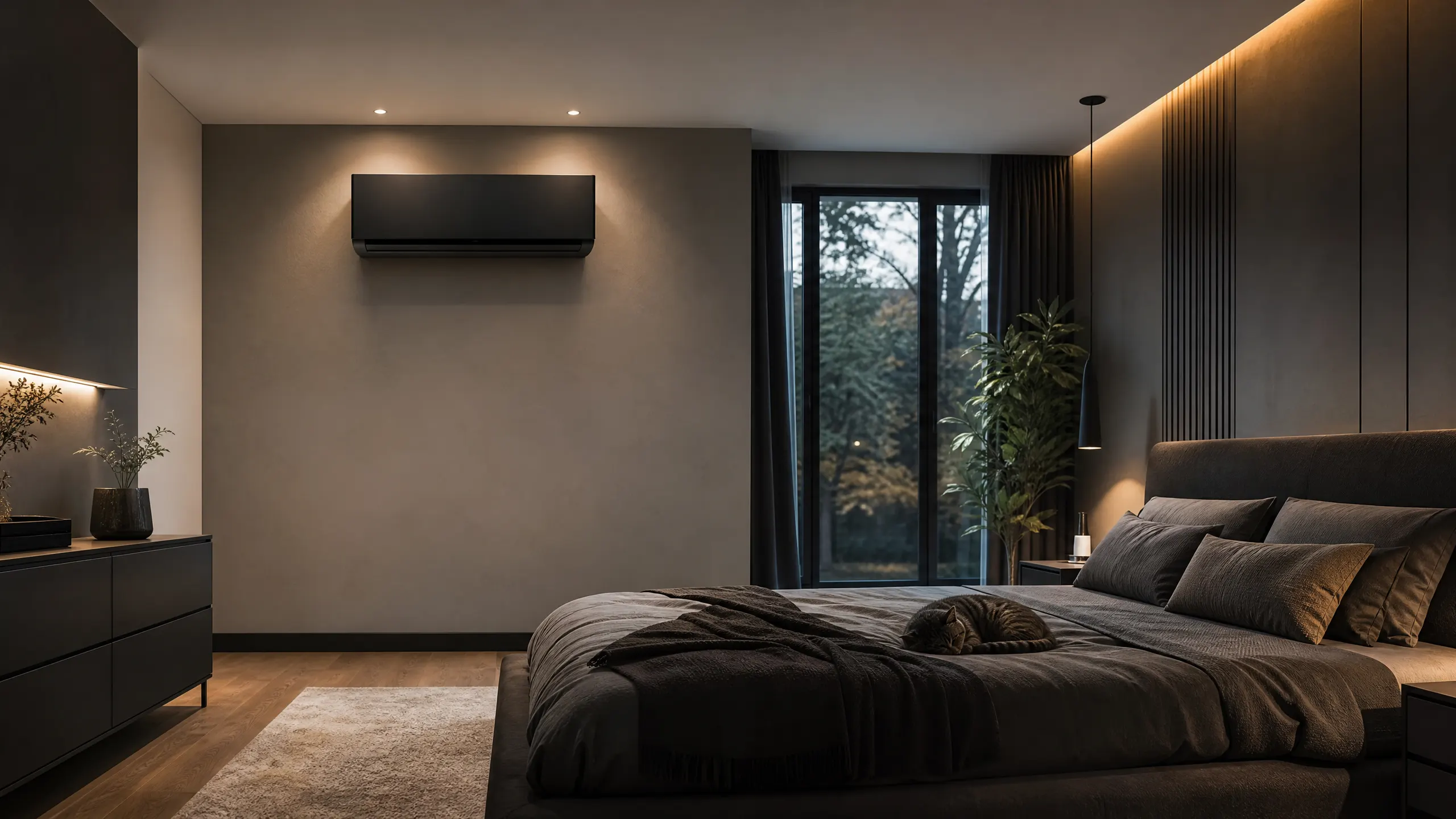





A dark, minimalist bedroom with a king-size bed, wall-mounted air conditioning unit, and large windows, with a cat sleeping on the duvet.

Mini Split Installation in Crystal Lake, IL

Tell us about the job

Takes about a minute. No obligation.

New system or replacementMini-splitMcHenry County, IL
Step 1 of 2

What ZIP code is the job in?

Gas heats 85 percent of homes in McHenry County, and most of those furnaces push air through ductwork already in place. A mini split doesn't need any of that. It runs its own line to each head, so it works as a way to cool or heat a room that your ducts never reached well, or to cover an addition without opening up the furnace system to feed it. Some homeowners add one or two heads alongside the furnace they already have. Others use a multi-zone system as the only heating and cooling in a space that was never on ductwork at all.

8 months
October through May, your system heats
3 months
June through August, it cools
17°F
the average winter night it heats against
81°F
the average summer afternoon it cools against
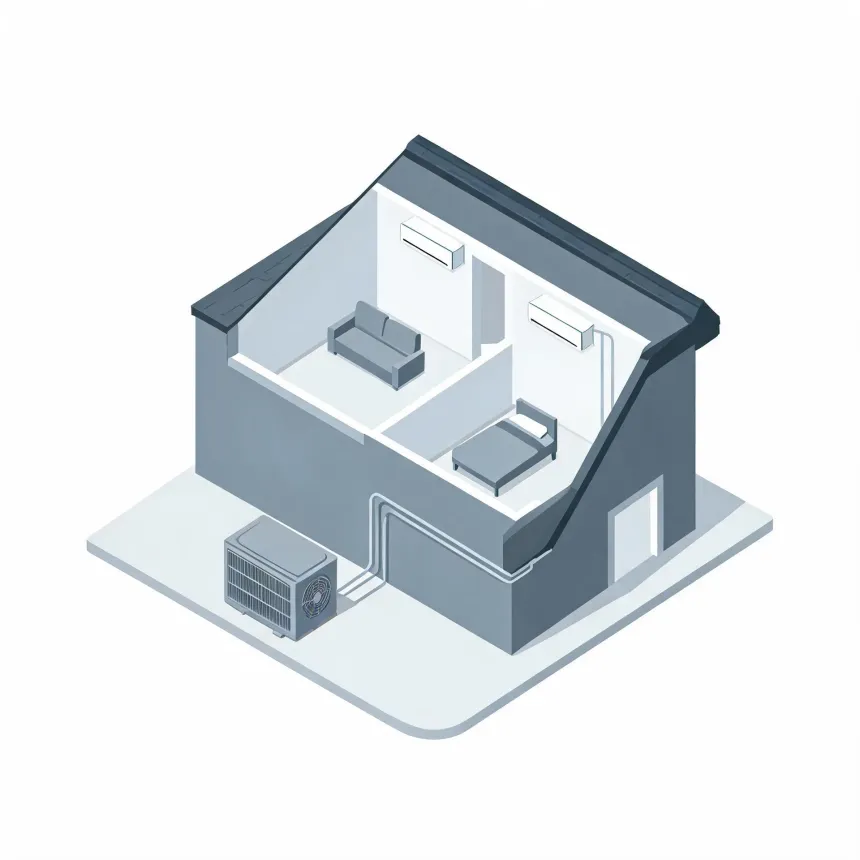
Isometric cutaway illustration of a two-room house showing two wall-mounted indoor air conditioning units connected by line sets to an outdoor condenser unit on the ground outside.
Your system heats October through May and cools June through August.

NOAA nClimDiv, 1991–2020 normals

A mini split's rated capacity doesn't change with electric rates here.

Sizing it to the room instead of oversizing it is what keeps the kilowatt-hours down.

Three months of summer, nothing here that calls for more than a standard mini split

Cooling runs June through August
Summer afternoons average 81°F
140 damaging wind events from 2015 to 2024
Crystal Lake cools three months a yearCooling starts in June. Installed before May is out, it's ready, not rushed.

Crystal Lake falls in climate zone 5A, a cool zone where winter heating matters more than summer cooling. Any mini-split heat pump sold here new has to meet the same federal minimum as every other split system, 14.3 SEER2 for cooling and 7.5 HSPF2 for heating. There's no separate, lower bar for ductless equipment. That HSPF2 number is what matters most in a zone like this, since the unit will spend more of the year heating than cooling. A system that clears the minimum qualifies for the federal efficiency tax credit, worth checking into before you settle on a model.

Standard equipment, sized right, is what this job calls for

McHenry County sees its share of wind, hail and winter storms, but none of that changes what a mini split needs to be. The equipment that meets the federal minimum here is built for weather like this already. Get the sizing right for the room and a standard system holds up fine.

Find a contractor
A white outdoor air conditioner condenser unit mounted on metal wall brackets against gray horizontal siding, with a blue sky and white clouds behind it.

The label is a ratio, not a size

SEER2 and HSPF2 are both ratios. Divide the output a system produces over a season by the electricity it takes to make it, and that's the number on the label. A higher number means more heat or cooling out for the same power in. It says nothing about how big a system is or how fast it can cool a room, only how much it costs in electricity to do what it does. Systems can heat the same space equally well and still land far apart on the label, because one is throwing away less power as waste. That rating holds as long as the system is sized to the space and installed the way the manufacturer means it to run. Oversize it, undersize it, or let the refrigerant charge drift from spec, and the real number on your power bill stops matching the one on the label.

Ask what the room load calculation found

A contractor should size each head to the room it serves, not guess from square footage alone. Window area, insulation and what's on the other side of the walls all change the number. If nobody mentions running a load calculation, ask why not.
Ask how many heads one outdoor unit will run

A multi-zone outdoor unit splits its capacity across every indoor head connected to it. Loading too many heads onto one outdoor unit can leave each one short of what it needs on the coldest or hottest days. Find out if the system is sized for the heads it has now or if more will get added later.

Sizing a mini split starts with the room, not a rule of thumb. A contractor works out how much heat the room loses in winter and gains in summer, looking at window area, insulation, ceiling height, and what's on the other side of each wall. That number tells them which head to put in, measured in BTUs. Go too big and the unit short-cycles, blasting the room to temperature and shutting off before it finishes pulling moisture out of the air, so the space feels clammy even when it's cool. Go too small and it runs flat out on the coldest or hottest days and still can't keep up. The right size is the one that runs long, steady cycles most of the time, which is also what keeps the compressor lasting as long as it's built to.

Installation starts outside, with the outdoor unit set on a pad or wall bracket somewhere it can pull in air and drain condensate without freezing up on the coldest days. From there a technician runs a line set, the refrigerant lines and the drain line, through a small hole drilled in the wall to each indoor head. Each head gets mounted high on the wall or in the ceiling, leveled so condensate drains the way it's supposed to instead of pooling. Once everything's connected, the lines get pulled down to a vacuum to clear out moisture and air before any refrigerant moves through them. Skip that step and moisture left in the lines turns to acid over time, eating at the compressor from the inside. The last part is charging the system to the exact weight the manufacturer specs for that line length, then checking that each head is actually moving the air and hitting the temperature it's set to.