A modern bedroom with dark furnishings, a wall-mounted air conditioning unit, and a cat resting on a large bed.

Mini Split Installation in Decatur, IL

Tell us about the job

Takes about a minute. No obligation.

New system or replacementMini-splitMacon County, IL
Step 1 of 2

What ZIP code is the job in?

Electricity here runs 18.18 cents a kilowatt-hour

That rate is higher than what most US counties pay, and a mini-split runs on electricity alone. Every hour it runs to cool or heat the house, the meter is turning faster than it would somewhere with cheaper power.

The efficiency rating on the unit matters more here

A mini-split that wastes power costs a Decatur homeowner more than the same waste would cost somewhere with lower rates. The unit's efficiency rating is not a number to skim past when power itself costs this much.

7 months
October through April, your system heats
4 months
June through September, it cools
22°F
the average winter night it heats against
84°F
the average summer afternoon it cools against
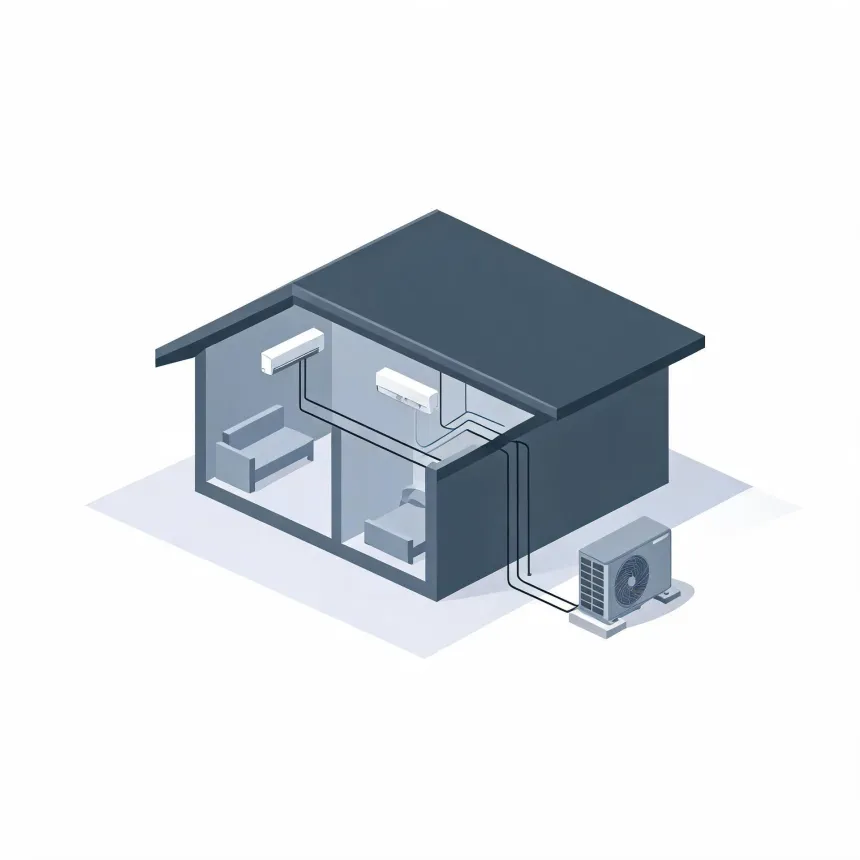
Isometric illustration of a cutaway house showing two wall-mounted mini-split indoor units connected by line sets to an outdoor condenser on a pad outside.
Your system heats October through April and cools June through September.

NOAA nClimDiv, 1991–2020 normals

Cooling starts in June here, and most homes run it through September.

Get the mini-split in before May ends, and the first hot week finds a system already running, not one still waiting on a crew.

Most of Decatur heats with gas, and that changes what a mini-split's job is

73.5% of homes heat with gas
Cooling runs June through September
Summer afternoons average 84°F
Half this county's homes were built in 1964 or earlierAn older home doesn't move air the way a new one does, and the mini-split installed has to account for that.

Macon County falls under zone 5A, a cool, humid climate where heating carries the bigger load over the year. Any split-system heat pump sold new here, mini-splits included, has to clear federal minimums: at least 14.3 Btu of cooling delivered for every watt-hour it draws, and at least 7.5 Btu of heat for every watt-hour in winter. Those numbers set a floor, not a ceiling, and a contractor sizing a system for this county is already working above it. A unit that barely clears the minimum will cost more to run than one built well past it, especially with power priced the way it is here. Ask what rating the installer is quoting before you ask about the install itself.

The rating you ask for now is the one you'll live with on every bill

That efficiency rating only pays off once the unit is in and running. Get the installer's rating quoted up front, before the work starts, and you know what every bill after that will look like.

Find a contractor
A beige split-system air conditioner outdoor condenser unit mounted on metal wall brackets atop a stucco wall.

An older house needs a system sized to it, not to a chart

Half the homes in this county went up in 1964 or earlier. If that's the house you're in, don't let an installer size the new unit off a square footage chart alone. Ask them to size it to the house, the windows you have, where the sun hits, what's done and hasn't been done to it over the years. A mini-split sized for a generic house will run wrong in a specific one, long or short, and either way you pay for the mismatch every month it runs.

Two numbers on one label, not one

The label lists a cooling rating and a heating rating, and a mini-split is judged on both since it runs both ways. A unit can carry a strong cooling number and a weak heating one, or the other way around. Look at both before deciding, not just whichever one the brochure leads with.

The rating assumes the unit is sized and set up right

That number is measured under fixed lab conditions, with the system matched correctly to begin with. Oversize the unit for the room or get the refrigerant charge wrong, and it stops hitting that number no matter what the label says. The rating is only as good as the install behind it.

A mini-split lives or dies on a few questions most buyers never ask. Start with how many zones the system actually supports and whether the outdoor unit can run all of them at once, at full output, or starts choking the farthest one when the others call for heat or cool. Ask what happens at low temperatures. Not every heat pump holds its rated output once the air outside drops, and a unit that quietly cuts its heating capacity in half on a cold night will have you reaching for backup heat. Ask how the line set is run and how long it is, since longer runs and more joints lose efficiency and give refrigerant more places to leak. Ask what the warranty covers, parts versus labor, and whether it depends on the installer being certified by the manufacturer, because some coverage disappears if they aren't. And ask who sizes the system and how. A unit picked off a chart without a load calculation is a guess wearing a label.

Installation starts with the load calculation already done and the equipment already chosen, so the first work on-site is placing the outdoor unit. It needs clearance on all sides and a path for the line set to reach each indoor head without too many bends. Mounting the indoor units comes next, usually high on a wall or in the ceiling, each one positioned to throw air across the room rather than into a corner. Then the installer drills through the wall for the line set, the refrigerant lines, power wire and condensate drain bundled together and run to the outdoor unit. Once everything is connected, the system gets evacuated with a vacuum pump to pull out moisture and air before any refrigerant moves, a step that protects the compressor more than almost anything else done that day. Only after the vacuum holds does the installer open the valves, charge the line if needed, and power it on to check that every zone calls for heat or cool and responds.