
Electricity here runs 17.77 cents a kilowatt-hour
Woodford County pays more for power than most US counties. A mini-split runs on electricity alone, so every hour it works shows up on that same expensive rate.
Takes about a minute. No obligation.
Woodford County pays more for power than most US counties. A mini-split runs on electricity alone, so every hour it works shows up on that same expensive rate.
Two systems can cool the same house and cost very different amounts to run. In a county where the electric rate is already high, the difference between an efficient unit and a weak one shows up every month, not just at install.
NOAA nClimDiv, 1991–2020 normals
Gas heats 65.6% of homes in Woodford County, more than electric and propane combined.
Most homes here already have a gas furnace, so a mini-split usually goes in to handle cooling, not to replace the heat.




Woodford County falls under zone 5A in the 2021 energy code, a cool zone where heating is the bigger job over the year. Any mini-split installed here still has to clear the federal efficiency floor for split-system heat pumps: at least 14.3 Btu of cooling for every watt-hour it draws, and at least 7.5 Btu of heat for every watt-hour in winter, for units built from 2023 on. That rule applies everywhere, but it sets the floor on what a contractor can even offer you here. A unit that barely clears that line will cost more to run on a rate like this one than a unit built well past it.
The unit a contractor installs is the rate locked into every bill that follows. Power here already costs more than most places pay. Asking what a system clears, not just whether it clears the floor, is a question worth asking before the install, not after.
Find a contractorSizing a mini-split means a contractor measures the room, the windows, how the house holds heat, before picking a unit. That measurement matters more in a house built decades ago than in one built last year. Get it wrong in either direction and you pay for it on every bill after: too small and it runs flat out without keeping up, too big and it short cycles instead of settling in to run steady. Ask for that room-by-room measurement before you ask for a quote.
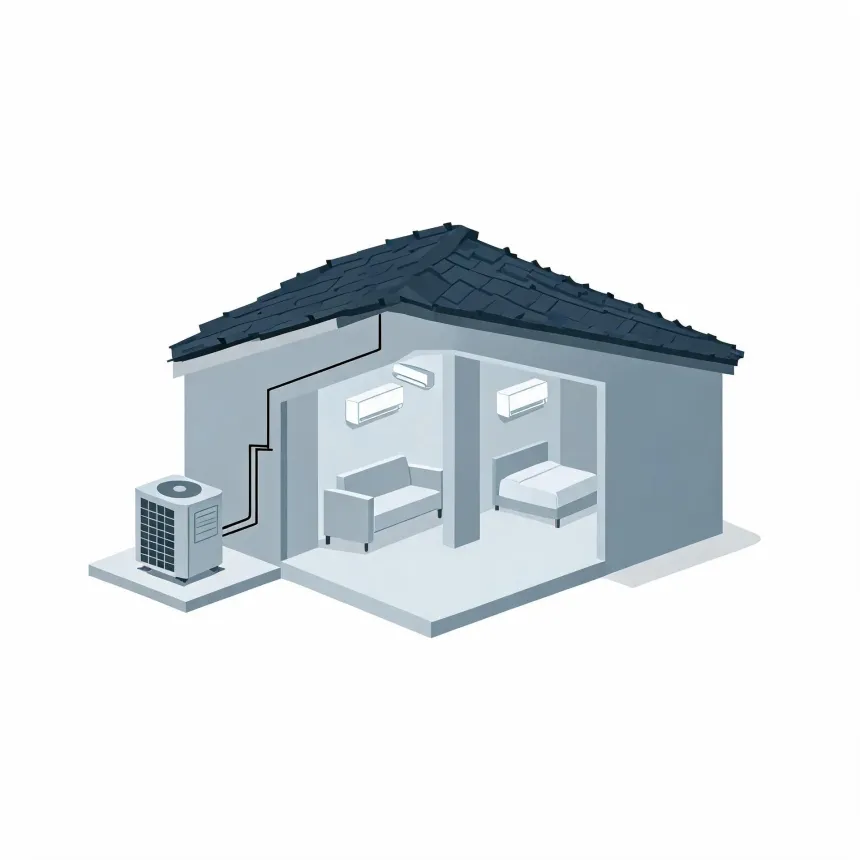
A mini-split needs a line set run between the outdoor unit and each indoor head, a hole through the wall for the refrigerant lines and wiring, and a condensate line that actually drains somewhere useful. Where the outdoor unit can sit, how far the lines have to travel, and how many walls get crossed all change what the job takes. A straight run through one wall is a different job than lines routed through a attic or down multiple floors.
One outdoor unit can often run several indoor heads, each one a separate zone with its own thermostat. That setup costs more up front than a single zone, but it means a bedroom and a living room aren't forced to share one setting. Deciding how many zones a house needs, and where each head goes, is part of what a contractor prices before anything gets mounted.
Comparing mini-splits means comparing more than the price on the quote. Ask what the unit's rated capacity is for both cooling and heat, since a heat pump has to be sized for the coldest stretch it will face, not just the hottest. Ask what sound rating the outdoor unit carries, because some condensers run noticeably louder than others at full output. Ask how the manufacturer handles parts and labor coverage, and for how long, since compressor problems years down the road cost far more without it. Ask whether the indoor head uses a variable-speed compressor or a single-speed one. A variable-speed system ramps up and down to match the load instead of switching fully on and off, which keeps the room steadier and puts less wear on the equipment over time.
Installation starts with the outdoor unit going on its pad or wall brackets, set level so the compressor inside isn't running at an angle once it's working. Next comes the hole through the wall, cut just big enough for the line set, the drain line, and the wiring to pass through together. The line set connects the indoor head to the outdoor unit, and before any refrigerant moves through it, the whole system gets pulled down to a vacuum. That step pulls out moisture and air, because either one left in the lines can damage the compressor once it starts running. Once the lines hold vacuum, the system gets charged, the indoor head gets mounted and leveled, and the contractor runs it through both cooling and heat to check that every zone responds the way it should.