Electricity here runs 17.71 cents a kilowatt-hour
Knox County pays more for power than most US counties. A mini-split runs on electricity for both heating and cooling, so that rate applies every time it cycles on, not just in summer.

Takes about a minute. No obligation.
Knox County pays more for power than most US counties. A mini-split runs on electricity for both heating and cooling, so that rate applies every time it cycles on, not just in summer.
A 63°F dew point through June, July and August is heavy air. A mini-split has to pull more moisture out of it to cool the room, and that extra work shows up as extra kilowatt-hours at that rate.
NOAA nClimDiv, 1991–2020 normals
Gas heats 67.4% of homes in Knox County.
A mini-split installed here usually isn't replacing that furnace. It takes on the cooling load, and often a room or two the furnace never kept comfortable.




Knox County sits in zone 5A, a cool, humid climate where heating carries the bigger load over a year. Any mini-split installed here falls under the same federal rule as other split-system heat pumps. Built on or after January 1, 2023, it has to remove at least 14.3 Btu of heat for every watt-hour it draws when it's cooling, and deliver at least 7.5 Btu of heat for every watt-hour when it's heating. That's a floor. Some units on a quote will clear it by a little, some by a lot, and that difference is worth asking about. A federal tax credit is available for equipment that qualifies, on top of whatever the efficiency itself saves.
Power here costs more than in most places, and a mini-split runs on electricity for every degree it heats or cools. The federal minimum efficiency is a floor, not a target, and some units on a quote clear it by a lot more than others. Ask for the efficiency numbers on each option before deciding.
Find a contractorA mini-split installation usually starts with a decision about the old equipment, whatever that happens to be. A window unit or a through-wall sleeve just gets pulled out and the opening gets patched or re-sided. If there's a central system being replaced alongside the new mini-split, the old condenser outside gets disconnected and hauled off, and the refrigerant in it has to be recovered into a tank rather than vented, because that's how refrigerant handling works regardless of who's doing it. Old line sets usually aren't reused. They're sized and charged for a different unit, and corrosion or contamination inside a line that's been sitting can carry straight into the new compressor. A new line set gets run even when the path is the same path. If ductwork is coming out because nothing will use it anymore, that's its own job, separate from the mini-split going in, and it doesn't hold up the install. None of this changes how the new system gets sized or placed. The old equipment's removal and the new equipment's installation are two different jobs that happen to share a day.
A mini-split carries a cooling rating and a heating rating, and they're not the same number. One tells you how it performs pulling heat out of a room, the other how it performs putting heat into one. A unit that's strong on one side can be average on the other. Ask for both before comparing anything else on the quote.
That efficiency number is measured on equipment matched to the space it's cooling and heating. Oversize the unit and it short cycles, shutting off before it pulls moisture out of the air, then starting again. Undersize it and it runs flat out trying to catch up. Either way the unit on the wall can carry a high rating and still cost more to run than it should, because the rating was never tested under those conditions.
Sizing a mini-split starts with a heat loss and heat gain calculation on the actual room, not a rule of thumb based on square footage. A tech measures the walls, the windows, the insulation, which way the room faces, and what's on the other side of each wall, then works out how much heat that room loses in winter and gains in summer. That number is what the equipment needs to match. An undersized unit runs constantly and never quite catches up on the hottest or coldest days. An oversized one cycles on, satisfies the thermostat fast, and shuts off before it's pulled the moisture out of the air, so the room feels cool but clammy. Bigger isn't safer here. The unit has to be sized to the room it's actually serving, not rounded up for peace of mind.
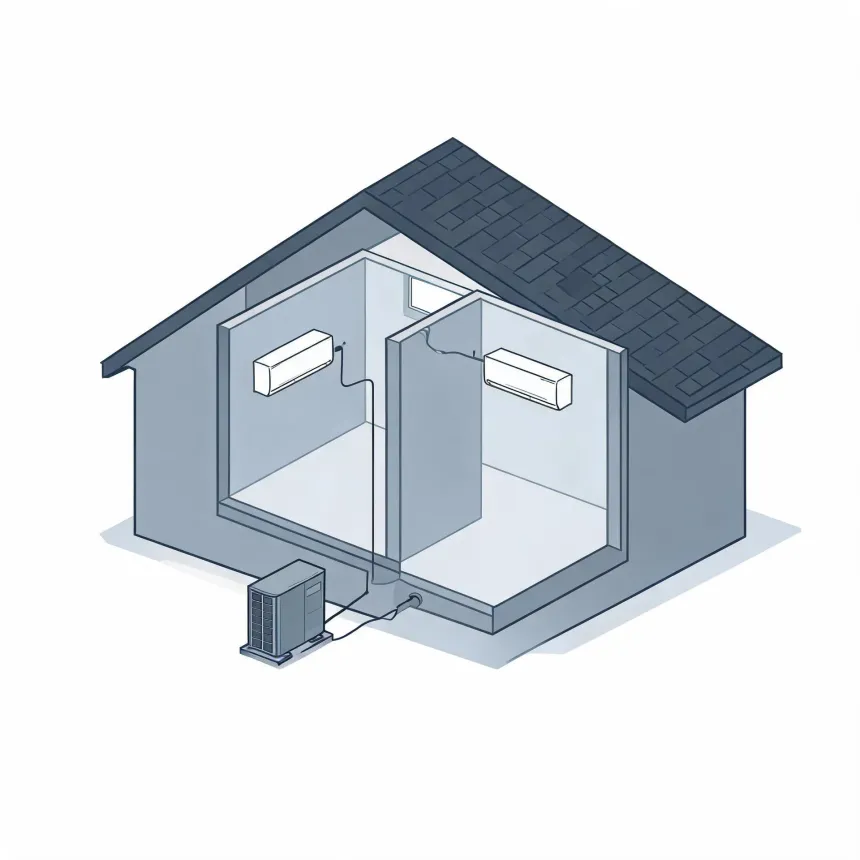
Installation day starts with the spot the indoor unit is going to hang, not the box it comes in. A tech runs a line set from that spot to wherever the outdoor unit will sit, carrying refrigerant lines, a condensate drain, and electrical wiring, usually through one hole drilled in the wall. That hole gets sealed once the lines are through it. The outdoor unit sits on a pad or brackets, leveled, with clearance around it so air can move through the coil. Once both units are set, the lines get connected, and the system is evacuated with a vacuum pump to pull out air and moisture before any refrigerant goes in. That step matters more than people expect, because trapped air or moisture in the line set will wear on the compressor for as long as the system runs. After that it's charged to the manufacturer's spec, tested under both heating and cooling, and checked for leaks at every fitting.