





A lit residential street at dusk featuring large two-story brick houses with glowing windows, mature trees, and a street lamp.

Mini Split Installation in Kankakee, IL

Tell us about the job

Takes about a minute. No obligation.

New system or replacementMini-splitKankakee County, IL
Step 1 of 2

What ZIP code is the job in?

Electricity in Kankakee County runs 18.08 cents per kilowatt-hour, more than what most counties in the country pay. A mini-split is still an electric load, so that rate applies every time it kicks on. Summer here adds another cost. The dew point averages 63°F across June, July and August, heavy enough that a system spends real effort pulling moisture out of the air, not just cooling it. That work shows up on the meter alongside the cooling itself. A unit that handles both jobs well costs less to run than one that doesn't, and at this rate the gap between them is worth knowing before you buy.

8 months
October through May, your system heats
3 months
June through August, it cools
20°F
the average winter night it heats against
83°F
the average summer afternoon it cools against
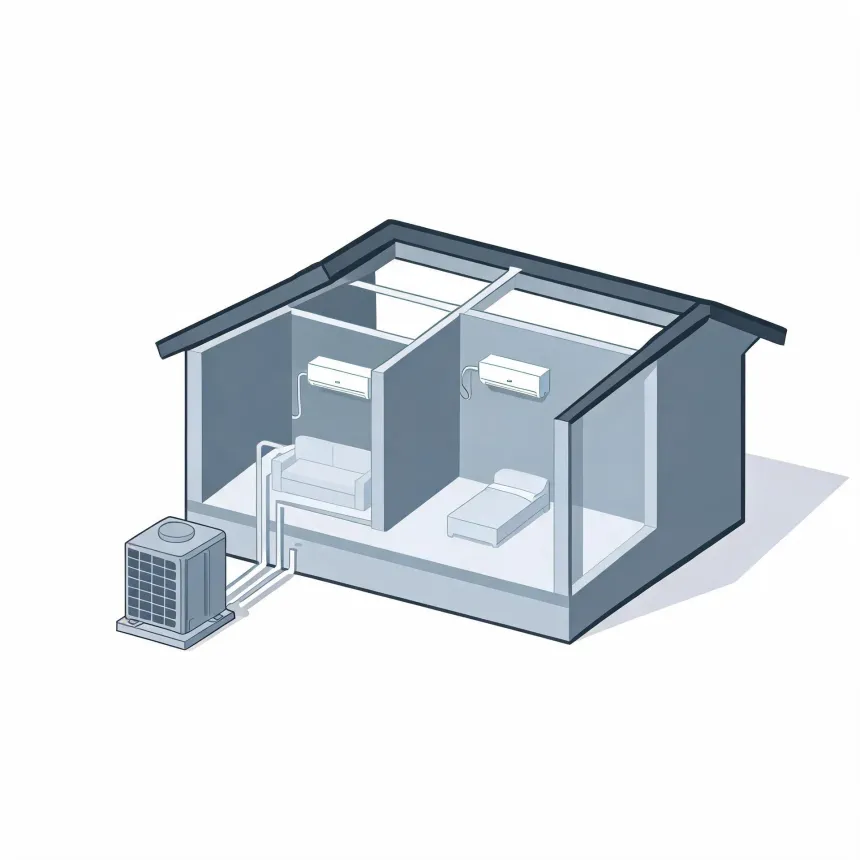
Illustrated cutaway of a two-room house showing two wall-mounted indoor air conditioning units connected by pipes to an outdoor condenser unit on the ground outside.
Your system heats October through May and cools June through August.

NOAA nClimDiv, 1991–2020 normals

Most homes in Kankakee County heat with gas, 77.1 percent of them.

A mini-split still handles the cooling load and often takes on some of the heating too, so it runs alongside that gas furnace rather than replacing it.

Get it installed before June, not during a heat wave

Cooling runs June through August
Summer afternoons average 83°F
99 damaging wind events from 2015 to 2024
Built for an Older HouseHalf the homes in Kankakee County went up in 1972 or earlier, and a mini-split has to work with the house it's going into.

Kankakee County falls under climate zone 5A, a cool zone where the heating load matters as much as cooling, maybe more. Any mini-split heat pump installed here has to meet the federal minimum for that category, a split system rated at least 14.3 for cooling and 7.5 for heating. That's not a target, it's the floor. Contractors won't install below it because the units aren't sold that way anymore. On top of that, a mini-split that clears the efficiency bar may qualify for a federal tax credit, worth looking into before the purchase instead of after.

Pick the system that costs less to run, not just less to buy

The upfront price is only part of it. Power here costs more than in most places, and a mini-split draws on it every time the compressor kicks on. A unit with a higher efficiency rating costs less to run over the years you own it. Worth checking that rating before you settle on a system.

Find a contractor
A white outdoor air conditioner condenser unit mounted on metal wall brackets against gray horizontal siding, with a blue sky and white clouds behind it.

Running for Years, in a House That's Already Decades Old

A system installed now should run for years, through summers and winters alike, in the house as it actually stands. In a house built in 1972 or earlier, that means working with an electrical panel and wall layout that were never planned around a mini-split. The line set has to get from the indoor head to an outdoor unit, and the shortest path on paper isn't always open in the wall. A contractor who walks the house before quoting the job can see that, a contractor who quotes over the phone can't.

The Old Equipment Doesn't Just Unplug

Whatever's heating or cooling the space now, whether it's a window unit, electric baseboard or an older ductless system, it has a power connection, maybe a dedicated circuit, and if it's a heat pump or AC, a line set carrying refrigerant. That refrigerant has to be recovered, not vented, before anything gets disconnected. It's part of the job, not an afterthought.
What's Left Behind Can Shape the New Job

An old wall sleeve, an abandoned circuit, a line set run through a wall that no longer fits where the new unit needs to go. Some of it can be reused. Some of it has to come out before the new system goes in. A contractor who sees what's actually there before quoting can tell you which is which.

Sizing a mini-split is not about matching the room's square footage to a number on a brochure. A contractor works out a heat load calculation, room by room, weighing the windows, the insulation, the ceiling height, which way the walls face. Too big and the unit short cycles, blasting cold air until the thermostat's satisfied, then shutting off before it's pulled the humidity out of the room. That leaves the space feeling clammy even at the right temperature. Too small and it runs flat out on the hottest and coldest days, never quite catching up, wearing itself out trying. The right size runs long, steady cycles instead, which is what actually keeps a room comfortable and keeps the compressor from working harder than it has to. A contractor who skips the load calculation and sizes off square footage alone is guessing, and the homeowner is the one who lives with the guess.

Installation day starts with the outdoor unit and the indoor head going up, but most of the time goes into the line set between them. That line runs through a wall, carrying refrigerant lines, a drain line and electrical wiring together, so the hole gets drilled first and everything gets fished through before either unit is mounted for good. Once both ends are in place, the technician pulls a vacuum on the line set to clear out air and moisture, because either one left inside will foul the refrigerant charge later. That vacuum has to hold steady for a stretch before the system gets charged and switched on, which is the part that can't be rushed without risking the compressor. After startup, the technician checks refrigerant pressure, tests the thermostat or remote, and confirms the condensate drain is actually carrying water out rather than pooling somewhere it shouldn't. The unit should be blowing at the right temperature and holding it before anyone calls the job done.