Electricity here runs 15.87 cents a kilowatthour
Illinois households paid that rate in 2024. A mini split is still an electric load, and that price applies to every hour it runs.
Takes about a minute. No obligation.
Illinois households paid that rate in 2024. A mini split is still an electric load, and that price applies to every hour it runs.
Two systems billed at the same rate can still leave you with different bills, because one moves heat with less power than the other. In Morris, that gap shows up every month, not once.
NOAA nClimDiv, 1991–2020 normals
Cooling starts in June here.
Get the mini split installed by May and it's running before the first hot week, not behind it.




Grundy County is in zone 5A under the 2021 energy code. That's a cool zone, where heating carries more of the load than cooling does. Any mini-split installed here has to meet the federal minimum for a split-system heat pump, which is 14.3 SEER2 for cooling and 7.5 HSPF2 for heating. The standard doesn't treat ductless systems as a separate class, so that minimum applies whether the system has ducts or not. A unit rated below it can't go into a new installation. A federal tax credit is also available toward a qualifying system.
Get the SEER2 rating in writing before you choose a system. At 15.87 cents a kilowatthour, that number follows you onto every bill for as long as you run it.
Find a contractorSizing a mini split comes down to matching the indoor unit's output to the heat loss and heat gain of the room it serves, not the square footage alone. A contractor works this out room by room, factoring in window area, insulation, ceiling height and how many exterior walls a room has. Oversize it and the unit short cycles, reaching the set temperature fast and shutting off before it's pulled any moisture out of the air, so the room feels cool but damp. Undersize it and the compressor runs flat out and still can't keep up on the coldest or hottest days. Either mistake shortens the life of the compressor, since it's the part doing the most cycling or the most strain. A correctly sized system spends most of its time running at a low, steady output rather than switching on and off or maxing out, and that steady load is what the compressor is built for.
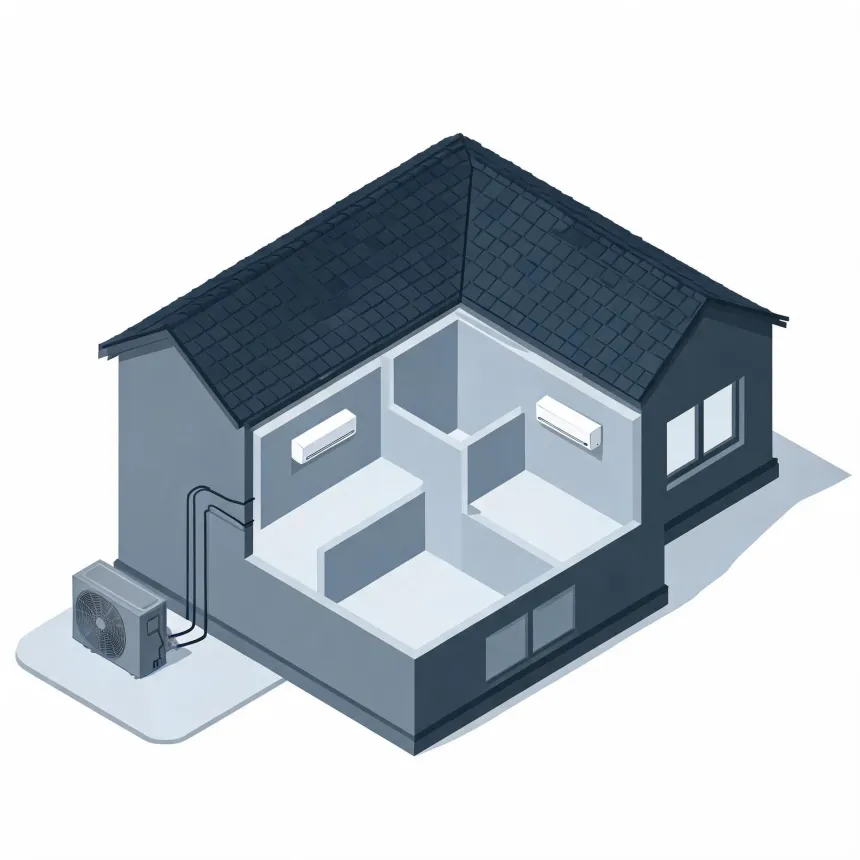
An outdoor unit can carry a single indoor head or several. Multi-zone systems split capacity across every head running at once, so zones calling for heat or cooling at the same time share one compressor's output. Ask whether the system is single-zone or multi-zone, and if it's multi-zone, how the manufacturer rates performance when every zone runs together.
Compressor and parts coverage on a mini split usually depends on the system being installed and maintained by someone licensed, with proof kept on file. Some manufacturers also want the outdoor unit registered within a set window after installation, or the coverage drops to a shorter default term. Ask what the warranty covers, what voids it, and who is responsible for registering it.
The old system doesn't have to come out before the new one goes in. On a straightforward swap, a contractor can run the new lines and set the new indoor and outdoor units, then deal with removal after. If the old system is a window unit or portable AC, it just gets disconnected and hauled off. If it's a central system being replaced by mini splits, the old air handler, condenser and any abandoned ductwork come out, and the refrigerant in that old system has to be recovered properly rather than vented. Whatever's left behind, like an old line set or an electrical disconnect, either gets reused if it's in good shape or capped off so nothing's live or open to the weather.
The equipment is one line on the invoice, not the whole number. Most of the cost is the work around it. A contractor has to run new line sets between the outdoor and indoor units, set a condensate drain that actually slopes to daylight, and wire a dedicated circuit if the panel doesn't already have one free. A wall sleeve through masonry costs more labor than one through siding. Distance matters too. A long run between the outdoor unit and the farthest indoor head takes more refrigerant line, more time to insulate, and more time to seal than a short one. Add a second or third indoor head and you add another spot to mount, another line set to run, and another zone to wire in, even though they all still share one outdoor unit. None of that shows up until someone has actually looked at the walls, the panel and where the units need to go.