




A gray cat sleeps curled up on a dark-made bed in a moody, minimalist bedroom with a wall-mounted air conditioning unit and warm accent lighting.

Mini Split Installation in Oswego, IL

Tell us about the job

Takes about a minute. No obligation.

New system or replacementMini-splitKendall County, IL
Step 1 of 2

What ZIP code is the job in?

Gas heats 86.7 percent of homes in Kendall County, so most houses a mini-split goes into already have a furnace doing the work in winter. That changes what the mini-split is there for. Instead of carrying the whole house through the cold, it can handle the rooms the furnace struggles to reach, or take over cooling and the mild months while the furnace sits idle. Some setups switch the mini-split off once it gets cold enough outside that a heat pump loses its edge, and let the furnace take over from there. Electricity heats 9.7 percent of homes here and bottled or LP gas heats 2.7 percent, so a mini-split standing in as the only heat source is the less common case.

8 months
October through May, your system heats
3 months
June through August, it cools
19°F
the average winter night it heats against
83°F
the average summer afternoon it cools against
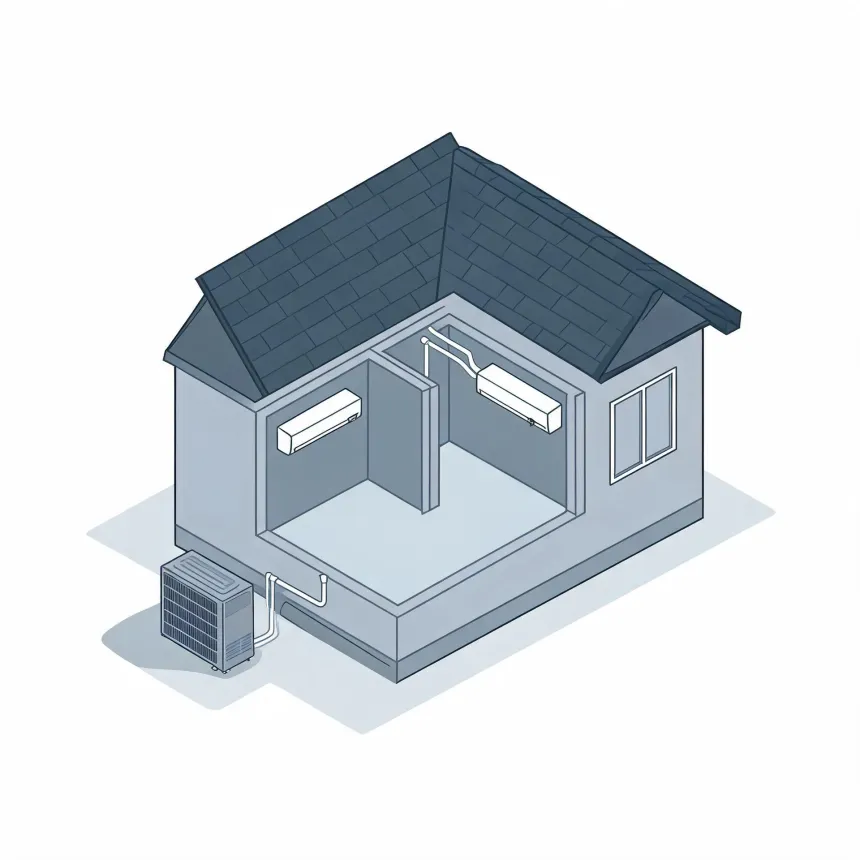
Isometric line illustration of a cutaway house with a shingled gable roof, showing two wall-mounted indoor air conditioning units connected by piping to an outdoor condenser unit on the ground outside.
Your system heats October through May and cools June through August.

NOAA nClimDiv, 1991–2020 normals

Cooling starts in June here and runs through August.

Get the mini-split in during May and the install happens on your timeline, not during the first hot week.

Weather here is rough on outdoor equipment, but it doesn't call for anything beyond a correctly sized system

130 severe weather events from 2015 to 2024
16% of homes statewide lost power a day or more in 2024
70 damaging wind events from 2015 to 2024

Kendall County falls under zone 5A in the federal energy code, a zone where heating load outweighs cooling load. Any split-system heat pump sold new here, mini-splits included, has to clear a federal efficiency floor: at least 14.3 SEER2 for cooling and 7.5 HSPF2 for heating, for units built from 2023 onward. That rule applies nationwide, but it sets the baseline for what a contractor can legally install in Oswego. Units priced below that floor simply are not an option here. Above that minimum, efficiency is a matter of what you choose to pay for up front against what you save on the power bill later.

A correctly sized mini-split is all this county asks for

Electricity here runs 17.94 cents per kilowatt-hour, on the higher side, which is the main reason to size a mini-split correctly rather than go bigger than the room needs. A unit matched to the space hits the federal efficiency floor and does the job without running up the bill. There's nothing about Kendall County that calls for more than that.

Find a contractor
A man in a dark jacket, cap and tan work pants climbs concrete steps toward a teal front door, carrying a canvas tool bag beside a potted shrub in a blue planter.
A white mini-split air conditioner outdoor condenser unit mounted on metal brackets against a beige stucco exterior wall, with a blue sky and scattered clouds in the background.

Three Months of Work a Year

Three months of real cooling load, June through August, with afternoon highs averaging 83°F. That's the stretch this mini-split actually has to earn its keep. The rest of the year it's either idle or handling a smaller share of the heat, since the furnace carries most homes here through the cold. A system built to meet three months of moderate heat and humidity isn't being asked to do much more than that, day after day, for years. Nothing about that workload pushes toward a bigger unit or a higher tier than the space calls for.

Sizing comes from a room by room heat load, not a rule of thumb

A contractor works out how much heat a space gains in summer and loses in winter by looking at square footage, window area, insulation, and how many walls face outside. That calculation points to a specific capacity. Picking a unit because it matches the one next door, or because bigger feels safer, skips the part that actually determines whether it works.
A mini-split that's too big struggles more than one that's too small

An oversized unit cools the room fast, shuts off, and starts again a few minutes later. That short cycling means it never runs long enough to pull moisture out of the air, so the room feels cold and damp instead of just comfortable. It also wears the compressor down faster, since starting up is harder on the system than running steady. The right-sized unit runs longer stretches at a lower output, which is what keeps a room both cool and dry.

Sizing is one piece of what sets the price. Where the lines run is another. A mini-split needs a line set carrying refrigerant between the outdoor compressor and each indoor head, plus a condensate line to drain the moisture it pulls out of the air, plus a dedicated electrical circuit. Running those through an exterior wall near the indoor unit keeps the line set short and simple. Running them further, up through a chase or across the house to reach the room that actually needs conditioning, means more labor and more materials before anyone talks about the equipment itself. A single-zone system, one outdoor compressor paired with one indoor head, costs less to install than a multi-zone setup where one compressor feeds several heads in different rooms, since each added head means another line set and another spot for a contractor to mount and level. The brand and tier of equipment matter too, but the path the lines take and how many zones the system covers usually decide more of the bill than the unit itself.

Installation starts outside, with a survey of where the outdoor compressor will sit and where each indoor head will mount. A contractor marks the wall for the line set, the hole it needs is small, just wide enough for the refrigerant lines, the condensate drain, and the electrical whip to pass through. That hole gets sealed once the lines are in, so the wall isn't left open to the weather. Inside, the indoor head gets mounted to a bracket, leveled, and connected before anyone touches refrigerant. The line set then gets connected at both ends, and the system is pressure tested to make sure there are no leaks before it's charged. Once it holds pressure, the lines get charged, the system gets powered up, and the contractor checks that each head is cooling and heating the way it should before calling the job done.