





A illuminated two-story red brick house on a quiet residential street at dusk, flanked by mature trees under a deep blue evening sky.

Mini Split Installation in Ottawa, IL

Tell us about the job

Takes about a minute. No obligation.

New system or replacementMini-splitLaSalle County, IL
Step 1 of 2

What ZIP code is the job in?

Gas heats most houses in LaSalle County, close to three out of four. A mini-split here usually joins that setup rather than replacing it, covering a room or two while the furnace handles the rest of the house. Electric heat is far less common, around one in seven homes, and propane covers most of what's left. If your house already runs on gas, the contractor sizing your mini-split will plan it as backup or supplement, not a full swap. That changes which unit makes sense and where it gets placed.

8 months
October through May, your system heats
3 months
June through August, it cools
19°F
the average winter night it heats against
83°F
the average summer afternoon it cools against
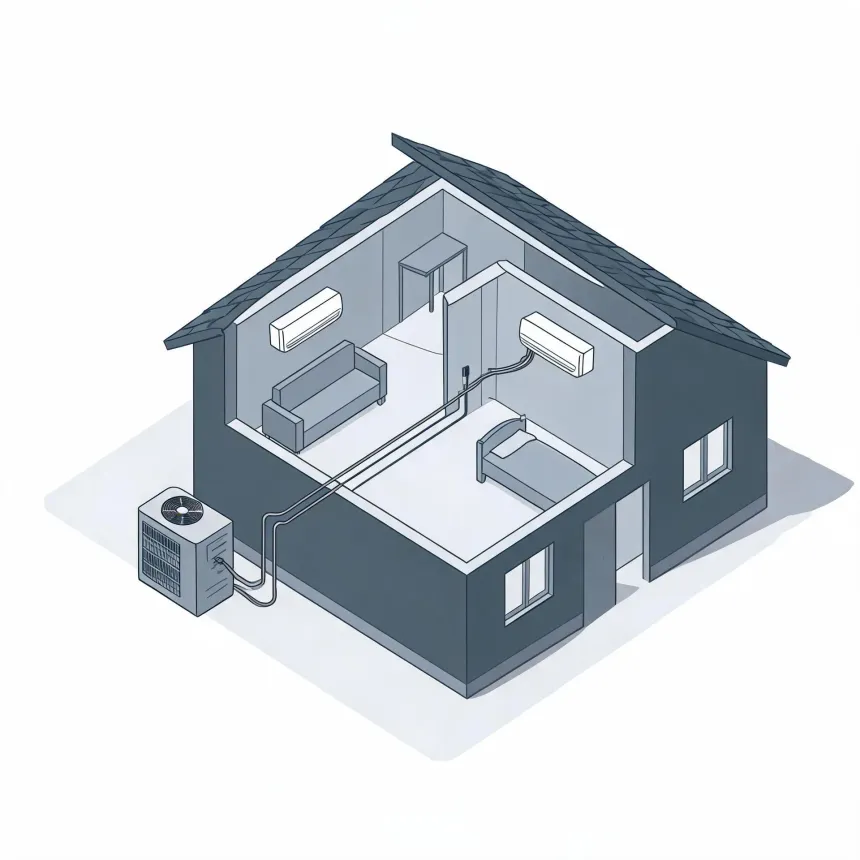
Isometric cutaway illustration of a small house showing two wall-mounted indoor air conditioning units connected by line sets to an outdoor condenser unit beside the exterior wall, with a sofa in one room and a bed in another.
Your system heats October through May and cools June through August.

NOAA nClimDiv, 1991–2020 normals

LaSalle County summers run three months, with afternoon highs averaging 83°F.

A mini-split sized for a normal summer here doesn't need to be bigger or pricier than standard.

The weather tests the power supply, not the mini-split

206 severe weather events from 2015 to 2024
16% of homes statewide lost power a day or more in 2024
124 damaging wind events from 2015 to 2024

Electricity here runs 16.82 cents per kilowatt-hour, a bit above the national average. That matters more for a mini-split than it would for a gas furnace, since the unit runs on power alone whenever it's heating or cooling. A standard-sized, standard-efficiency unit still makes sense for a room or two. Going bigger than the space calls for just means paying that rate on more capacity than you use. The sizing a contractor works out from the room, not the rate, is what keeps the bill reasonable.

Get it in before June, not during the first hot week

June through August is when this gets used. May is when it should go in. A mini-split put in before the heat starts gets set up and checked with nothing riding on it, instead of during the first hot week when it has to carry right away.

Find a contractor
A person in a dark long-sleeved shirt and brown work pants, seen from behind, climbs porch steps toward a teal front door while carrying a canvas tool bag, with a potted shrub beside the steps.
A white mini-split air conditioner outdoor condenser unit mounted on metal brackets against a beige stucco exterior wall, with a blue sky and scattered clouds in the background.

Older houses need the walk-through, not a workaround

Half the houses in LaSalle County were built in 1963 or earlier. A house that age almost never has the line-set path or electrical a mini-split needs already in place, so the contractor is building that from scratch rather than reusing what's there. That's normal and it's not a mark against the house. It just means the walk-through matters: where the condenser sits outside, how the line runs in to the indoor unit, whether the panel has room for the new circuit. Get that right at installation and the system runs the way it's supposed to for as long as a newer house's would.

The room it's replacing probably kept a window unit or space heater

Most rooms getting a mini-split were running on something smaller before, a window AC in summer or a space heater in winter, sometimes both. That equipment usually just gets removed. There's no ductwork to cap off and no old unit sitting in a closet that needs draining or disconnecting the way a furnace or water heater would.
If a mini-split is coming out, the old lineset doesn't get reused

When a mini-split is being replaced rather than added, the refrigerant lines running between the indoor and outdoor units usually come out with it. Line sets get sized and routed for the specific unit, and old ones are often the wrong diameter or worn at the flare fittings. The outdoor pad or bracket can sometimes stay, but the contractor will check it before building the new system onto it.

The efficiency rating on a mini-split, the SEER2 number, tells you how much cooling you get out of the power it draws over a full season, not how strong it is. A higher-rated unit and a lower-rated one of the same size will cool a room the same way on a mild afternoon. The difference shows up on the electric bill over the whole season, because the higher-rated one is drawing less power to do the same job. There's a second rating too, HSPF2, that works the same way for heating. Neither number tells you whether the unit is sized right for the room. A high rating on an oversized unit still costs more to run than a correctly sized one with a lower rating, since it's moving more capacity than the room needs every time it cycles on.

LaSalle County falls in climate zone 5A, a cool zone where the energy code counts on heating to do more work than cooling over the year. That doesn't single out mini-splits. Any split-system heat pump sold new, mini-split or central, has to meet the same federal minimums: at least 14.3 for cooling and 7.5 for heating, the SEER2 and HSPF2 numbers from the sticker. That floor is set at the factory, not the install, so it's not something a contractor can size around. A unit built to meet it will carry a gas furnace's slack in the coldest months without strain, which is the job it's usually given in homes here.