




A nighttime view of a tree-lined residential street with illuminated two-story brick houses and street lamps.

Mini Split Installation in Pekin, IL

Tell us about the job

Takes about a minute. No obligation.

New system or replacementMini-splitTazewell County, IL
Step 1 of 2

What ZIP code is the job in?

Electricity in Tazewell County runs 17.94 cents per kilowatt-hour on average, higher than most US counties pay. A mini-split moves heat instead of burning fuel to make it, so it gets more out of every kilowatt it draws. But not all of them do it equally well. The efficiency rating on the unit you install decides how much of that expensive power turns into actual heating and cooling, and how much just runs up the meter. In a place where power already costs more, that difference lands on your bill every single month.

8 months
October through May, your system heats
4 months
June through September, it cools
20°F
the average winter night it heats against
84°F
the average summer afternoon it cools against
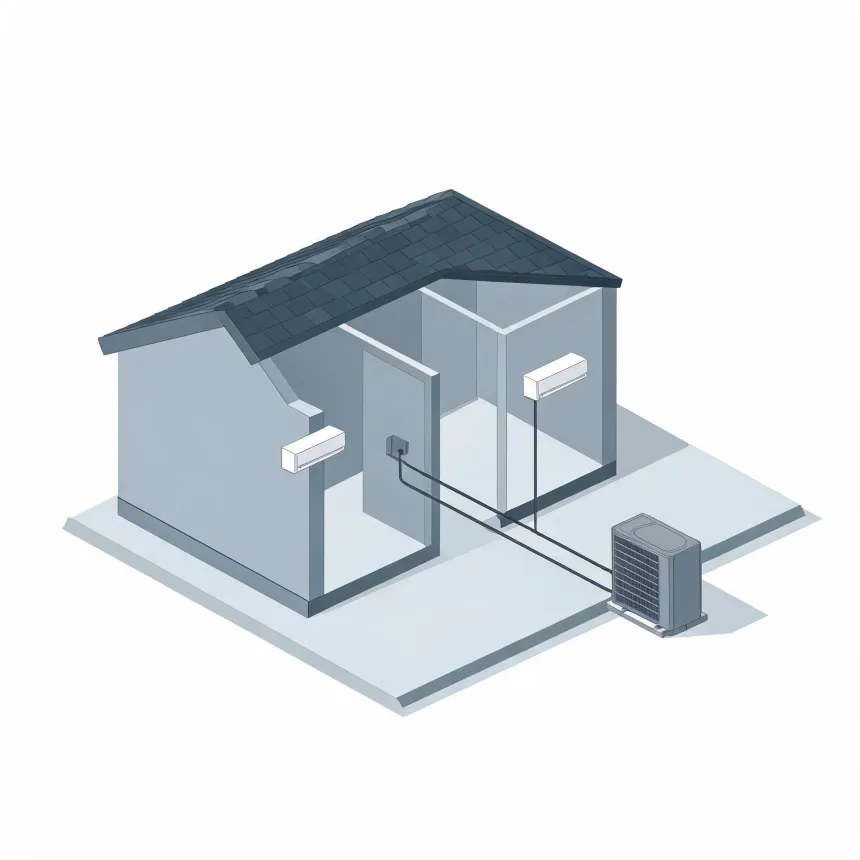
Isometric illustration of a cutaway gray house with a dark shingled roof, showing two wall-mounted indoor air handlers connected by line sets to an outdoor condenser unit on a pad outside.
Your system heats October through May and cools June through September.

NOAA nClimDiv, 1991–2020 normals

Half the homes in Tazewell County were built in 1969 or earlier.

An older home needs a mini-split sized and installed for the place it's going into, not a generic fit.

This county sees storms often, and the power doesn't always hold

261 severe weather events from 2015 to 2024
16% of homes statewide lost power a day or more in 2024
154 damaging wind events from 2015 to 2024

Tazewell County falls under zone 5A in the 2021 energy code, a cool zone where heating carries more of the load than cooling does. Any mini-split installed here has to meet the federal minimum for that split-system class: at least 14.3 Btu of cooling for every watt-hour it draws, and at least 7.5 Btu of heating for every watt-hour over the winter. Manufacturers build to that floor, not above it unless you ask. A unit priced below the rest is worth checking against those two numbers before anything else. The federal tax credit for qualifying heat pumps is there to help offset a system that clears the bar by a wider margin.

Check the efficiency rating before you sign

Ask what efficiency rating the unit you're quoted carries, and check it against the federal minimum before you decide. A system that clears that bar by more pulls less from a meter that already charges you more than most places do.

Find a contractor
A beige split-system air conditioner outdoor condenser unit mounted on metal wall brackets atop a stucco wall.

This unit doesn't get an easy season

Cooling runs about four months here, June through September, with afternoon highs averaging 84°F. The dew point sits at 64°F those months, which is the number that tells you how heavy the air feels standing outside. A mini-split in Pekin spends that stretch pulling moisture as hard as it pulls heat, and the compressor doesn't get much of a break overnight either. Zone 5A puts more of the yearly load on heating, so the same unit is working through a long cold stretch on the other end. Two seasons, both demanding, most of the year. That's more hours on the compressor than a system in a milder zone ever sees, and it's why the parts worth checking during install are the ones that wear first under that kind of load.

Ask what the quote actually covers

A mini-split quote should spell out the line set length, the condensate drain path, and whether the electrical circuit needs upgrading for the new unit. Two bids for the same brand and size can land far apart because one includes a dedicated circuit and proper line set insulation and the other doesn't. Ask each contractor to walk through the install step by step, not just hand over a number.
Ask how they're sizing it

A mini-split sized by square footage alone is a guess. The right size comes from a load calculation that accounts for insulation, window area, and ceiling height in the specific room or space it's heating and cooling. An oversized unit short cycles and struggles to pull moisture out of the air. An undersized one runs constantly and still can't keep up on the coldest or hottest days.

If this install is replacing window units or an older ducted system, someone has to deal with what's already there. A window unit just comes out. An old central system is different: the indoor coil, the outdoor condenser, and any ductwork tied only to that system usually get disconnected and hauled off once the mini-split takes over. Refrigerant in an old system has to be recovered properly, not vented, so factor that into the job if your existing setup still has a working compressor. If the old system heated the whole house and the mini-split is only covering part of it, make sure the two aren't fighting over the same rooms. A contractor should walk through what gets removed, what gets capped, and what stays, before the new lines ever go in.

Gas heats 73.2% of the homes in Tazewell County, electricity heats 20.1%, and a small slice runs on bottled or LP gas. A mini-split doesn't replace that gas furnace outright in most of these homes. It usually goes in alongside it, covering the rooms that run hot or cold on their own, while the furnace keeps handling the main heating load through winter. That changes what the installer needs to plan for, since the mini-split and the furnace end up sharing the house instead of one taking over from the other. If you're adding a mini-split to a gas-heated home, ask how the contractor is dividing the load between the two systems so neither one is working against the other.