A row of dark-sided single-story cottages with brown shingled gable roofs behind trimmed hedges, mown lawn and a light-colored path, surrounded by large deciduous trees under an overcast sky.

Mini Split Installation in Rochelle, IL

Tell us about the job

Takes about a minute. No obligation.

New system or replacementMini-splitOgle County, IL
Step 1 of 2

What ZIP code is the job in?

Most of Ogle County heats with gas

Utility gas heats 66.5% of occupied homes in Ogle County. Bottled or LP gas covers another 16%. Electric heat accounts for 14.6%. A mini split installed here is almost always going in alongside a gas furnace, not replacing the only heat source in the house.

That changes what the mini split's job is

With gas furnace heat already in place, a mini split is usually there for cooling and for shoulder season comfort in a room the main system doesn't reach well. Sizing it for that job is different than sizing one to carry a home through an Illinois winter on its own.

8 months
October through May, your system heats
3 months
June through August, it cools
16°F
the average winter night it heats against
82°F
the average summer afternoon it cools against
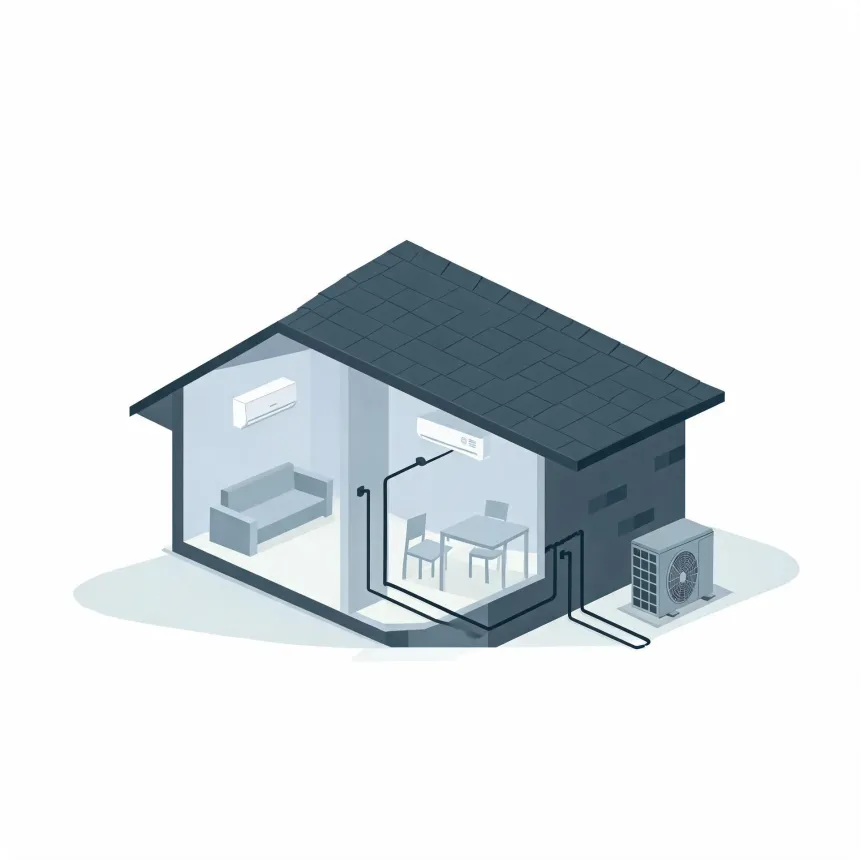
Isometric illustration of a cutaway single-story house showing two wall-mounted mini-split indoor units connected by line sets to an outdoor condenser beside the building, with a sofa, table and chairs inside.
Your system heats October through May and cools June through August.

NOAA nClimDiv, 1991–2020 normals

Half the homes in Ogle County were built in 1972 or earlier.

An installer still has to check what wiring and wall construction the house has before mounting a line set.

Ogle County's weather doesn't change what size mini split this job needs

123 severe weather events from 2015 to 2024
16% of homes statewide lost power a day or more in 2024
76 damaging wind events from 2015 to 2024
A standard mini split handles Rochelle fineIllinois electricity ran 15.87 cents per kilowatthour in 2024, nothing here pushes you toward oversizing

Cooling only runs three months here, June through August, with afternoon highs averaging 82°F. A mini split doing cooling duty in Rochelle isn't working against the kind of heat that wears down a compressor over a long season. The gas furnace carries the winter, so the mini split's summer job is a light load most of the year. That changes what's worth paying for. A well-installed mid-range unit, sized right and charged correctly, will hold up fine for a job this size.

Any mini split here has to meet zone 5A's efficiency minimums

Ogle County falls under climate zone 5A. A ductless mini-split sold here has to meet the same federal minimums as any other split-system heat pump, 14.3 SEER2 for cooling and 7.5 HSPF2 for heating. There is no separate rule for ductless systems. A federal tax credit is available for equipment that qualifies. Get a quote to see what fits your home.

Find a contractor
A man in a cap, long-sleeved shirt and work pants, seen from behind, carries a canvas tool bag up wooden porch steps toward a teal front door, with a potted shrub in a blue-green planter beside him.
A beige split-system air conditioner outdoor condenser unit mounted on metal wall brackets atop a stucco wall.

Get it installed in May, before Rochelle needs it

Cooling runs here from June through August. May is the month to get a mini split installed, before the first hot day has you waiting on a contractor. One working in May can check the wall construction, run the line set, and get the charge right without a homeowner standing there sweating. Wait until the house is already warm and you take whatever appointment is open, not the one that works best for your schedule.

The old system usually stays put

When a mini split is going in alongside a gas furnace for cooling or shoulder season help, there's nothing to remove. The furnace keeps heating the house the same way it always has. The mini split is new equipment added to the job, not a replacement for what's already there.

A straight swap is a different job

If what's being replaced is an older ductless system or a window unit being retired for good, the indoor and outdoor units both come out, along with the old line set and mounting bracket. A line set run for one system usually isn't reused for another, since the sizing and refrigerant type rarely match.

What drives the price on a mini split job is mostly the line set run. A short, straight shot from outdoor unit to indoor head costs less in labor than a run that has to go up through a wall cavity, across an attic, or around framing to reach the room that needs it. Every extra foot of line set is more refrigerant line to insulate, more wall to patch, and more time on the ladder. The number of indoor heads matters too. A single zone is one line set and one thermostat to manage. Add a second or third head off the same outdoor unit and you're paying for the extra line sets, the extra mounting brackets, and the extra time to get each zone charged and balanced on its own. Wall construction plays into it as well, since brick or block takes longer to core through than wood siding, and that's labor the installer has to account for before the first bracket goes up.

Sizing a mini split starts with a load calculation, not a chart that matches square footage to a model number. The installer works out how much heat the room gains in summer and loses in winter, accounting for window area, insulation, ceiling height, and what's on the other side of each wall. Oversized and the unit short cycles, cooling the room fast then shutting off before it pulls the moisture out of the air, which leaves the space feeling clammy even at the right temperature. Undersized and it can't keep the room comfortable on the hottest afternoons no matter how long it runs. A room with a lot of west-facing glass needs more capacity than one the same size with no windows at all. Get the load calculation right and the rest of the install, the line set, the head placement, the charge, all of it is working for a unit that actually fits the room.