





A illuminated two-story red brick house on a quiet residential street at dusk, flanked by mature trees under a deep blue evening sky.

Mini Split Installation in Springfield, IL

Tell us about the job

Takes about a minute. No obligation.

New system or replacementMini-splitSangamon County, IL
Step 1 of 2

What ZIP code is the job in?

Sangamon County saw 335 severe weather events between 2015 and 2024. Most of that was wind and hail: 198 damaging wind events and 110 hail events, with 15 tornadoes on top of that. An outdoor condenser sits outside through all of it, exposed to whatever the wind throws at it and whatever the hail drops on it. Statewide, 16% of Illinois households lost power for 24 hours or more in 2024. A mini-split runs on electricity, so where the outdoor unit goes and how it's mounted should account for weather that actually shows up here, not just the heat and cold.

7 months
October through April, your system heats
5 months
May through September, it cools
22°F
the average winter night it heats against
85°F
the average summer afternoon it cools against
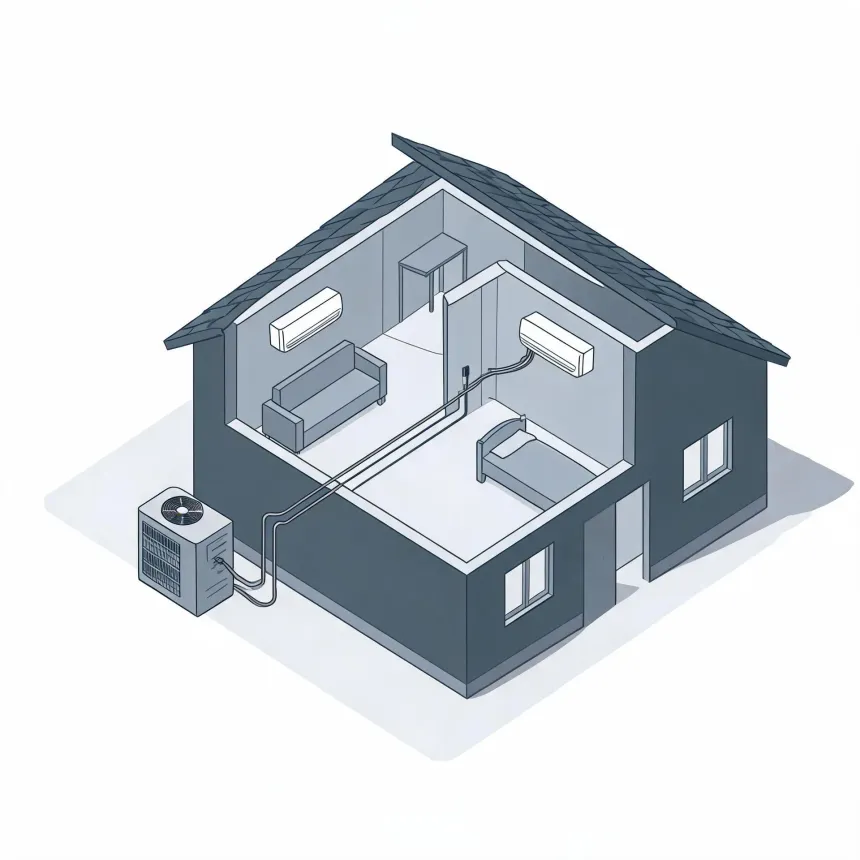
Isometric cutaway illustration of a small house showing two wall-mounted indoor air conditioning units connected by line sets to an outdoor condenser unit beside the exterior wall, with a sofa in one room and a bed in another.
Your system heats October through April and cools May through September.

NOAA nClimDiv, 1991–2020 normals

Cooling here starts in May.

Install before April ends and the mounting work isn't competing with the first hot week.

Gas heats most homes here, which decides what the mini-split is for

73.2% of homes heat with gas
Cooling runs May through September
Summer afternoons average 85°F
Five months of hard cooling, and weather that doesn't let up198 damaging wind events and 110 hail events hit Sangamon County between 2015 and 2024.

Sangamon County falls in climate zone 5A, a cold, humid zone where the federal code treats heating as the bigger job. A mini-split installed here still has to be a cooling machine too, and the federal government sets a floor for that. Any split-system heat pump built from January 2023 onward has to deliver at least 14.3 Btu of cooling for every watt-hour it draws over the summer, and at least 7.5 Btu of heat for every watt-hour over the winter. That's not a target a contractor aims for. It's the minimum the equipment has to clear before it can be sold. Ask what rating the unit you're looking at actually carries, since plenty on the market today beat that floor by a wide margin.

Plan this install around the weather that actually hits Sangamon County

Pick the mounting spot and the mounting hardware with wind and hail in mind, not just a clear wall. Ask the installer about surge protection for the outdoor unit and what keeps the indoor head running if the power drops. That's part of the installation decision, not an afterthought.

Find a contractor
A white mini-split air conditioner outdoor condenser unit mounted on metal brackets against a beige stucco exterior wall, with a blue sky and scattered clouds in the background.

Five months of real work, every year

Cooling runs about five months here, May through September, with afternoon highs averaging 85°F through June, July and August. That's the stretch the outdoor unit has to earn its keep, day after day, with wind and hail working on it the whole time. Size the system for this house, not for the lowest number on a quote. A unit that's too small runs flat out all summer and still falls behind on the worst days. One sized right cycles normally and has less wear to show for the season.

Ask what backs the outdoor unit up in a storm

A mini-split has an outdoor condenser and an indoor air handler connected by a refrigerant line and a run of electrical wiring. Ask what surge protection sits on that circuit, since a nearby lightning strike or a grid fault during a storm can take out the control board without ever cutting power outright. Ask too what happens to the indoor head if power drops and comes back on its own. Most equipment restarts on its own, but settings and timers can reset, so it's worth knowing ahead of time rather than guessing after the fact.
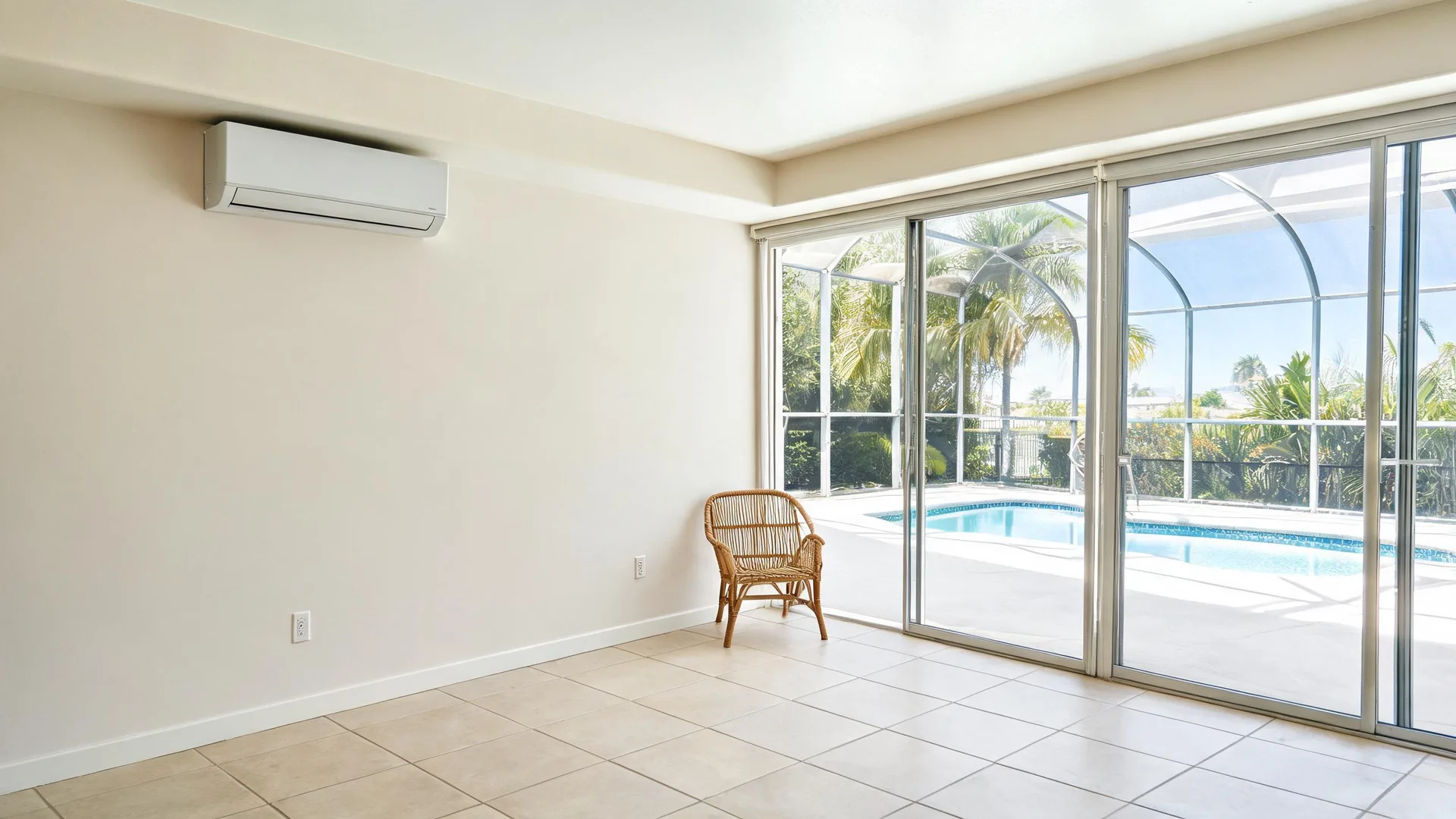
Ask how the mounting matches the equipment

The outdoor unit has to sit on a stand or wall bracket rated for its weight, with clearance around it for airflow and service access. Ask what bracket or pad the installer plans to use and whether it's rated for wind load, not just sized to hold the unit up on a calm day. The refrigerant lines and electrical whip that run between the two halves also need to be protected where they pass through the wall and along the exterior. A line set left exposed is the first thing damaged when debris moves across a yard.

Sizing a mini-split starts with a heat loss and heat gain calculation on the actual room or rooms it's meant to cover, not a guess based on square footage alone. The calculation accounts for insulation, window area, ceiling height, and how many exterior walls a room has, because two rooms the same size can need different amounts of capacity. Go too big and the unit short cycles, reaching the thermostat setting fast and shutting off before it's pulled the humidity out of the air, which leaves the room cold but damp. Go too small and it runs constantly, struggling to catch up on the hottest and coldest days without ever getting there. Either mistake shows up as wasted wear on the compressor, since neither a unit that's cycling too often nor one that never gets a break is running the way it was built to. A load calculation also has to account for every room a system serves, since a multi-zone setup splits its total capacity across heads, and one undersized room will always lag behind the rest of the house.

Installation starts with the walkthrough, not the drilling. The installer walks the space being conditioned and the spot picked for the outdoor unit, checking wall construction where the line set will pass through and confirming there's a clear path for refrigerant lines, electrical wiring, and the condensate drain to travel together. Once that's set, mounting the indoor head and outdoor unit is the fast part. The slower, more exacting work is the line set: running copper tubing between the two halves, flaring the ends, and connecting them without introducing contamination or moisture into the refrigerant circuit. After the connections are made, the system gets evacuated with a vacuum pump to pull out air and moisture before refrigerant is ever released into it. That vacuum test matters more than almost anything else done that day, since trapped moisture or air left in the lines will shorten the compressor's life no matter how well everything else was installed. Only after the system holds vacuum does the installer release refrigerant, power up the unit, and check that it's heating and cooling the way it's supposed to.