Three lit brick homes on a tree-lined residential street photographed at dusk.

Mini Split Installation in Sterling, IL

Tell us about the job

Takes about a minute. No obligation.

New system or replacementMini-splitWhiteside County, IL
Step 1 of 2

What ZIP code is the job in?

Gas heats most homes here

Close to three in four homes in Whiteside County heat with utility gas. Electricity and propane split most of what's left. A mini-split adds cooling and a second way to heat a space that gas doesn't reach well, like a bonus room or a garage.

It pairs with what's already there

Most homes here keep their gas furnace as the main heat source and add the mini-split for the rooms it suits best, plus summer cooling. The installer still has to size the unit to the space and figure out where the line set and outdoor unit go.

8 months
October through May, your system heats
3 months
June through August, it cools
17°F
the average winter night it heats against
83°F
the average summer afternoon it cools against
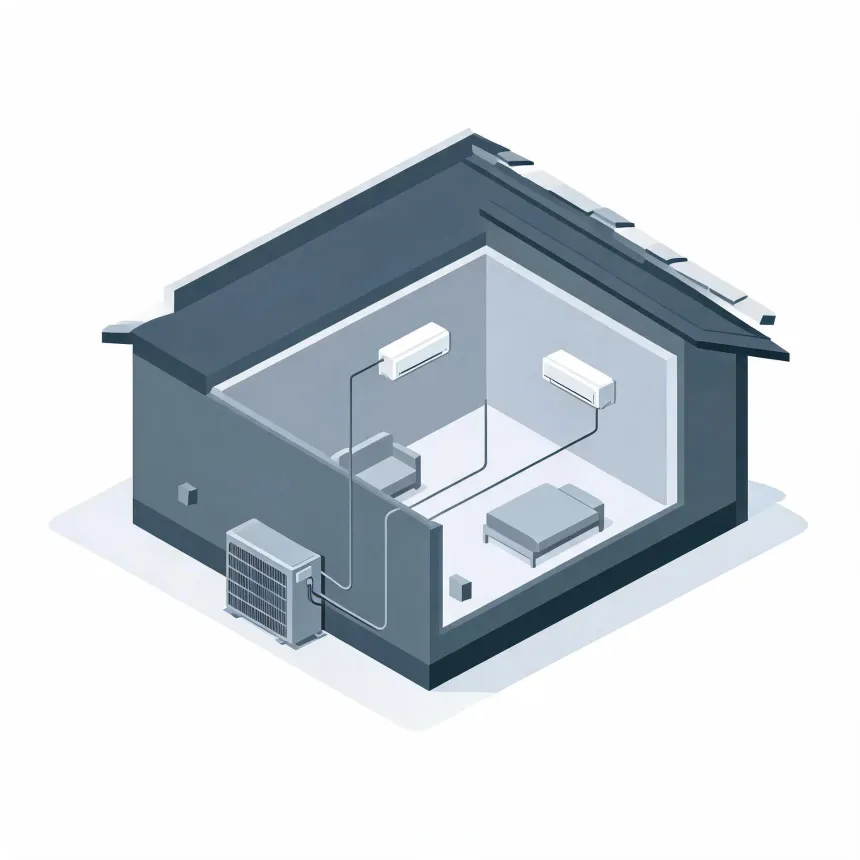
Isometric illustration of a cutaway house interior showing two wall-mounted indoor air conditioning units connected by line sets to an outdoor condenser unit beside the exterior wall.
Your system heats October through May and cools June through August.

NOAA nClimDiv, 1991–2020 normals

Cooling in Whiteside County starts in June.

Have the mini-split in before May runs out, so the install isn't fighting the season.

A normal size, sized for an 83 degree afternoon, costs less to run at 18.23 cents a kilowatt-hour

Power here costs 18.23 cents per kilowatt-hour
Cooling runs June through August
Summer afternoons average 83°F
Built for an 83 Degree SummerSummer here tops out around 83°F, which is what a mini-split in this county actually has to handle.

Whiteside County sits in climate zone 5A, a zone where winters drive the bigger energy load. Any mini-split heat pump installed here has to meet the federal minimum for that kind of system: at least 14.3 Btu of cooling for every watt-hour it draws over the summer, and at least 7.5 Btu of heat for every watt-hour over the winter. That standard applies to units built from January 2023 on, and it's the same number whether the system is the only heat in a room or backup to the gas furnace. It narrows what an installer can offer. A unit that falls short of those numbers isn't a legal option here, whatever it costs up front.

A Standard Mini-Split Is Built for What This County Sees

Power outages aren't rare here. Whiteside County logged 137 severe weather events between 2015 and 2024, including 58 damaging wind events, 37 hail events and 21 tornadoes. None of that calls for oversizing a mini-split or paying for a higher efficiency tier than the place needs. A correctly sized, code-minimum system handles what this county asks of it. Get it installed and sized right before summer gets here.

Find a contractor
A white mini-split air conditioner outdoor condenser unit mounted on metal brackets against a beige stucco exterior wall, with a blue sky and scattered clouds in the background.

An Older House Sets the Terms

Half the homes in Whiteside County were built in 1961 or earlier. A house that age wasn't built with a mini-split in mind, and the walls, the attic space, the room layout all came first. That doesn't rule anything out, but it means the installer is fitting the system to the house rather than the other way around. Line set runs, where the outdoor unit can sit, how the wall is framed where the indoor unit needs to go. On an older place these are worth walking through before the work starts, not after.

The Rating Is Measured, Not Estimated

The efficiency number on a mini-split's label comes from running the unit under fixed lab conditions, not from guessing how it will perform in any one house. It tells you the ratio between the heat moved and the power drawn to move it. A higher number means the compressor and the heat exchange coils are doing more work for less electricity. It does not tell you how warm a room will feel or how fast it cools, only how efficiently the system gets there.

It Sets a Floor, Not a Design

Meeting the minimum rating does not mean a unit is sized wrong, and exceeding it does not fix a bad installation. A correctly sized unit on the right circuit, with the line set run cleanly and the indoor head placed where it can actually move air through the room, will outperform an oversized or poorly placed unit with a higher efficiency number on the label. The rating is a baseline the equipment has to clear. The installation decides whether the house ever sees that number in practice.

Comparing mini-splits usually turns into comparing efficiency numbers, but that's only one line on the spec sheet. Ask how many zones the system supports and whether the indoor heads can run on separate schedules, because a single-zone and multi-zone unit solve different problems even when the label looks similar. Ask what the minimum and maximum output is at low temperatures, not just at a mild setting, since that range tells you whether the system keeps up on the coldest nights or just the easy ones. Ask what refrigerant it uses, since that affects what service options and spare parts look like down the road. Ask about the sound rating of the outdoor unit, measured at a distance, because a unit sitting near a bedroom window or a neighbor's fence line matters more than the brochure number alone. And ask what the warranty actually covers: parts, compressor, and whether it's void if someone other than a licensed installer opens the line set.

If the house is on the older half of the county, built in 1961 or earlier, that walk-through matters more, not less. An installer needs to see the actual wall where the indoor head will mount and the actual path the line set has to take, not a floor plan. That means checking where the studs fall, whether the spot picked for the outdoor unit has a clean run back inside, and whether the electrical panel can take the new circuit without a separate upgrade. None of that shows up on a spec sheet. It shows up when someone is standing in the room with a tape measure, and it is faster to find out before the equipment arrives than during the install.